
True Religion Logo History: Meaning, Symbolism & Brand Heritage
True Religion emerged at the beginning of the 21st century as one of the most distinctive premium denim brands in the United States, blending heavy craftsmanship, bold stitching, and spiritual symbolism into a highly recognizable identity. While its jeans quickly became known for exaggerated seams and premium positioning, the brand’s logo heritage followed a more nuanced path, evolving visually while preserving its original symbolic core.
Much like the carefully managed evolution explored in the Levi’s logo history or the icon-driven consistency behind the Diesel logo history, True Religion demonstrates how a fashion brand can modernize its visual language without abandoning its foundational meaning. Within the broader landscape of American denim logo heritage, the brand stands out for transforming a figurative symbol into a minimalist icon while retaining its conceptual roots.
Meaning and History: The Origin of the True Religion Identity
True Religion was founded in 2002 in California by Jeff Lubell and Kym Gold. The brand was conceived during a period when premium denim was rapidly redefining casual fashion, and differentiation relied heavily on construction details, storytelling, and symbolism.
True Religion positioned itself as a rebellious alternative to traditional denim brands, emphasizing individuality, authenticity, and craftsmanship. This philosophy was embedded directly into its name, which suggested honesty, belief, and personal conviction. The brand expanded rapidly throughout the 2000s, gaining popularity among celebrities and streetwear enthusiasts alike.
In 2013, True Religion was acquired by TowerBrook Capital Partners. Financial challenges followed, and the company filed for bankruptcy protection in 2017. Despite these corporate shifts, the brand’s visual identity remained one of its most consistent assets, reinforcing recognition even during restructuring.
Logo Meaning: Faith, Authenticity, and Confidence
The True Religion logo meaning has always been rooted in positivity and belief. From its earliest incarnation, the logo was designed to communicate confidence in product quality and brand philosophy. Rather than referencing religion in a literal sense, the name and visual identity symbolized faith in craftsmanship and self-expression.
The original logo explicitly communicated this message through the smiling Buddha figure, whose expression was said to reflect satisfaction and enlightenment derived from quality products. Even after the brand moved away from this figurative emblem, the underlying message remained unchanged.
Logo Symbolism: From Buddha to Horseshoe
True Religion’s logo symbolism is one of continuity through abstraction. In its early years, the Buddha illustration served as a central symbol, representing happiness, balance, and spiritual fulfillment. The guitar-holding figure also subtly connected the brand to music culture and creative freedom.
As the brand matured, it transitioned away from detailed illustration toward a more versatile symbol: the horseshoe. While visually simpler, the horseshoe retained the original symbolism. According to the company, the horseshoe shape was inspired by the curve of the Buddha’s smile, effectively distilling the original emblem into a modern, scalable icon.
The horseshoe also carries its own cultural symbolism, traditionally associated with luck, protection, and strength. This layered meaning allowed the logo to resonate with a broader audience while remaining true to its origin.
True Religion Logo History Timeline
2002–2008: The Buddha Emblem Era
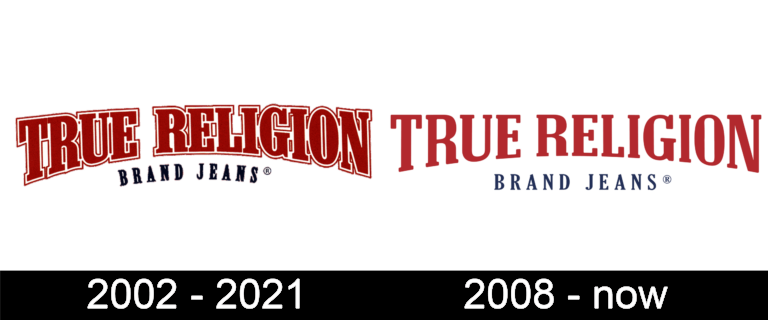
The original True Religion logo featured an arched wordmark rendered in a retro slab serif typeface. The brand name appeared in red, while the secondary text “brand jeans” was set below it in blue, also arched. This composition gave the logo a handcrafted, vintage feel.
Often accompanying the wordmark was the iconic Buddha illustration: a smiling, seated figure holding a guitar. This emblem reinforced the brand’s spiritual undertones and conveyed satisfaction, confidence, and creative freedom. During this period, the logo played a major role in establishing True Religion as a premium yet unconventional denim label.
2008–Today: The Horseshoe Identity
Around 2008, True Religion began phasing out the Buddha illustration in favor of a cleaner, more adaptable symbol. The horseshoe logo became the brand’s primary visual marker, paired with a refined wordmark.
This transition marked a shift toward minimalism and modernity while preserving symbolic continuity. The horseshoe quickly became synonymous with the brand, appearing prominently on back pockets, labels, and hardware, and ultimately surpassing the wordmark in recognition.
Typography and Color Palette
Typography has evolved alongside the logo’s visual simplification. The original arched wordmark was based on a slab serif typeface similar to Neo Contact Regular, with letterforms distorted slightly to follow the curved structure. This added personality but reduced legibility at smaller scales.
The current logo uses a lighter serif typeface with more restrained proportions and angular serifs. While comparable to Castle Press #1 Regular, the final design features custom adjustments that improve readability and align with contemporary fashion branding.
The color palette also shifted over time. Early versions relied on red and dark blue, reinforcing Americana and heritage cues. Today, the brand favors black on white, a classic fashion combination that offers maximum flexibility across garments, washes, and materials. The horseshoe emblem is frequently rendered in white, black, or contrasting colors depending on application.
Logo Heritage and Brand Recognition
True Religion’s logo heritage illustrates how symbolism can survive even dramatic visual change. By translating the emotional core of its original emblem into a simplified form, the brand maintained continuity while adapting to evolving design standards.
Within broader discussions of premium denim logo history, True Religion stands as a notable example of symbolic reduction done correctly. The horseshoe is not merely decorative; it carries layered meaning tied directly to the brand’s origin and philosophy.
True Religion Logo as Symbolic Evolution
The True Religion logo represents a rare balance between change and consistency. While its visual form evolved from an illustrated emblem to a minimalist icon, its symbolic foundation remained intact. Rooted in positivity, belief, and authenticity, the logo continues to function as a powerful identifier within the fashion industry. True Religion’s logo heritage demonstrates that evolution does not require abandoning meaning, only refining how that meaning is expressed.
FAQ: True Religion Logo Meaning and History
What does the True Religion logo represent?
The logo represents faith in quality, positivity, and authenticity, originally symbolized by a smiling Buddha and later distilled into the horseshoe icon.
Why did True Religion replace the Buddha logo?
The brand transitioned to a cleaner horseshoe symbol to improve versatility and modern appeal while preserving the original symbolic meaning.
What does the horseshoe symbolize in the True Religion logo?
The horseshoe was inspired by the Buddha’s smile and also represents luck, strength, and protection.
When was the current True Religion logo introduced?
The horseshoe-based identity began appearing around 2008 and remains in use today.