
TCL Logo History: Meaning, Symbolism & Brand Heritage
In the global consumer electronics market, few brands have experienced such a rapid and disciplined rise as TCL. Originating in China during a period of economic transformation, the company evolved from a modest cassette manufacturer into one of the world’s largest producers of televisions, smartphones, and home appliances. Throughout this expansion, TCL relied on a restrained and highly pragmatic visual identity strategy, favoring clarity and consistency over expressive symbolism.
Unlike brands that built recognition through mascots or elaborate crests, TCL chose a minimalist route, allowing its name to function as its primary visual asset. This approach places the company in the same strategic lineage as brands examined in the Samsung logo history and the Sony logo history, where typography, color discipline, and repetition formed the foundation of long-term recognition. Within the broader context of consumer electronics logo heritage, TCL represents a case where simplicity itself became the defining identity.
Meaning and History: The Origin of the TCL Identity
TCL was established in 1981 as a state-backed enterprise in China, originally operating under the name TTK. Its earliest focus was audio cassette production, a logical entry point during an era when analog media dominated global consumer electronics. As China’s manufacturing sector expanded and diversified, the company gradually repositioned itself toward telecommunications equipment and household appliances.
The transition from TTK to TCL in the mid-1980s marked a critical moment in the brand’s history. Legal pressure from the Japanese company TDK forced a name change, resulting in “Telecom Corporation Limited,” later simplified to the universally recognized acronym TCL. This pragmatic renaming also influenced the brand’s visual strategy. From that point forward, the logo meaning was deliberately reduced to one core principle: legibility.
Rather than embedding narrative symbolism into the mark, TCL treated its logo as a functional identifier, prioritizing adaptability across products, markets, and technologies. This decision would later prove essential as the brand expanded globally.
Logo Meaning: Function Over Decoration
The TCL logo meaning is rooted in restraint. For most of its history, the logo has consisted solely of the company’s initials, presented without illustrative embellishment. This absence of metaphor is not accidental. It reflects a corporate philosophy centered on scalability, manufacturing efficiency, and technological focus.
By avoiding symbols tied to specific products or eras, TCL ensured that its visual identity could evolve alongside shifting consumer technologies. From cassette players to flat-panel televisions and smart devices, the logo remained relevant precisely because it did not attempt to tell a story beyond the brand name itself.
Logo Symbolism: Minimalism as Strategy
At first glance, TCL’s logo symbolism appears nearly nonexistent. However, within corporate identity design, minimalism can itself function as a symbol. The restrained wordmark communicates reliability, industrial discipline, and technical confidence. This approach aligns closely with the expectations placed on electronics manufacturers, where trust and consistency often outweigh emotional storytelling.
The persistent use of red introduces the only strong symbolic element. In Chinese visual culture, red signifies energy, prosperity, and forward momentum. In a global branding context, it also conveys visibility and urgency, ensuring the logo stands out on crowded retail shelves and digital interfaces.
TCL Logo History Timeline
1981–1983: The TTK Origins
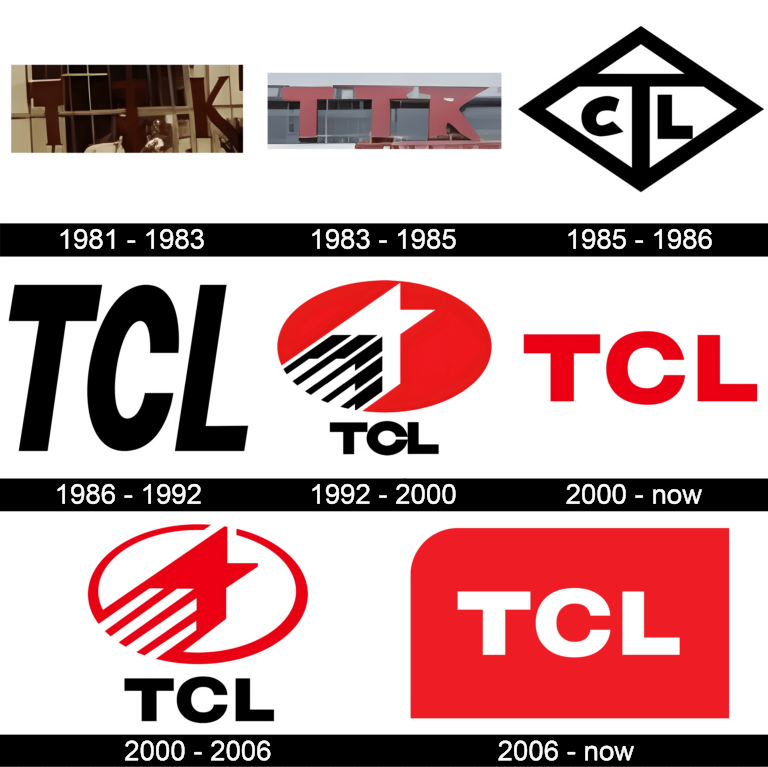
The earliest logo reflected the company’s original name, TTK. It consisted of three uppercase letters rendered without stylistic distinction. This purely typographic mark offered no reference to the company’s products or ambitions, serving only as a basic corporate identifier.

1983–1985: Establishing the Red Identity
During this period, the logo retained its letter-based structure but introduced red as the primary color. This marked the beginning of a long-term visual commitment that continues to define TCL’s brand presence. The darker red tone conveyed seriousness and industrial maturity.
1985–1986: Transition to TCL
Following legal disputes with TDK, the company adopted the name TCL. The accompanying logo attempted to reflect this change but suffered from typographic inconsistencies, including unclear letter ordering. This version is often regarded as transitional rather than foundational.

1986–1992: Functional Legibility
The revised logo corrected earlier issues by presenting a clean, italicized sans-serif wordmark. While visually neutral, it succeeded in establishing clarity and recognizability. The design avoided expressive elements, reinforcing TCL’s utilitarian branding approach.

1992–2000: Experimenting with an Emblem
In an effort to enhance recognition, TCL introduced an oval emblem featuring abstract internal shapes, paired with a black wordmark beneath it. This represented the company’s most ambitious attempt at symbolic branding, though the emblem failed to achieve lasting impact.

2000–2006: Refinement Through Simplification
The early 2000s brought a refined wordmark that addressed spacing and legibility issues present in earlier designs. The letters were given room to breathe, restoring visual balance and improving recognition across different media formats.
2006–Today: The Modern Red Rectangle
The current TCL logo places a white uppercase wordmark inside a red rectangular field with a subtly rounded corner. This design emphasizes precision, consistency, and modernity. Its simplicity allows for seamless application across hardware, packaging, advertising, and digital environments, reinforcing TCL’s global presence.
Typography and Color Palette
Typography plays a central role in the TCL logo description. The sans-serif letterforms are clean, evenly spaced, and free of decorative cuts, reinforcing the brand’s commitment to clarity. The consistent use of uppercase lettering adds authority and uniformity.
The color palette is intentionally limited. Scarlet red dominates, paired exclusively with white for contrast. This restriction enhances memorability and ensures strong visibility regardless of scale or background, a critical requirement for mass-market electronics branding.
Logo Heritage and Global Recognition
TCL’s logo heritage demonstrates that long-term brand equity does not always require expressive symbolism or frequent redesigns. Instead, the company achieved recognition through disciplined consistency. As TCL expanded into international markets, the logo’s simplicity facilitated cross-cultural acceptance, avoiding linguistic or symbolic misinterpretation.
Within studies of global electronics brand logo history, TCL stands as an example of how functional design choices can support aggressive growth strategies without diluting identity.
TCL Logo as a Study in Corporate Restraint
The TCL logo is a testament to the power of minimalism in corporate branding. From its early days as TTK to its current status as a global electronics leader, the logo evolved carefully, never straying far from its core principles of clarity and adaptability. In a market defined by rapid technological change, TCL’s visual identity proves that stability itself can become a competitive advantage.
FAQ: TCL Logo Meaning and History
What does the TCL logo represent?
The TCL logo represents clarity, technological focus, and reliability, achieved through minimalist typography and consistent color use.
Has the TCL logo always been text-based?
Yes, with brief exceptions, TCL has relied primarily on a wordmark-based identity throughout its history.
Why is red used in the TCL logo?
Red conveys energy and visibility while also reflecting cultural significance within China, reinforcing both global and local identity.
When was the current TCL logo introduced?
The modern rectangular TCL logo was introduced in 2006 and remains in use today.