
Pittsburgh Steelers Logo History: Meaning, Symbolism & Brand Heritage

Few franchises in professional sports have managed to transform industrial identity into global symbolism as effectively as the Pittsburgh Steelers. Founded in 1933, the Steelers are not only one of the oldest teams in the National Football League, but also one of the most decorated, sharing the record for the most Super Bowl victories with the New England Patriots. Yet beyond trophies and championships, the Steelers’ logo history has become a defining pillar of the franchise’s worldwide recognition.
Within NFL logo history, Pittsburgh occupies a distinctive position. While many teams rely on aggressive mascots or abstract modern marks, the Steelers built their identity on industrial symbolism and civic pride. Their emblem shares the long-term visual discipline seen in Green Bay Packers logo heritage, while its conceptual depth aligns with the origin-driven storytelling explored in San Francisco 49ers logo history. As part of the broader American sports logo heritage archive, the Steelers stand as one of the clearest examples of how regional industry can be transformed into timeless brand identity.
Meaning and History: The Origin of the Pittsburgh Steelers Identity
The Pittsburgh Steelers were established by Arthur J. Rooney in 1933, in a city defined by steel production, labor, and industrial resilience. From the outset, the franchise’s identity was closely tied to the working-class spirit of Pittsburgh, a connection that would later become central to its visual language.
Unlike teams that adopted animal mascots or mythological figures, the Steelers’ logo meaning emerged from real-world symbolism. The club’s black and gold colors were derived directly from the city’s flag, representing coal and iron ore, the raw materials that fueled Pittsburgh’s rise as an industrial powerhouse. This grounding in local identity allowed the Steelers’ brand to feel authentic rather than manufactured.
While the modern emblem was not introduced until the late 1960s, earlier logos experimented with civic imagery and industrial themes, gradually refining the visual vocabulary that would later define the franchise.
Pittsburgh Steelers Logo History Timeline
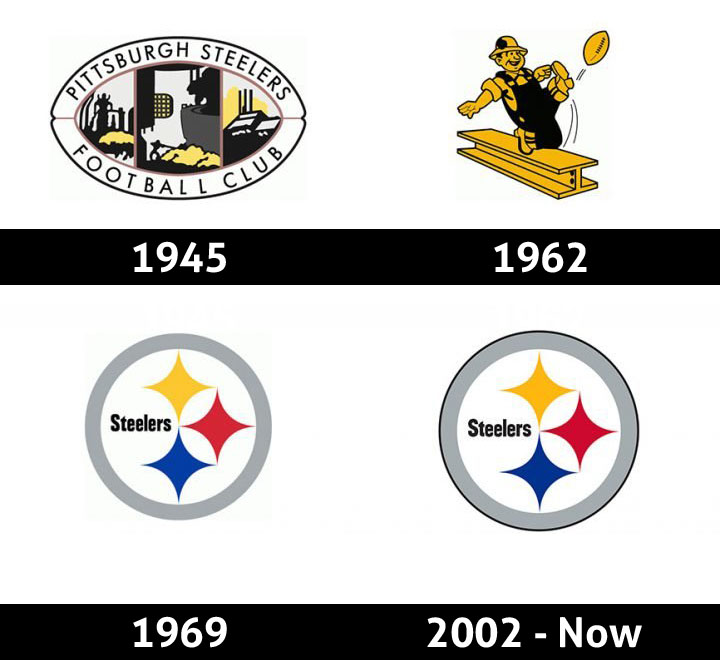
1945–1961: Civic Identity and Industrial Landscape
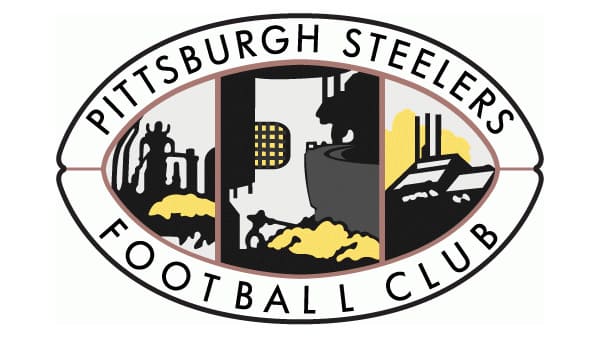
The first official Pittsburgh Steelers logo appeared in 1945. It featured an oval badge shaped like a horizontal football, enclosing a detailed composition divided into three vertical sections. Each section depicted elements of Pittsburgh’s cityscape, reinforcing the club’s civic roots.
Executed in white, gray, black, and yellow, the emblem was framed by a thick white border with black lettering around the perimeter. Subtle pink lines separated the internal elements, giving the badge a complex, almost heraldic appearance. This logo reflected an era when sports emblems leaned heavily on storytelling and local pride.
1962–1968: Industrial Worker Symbolism
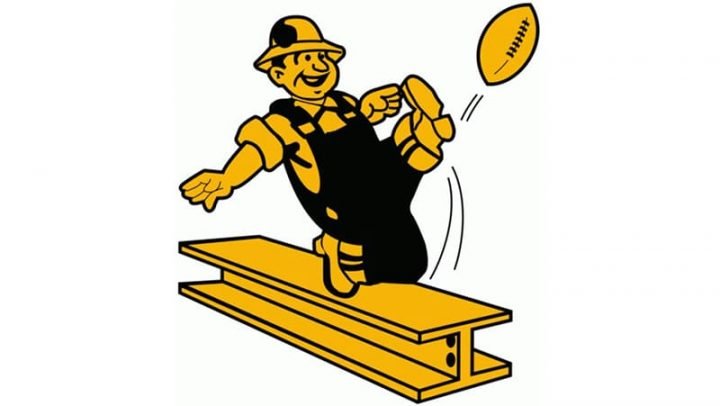
In 1962, the Steelers introduced a radically different emblem. The new logo depicted a cartoon-like steelworker wearing a helmet, walking along a steel beam while kicking a football. Rendered in yellow and black, the image was energetic and playful, yet unmistakably industrial.
This emblem captured the spirit of Pittsburgh’s workforce, but its illustrative style limited its scalability and longevity. While memorable, it served as a transitional phase rather than a permanent solution.
1969–2001: Adoption of the Iconic Steelmark Emblem
The most significant moment in Steelers logo history came in 1969, when the club adopted a logo based on the Steelmark, originally created by the American Iron and Steel Institute. The new emblem featured a white circular field outlined in gray, containing three four-pointed diamond shapes in yellow, red, and blue, alongside the “Steelers” wordmark in black.
Each colored shape symbolized a core element of steelmaking and industrial progress. This logo represented a departure from literal imagery, embracing abstraction while retaining deep symbolic meaning. It quickly became one of the most recognizable emblems in the NFL.

2002–Today: Refinement and Modern Precision
In 2002, the Steelers refined their iconic logo without altering its structure. A thin black outline was added, the contours were cleaned, and the wordmark became bolder and more assertive. These subtle adjustments enhanced clarity and legibility across digital and broadcast platforms.
Importantly, the core identity remained untouched, reinforcing the franchise’s commitment to continuity and respect for heritage.
Logo Symbolism: Industry, Progress, and Identity
The Pittsburgh Steelers logo symbolism is rooted in industrial philosophy rather than aggression. The three colored diamond shapes, often mistaken for stars, represent steel’s strength, innovation, and versatility. Their origins in the Steelmark emphasize progress through labor, technology, and craftsmanship.
The white background suggests clarity and integrity, while the black lettering conveys authority and seriousness. Unlike many NFL logos that prioritize intimidation, the Steelers emblem communicates resilience and reliability, values deeply embedded in the city’s culture.
A unique feature of the Steelers’ visual identity is the placement of the logo on only one side of the helmet. Initially intended as a temporary experiment, the asymmetrical design proved successful and was never changed, becoming a distinctive trademark within NFL logo heritage.
Pittsburgh Steelers Logo Heritage and Cultural Impact
The Steelers’ logo heritage extends far beyond football. It has become a cultural symbol representing Pittsburgh itself, appearing on merchandise, architecture, and personal memorabilia worldwide. Fans proudly associate the emblem with toughness, loyalty, and tradition, reinforcing emotional bonds across generations.
When compared with franchises discussed in Chicago Bears logo history or Detroit Lions logo heritage, the Steelers stand apart for their unwavering commitment to tradition. Their logo has not chased trends or undergone unnecessary reinvention, allowing its symbolism to deepen over time.
Pittsburgh Steelers Logo Heritage and Industrial Legacy
The Pittsburgh Steelers logo history illustrates how authenticity and restraint can create one of the most enduring visual identities in professional sports. Rooted in industrial symbolism and civic pride, the emblem has evolved only through refinement, never reinvention. Viewed alongside NFL logo history and the broader landscape of American sports logo heritage, the Steelers logo remains a benchmark for how origin, symbolism, and discipline can define a global brand.
FAQ: Pittsburgh Steelers Logo Meaning and History
What does the Pittsburgh Steelers logo represent?
It represents the steel industry, progress, and industrial strength through abstract diamond shapes derived from the Steelmark.
When was the Steelers logo introduced?
The iconic Steelmark-based logo was introduced in 1969.
Why is the Steelers logo only on one side of the helmet?
It began as an experiment in the 1960s and became a permanent trademark feature after early success.
What do the Steelers’ colors symbolize?
Black and gold symbolize coal and iron ore, reflecting Pittsburgh’s industrial heritage.