
Green Bay Packers Logo History: Meaning, Symbolism & Brand Heritage

Few franchises in American sports embody continuity and loyalty as deeply as the Green Bay Packers. Founded in 1919, the Packers are not only one of the oldest professional football teams in the United States but also one of the most successful, with multiple championships spanning both the pre–Super Bowl era and the modern NFL. Their identity is inseparable from tradition, community ownership, and a visual language that has remained remarkably restrained over time.
Unlike many teams that frequently reinvent their image, the Packers have built recognition through consistency. Their logo history reflects a gradual refinement rather than radical change, aligning closely with patterns observed across NFL logo history features and the long-standing design discipline highlighted in classic American sports logo heritage. Within the wider sports branding history archive, Green Bay stands as a model of how minimalism can become iconic.
Meaning and History: The Origin of the Green Bay Packers Identity
The Green Bay Packers were established in 1919 by Earl “Curly” Lambeau and George Calhoun. From the beginning, the club was closely tied to its local community, a relationship that would later define both its ownership structure and brand identity. The team’s name originated from its early sponsorship by a local meatpacking company, a practical origin that grounded the franchise firmly in working-class values.
The logo meaning has always been closely tied to loyalty, perseverance, and unity. Green, chosen as the primary color, symbolizes endurance and stability, while yellow introduces optimism and energy. Early visual experiments reflected the club’s search for a recognizable emblem, but even these early designs shared a common emphasis on seriousness and purpose rather than spectacle.
As professional football matured and visual branding standards evolved, the Packers’ logo heritage shifted toward simplicity, allowing symbolism and color to communicate identity more effectively than illustration.
Green Bay Packers Logo History Timeline
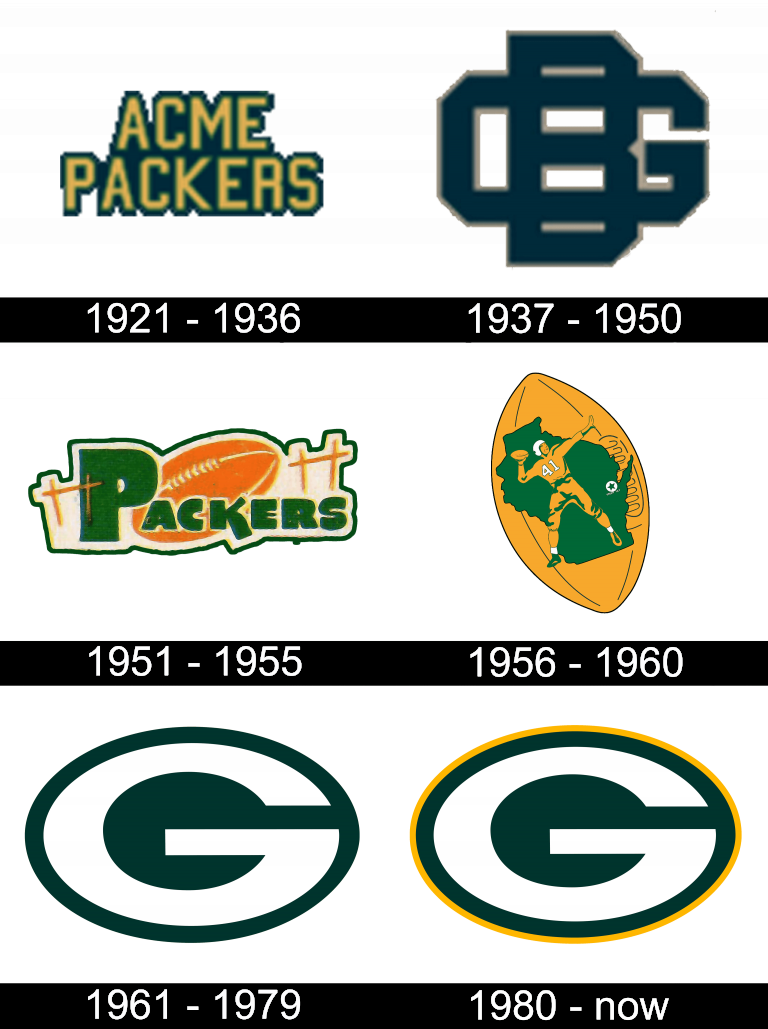
1921–1936: Early Wordmarks and Sponsorship Identity
The first official logo appeared several years after the team’s founding, during a period when the club was still closely associated with its original sponsors. The early badge relied on typographic structure rather than imagery, using bold lettering and contrasting outlines. This approach reflected the practical branding norms of early professional sports, where logos functioned primarily as identifiers rather than symbols.

1937–1955: Monograms and Transitional Visual Experiments
Following the official adoption of the Green Bay Packers name, the club introduced a “GB” monogram. This period marked the first move toward abstraction, replacing descriptive lettering with symbolic initials. Color experimentation also intensified during these years, as designers tested combinations that could better represent the team’s growing prominence within the league.

1955–1961: Figurative Concepts and Regional References
The mid-1950s introduced more illustrative designs, including football imagery and references to the state of Wisconsin. These logos were expressive and memorable but lacked the scalability and clarity needed for long-term use. While visually engaging, they represented a transitional phase rather than a final identity.
1961–1979: Introduction of the Iconic “G” Oval
In 1961, the Packers unveiled the logo that would define the franchise for generations. A white capital “G” enclosed within a dark green oval, the design was intentionally minimal. Its proportions were carefully balanced, allowing the letterform to echo the oval’s contour. This emblem marked a decisive shift toward timeless branding and established the foundation of modern Packers logo symbolism.
1980–Present: Refinement and Color Accents
Subtle refinements introduced in the late 20th century added a yellow outline to the oval, enhancing contrast and visibility, particularly on helmets. Importantly, the core structure remained unchanged. This era demonstrates how small adjustments can modernize a logo without compromising its heritage or recognizability.
Logo Symbolism: Loyalty, Discipline, and Timeless Design
The Green Bay Packers logo symbolism is rooted in restraint. The oval shape suggests unity and continuity, while the single letter communicates confidence without aggression. Unlike animal mascots or dynamic figures, the “G” functions as a quiet assertion of identity, relying on cultural familiarity rather than visual complexity.
Color remains central to the logo description. Green reinforces loyalty and resilience, qualities deeply associated with the franchise’s fan base, while yellow introduces warmth and approachability. Together, they create a balanced visual identity that feels both traditional and welcoming.
Green Bay Packers Logo Heritage and Cultural Impact
The Packers’ logo heritage extends far beyond football. As the only community-owned franchise in major American professional sports, the team’s visual identity carries emotional significance that few brands can replicate. The logo has become a symbol of shared ownership, continuity, and trust between the club and its supporters.
Within American football logo history, Green Bay stands apart for its refusal to chase trends. While many franchises have embraced aggressive redesigns, the Packers have demonstrated that consistency can build deeper emotional connections over time. Their logo is instantly recognizable across generations, reinforcing the power of disciplined branding.
Green Bay Packers Logo Heritage and Lasting Visual Identity
The Green Bay Packers logo history illustrates how simplicity, when combined with strong symbolism and cultural authenticity, can create one of the most enduring identities in professional sports. From early typographic experiments to the iconic “G” oval, the franchise’s visual evolution reflects a deep respect for origin, community, and tradition. In a constantly changing branding landscape, the Packers remain a benchmark for how logo heritage can outlast trends and define a legacy.
FAQ: Green Bay Packers Logo Meaning and History
What does the Green Bay Packers logo represent?
The logo represents loyalty, unity, and tradition, expressed through minimalist typography and a balanced color palette.
When was the Packers’ current logo introduced?
The iconic “G” oval was introduced in 1961 and has remained the foundation of the team’s identity since then.
Why is the Packers logo so simple?
The simplicity ensures timelessness, clarity, and strong emotional recognition across generations.
What do the Packers’ colors symbolize?
Green symbolizes endurance and loyalty, while yellow represents energy, optimism, and encouragement.