
Allegra Logo History: Meaning, Symbolism & Brand Heritage
In the competitive category of allergy relief medications, visual identity must communicate calm, safety, and efficacy at a glance. Allegra has achieved this balance through a logo system that feels soft and reassuring while remaining medically credible. Known globally as a fexofenadine-based antihistamine, Allegra positioned itself as a non-drowsy solution for modern life, and its visual identity evolved to reflect that promise. The Allegra logo history reveals a thoughtful transition from pharmaceutical labeling to emotionally resonant healthcare branding.
Unlike many clinical drug identities that rely solely on rigid typography, Allegra’s logo meaning introduces warmth and individuality without sacrificing trust. Within the broader landscape of pharmaceutical logo history, Allegra aligns closely with consumer-facing antihistamine brands such as Claritin logo history and Zyrtec logo heritage, where design plays a crucial role in communicating relief and everyday usability.
Meaning and History: The Origin of the Allegra Identity
Allegra is the brand name of fexofenadine, a second-generation antihistamine developed to treat allergy symptoms such as sneezing, itching, and hay fever without sedative effects. The compound was synthesized in 1993 in Massachusetts as a safer metabolite of terfenadine, offering effective symptom control with improved tolerability.
The brand is owned by Sanofi, one of the world’s largest pharmaceutical groups. From its inception, Allegra was positioned as a reliable yet gentle medication suitable for daily use. This positioning influenced not only clinical messaging but also visual identity, as the brand needed to feel approachable to consumers while maintaining pharmaceutical seriousness.
The logo meaning emerged from this dual requirement. Allegra’s identity had to signal medical competence while also evoking comfort and emotional relief—an essential balance in allergy treatment branding.
Allegra Logo History Timeline
1996–2011: Pharmaceutical Introduction and Early Differentiation.
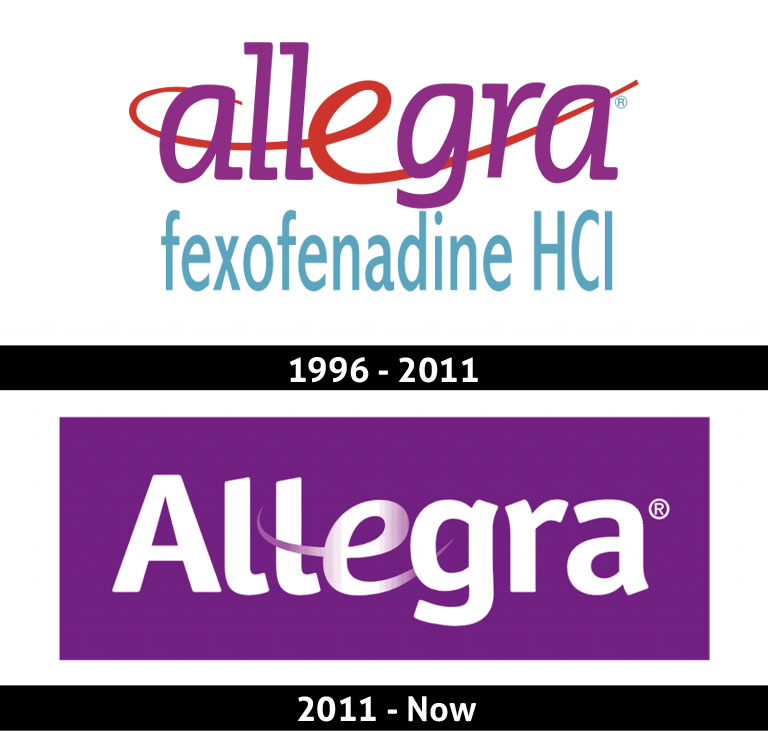
The original Allegra logo introduced in 1996 reflected its early pharmaceutical context. The design centered on a lowercase wordmark rendered in a soft serif typeface, giving the name a gentle and approachable tone. The word “Allegra” appeared in purple, a color already associated with calmness and care.
A distinctive feature of this early logo was the letter “e,” drawn with a long, hand-like red stroke that set it apart from the rest of the wordmark. Beneath the brand name, a secondary line reading “fexofenadine HCl” appeared in turquoise, clearly identifying the active ingredient and reinforcing medical transparency.
This version balanced branding and clinical information, serving both healthcare professionals and early consumer audiences during the brand’s establishment phase.
2011–Today: Emotional Branding and Iconic Recognition.
In 2011, Allegra introduced a refined logo that shifted emphasis from pharmaceutical labeling to emotional reassurance and brand recognition. The updated design retained the lowercase wordmark but simplified the composition, removing secondary descriptors from the primary logo.
The word “Allegra” now appears in white against a purple background, immediately enhancing contrast and visibility. The typography became smoother and more rounded, reinforcing a sense of gentleness and care. The most iconic element—the stylized letter “E”—was preserved and elevated. Its elongated, curved tail flows through the preceding letters, creating motion and cohesion within the wordmark.
This “E” became more than a typographic detail. It was adopted as a standalone brand symbol and embossed onto Allegra tablets, reinforcing recognition through both visual and tactile experience. Subtle gradients within the purple palette softened the overall appearance, making the logo feel refined and contemporary.
Logo Symbolism: Relief, Calm, and Gentle Strength
Allegra logo symbolism is rooted in emotional clarity rather than explicit medical imagery. The rounded letterforms and flowing curves communicate smoothness and ease, mirroring the brand’s promise of non-drowsy relief.
Purple dominates the identity, a deliberate choice in pharmaceutical branding. Darker shades convey reliability and wisdom, while lighter tones suggest care and sensitivity. White lettering reinforces cleanliness and trust, essential attributes for healthcare products.
The curved “E” acts as the brand’s visual anchor. Its motion suggests continuity and gentle action, reinforcing the idea of sustained relief without harsh side effects.
Typography and Color as Brand Signals
Typography defines the Allegra logo description. The wordmark is set in a bold yet friendly sans-serif style with softened contours, avoiding the rigidity typical of prescription drug branding. The customized “E” introduces personality without compromising legibility.
The color palette is intentionally limited. Purple serves as the primary color, supported by white for clarity and contrast. This combination differentiates Allegra from blue- or green-dominated competitors while maintaining a calm, medical tone.
Conclusion: Allegra Logo Heritage and Consumer-Centered Trust
The Allegra logo history illustrates a successful evolution from clinical introduction to emotionally intelligent healthcare branding. By preserving key visual elements while refining tone and simplicity, Allegra has built strong logo heritage grounded in recognition and reassurance.
Within the broader field of allergy medication logo heritage, Allegra stands as an example of how thoughtful design can support medical messaging while creating emotional connection. Its logo heritage demonstrates that in consumer healthcare, trust is reinforced not only by science, but by clarity, warmth, and consistency.
FAQ: Allegra Logo Meaning and History
What does the Allegra logo represent?
The Allegra logo represents calm, gentle relief, and reliability through soft typography and a soothing purple color palette.
Why is purple used in the Allegra logo?
Purple conveys calmness, wisdom, and care, aligning with Allegra’s non-drowsy and gentle approach to allergy relief.
What is the significance of the stylized “E” in the Allegra logo?
The curved “E” symbolizes smooth, continuous relief and serves as a recognizable brand mark embossed on Allegra tablets.
Who owns the Allegra brand?
Allegra is owned by Sanofi, a global pharmaceutical company.