
UiPath Logo History: Meaning, Symbolism & Brand Heritage
In the rapidly expanding world of enterprise automation, UiPath has emerged as one of the defining platforms in robotic process automation (RPA). Founded in 2005 by Romanian entrepreneur Daniel Dines, UiPath built its reputation by enabling software robots to replicate human interactions with digital systems, eliminating repetitive tasks across industries. The UiPath logo history mirrors this evolution from technical utility to globally recognized enterprise standard, balancing precision with approachability.
Much like the discipline seen in the Palantir logo heritage or the enterprise restraint explored in the C3.ai logo meaning, UiPath’s visual identity avoids excessive metaphor. Instead, it communicates clarity, structure, and confidence, qualities essential for organizations that entrust automation with mission-critical processes.
Meaning and History: The Origin of the UiPath Identity
UiPath was created to solve a practical problem: how to automate complex business workflows without relying solely on APIs. By allowing robots to imitate human actions across user interfaces, the platform made automation accessible even in fragmented legacy environments. This philosophy strongly influenced the brand’s identity.
The name “UiPath” directly references its functional core: navigating and automating user interfaces. From the beginning, the logo meaning emphasized usability and direction rather than abstraction. The brand needed to appeal to developers, analysts, and enterprise decision-makers alike, requiring a visual language that felt technical but not intimidating.
As UiPath expanded globally and transitioned from a niche automation tool into a publicly traded enterprise platform, its logo heritage evolved to reflect maturity, confidence, and scalability.
UiPath Logo History Timeline
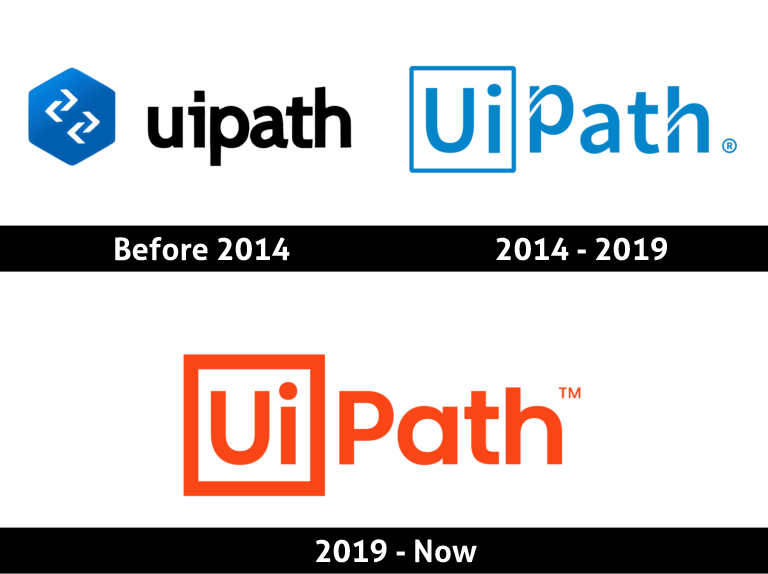
Before–2014: Early Automation Symbolism.
The earliest UiPath logo featured a bold geometric emblem paired with a clean wordmark. The icon was constructed as a hexagon filled with gradient blue tones, overlaid by four white arrowheads pointing inward. This composition suggested movement, direction, and convergence, concepts closely aligned with automation workflows.
The accompanying lowercase wordmark was rendered in a straightforward sans-serif typeface, emphasizing stability and technical reliability. While visually more complex than later iterations, this logo captured UiPath’s early focus on engineering-driven solutions.
2014–2019: Simplification and Structural Clarity.
In 2014, UiPath introduced a significantly redesigned logo that streamlined both form and color. The palette shifted to blue and white, and the emblem became typographic rather than symbolic. The “Ui” portion of the name was enclosed within a thin square frame, while “Path” appeared unframed to the right.
This design reinforced modularity and structure. The square around “Ui” suggested an interface window or application tile, subtly referencing the platform’s interaction with user environments. Typography became cleaner and more balanced, signaling UiPath’s transition toward a broader enterprise audience.
2019–Today: Confident Orange Identity.
The current UiPath logo, introduced in 2019, represents the brand’s most confident and recognizable phase. The structure established in 2014 was retained, but the color palette shifted dramatically to a vivid orange tone.
Both the framed “Ui” and the unframed “Path” are rendered in the same geometric sans-serif typeface and color, creating visual unity. The orange hue adds warmth and energy, distinguishing UiPath from the predominantly blue enterprise software landscape. This evolution reflects UiPath’s ambition to position automation not as a cold technical process, but as an empowering, human-centered capability.
Logo Symbolism: Direction, Modularity, and Momentum
The UiPath logo symbolism is grounded in structure rather than imagery. The square frame represents containment, control, and interface boundaries, while the linear wordmark extending beyond it implies progression and scalability. Together, these elements communicate a clear journey from user action to automated outcome.
Color plays a defining role in the logo description. The shift to orange introduced emotional contrast into an otherwise rational sector. Orange conveys energy, innovation, and confidence, aligning with UiPath’s mission to accelerate digital transformation while remaining approachable.
Typography reinforces this message. The geometric sans-serif letterforms are precise and modern, yet softened enough to avoid rigidity. This balance mirrors UiPath’s role as a bridge between human intent and machine execution.
Conclusion: A Visual Identity Aligned with Automation Leadership
The UiPath logo history illustrates how thoughtful evolution can reinforce brand positioning without sacrificing continuity. Each redesign refined the message: from technical experimentation to enterprise clarity, and finally to confident leadership in automation.
Within the broader landscape of enterprise software logo heritage and automation platform branding, UiPath stands as an example of how color, structure, and typography can communicate both reliability and momentum. Its logo meaning and origin remain closely tied to its core promise: guiding businesses along a clear path toward intelligent automation.
FAQ: UiPath Logo Meaning and History
What does the UiPath logo represent?
The logo represents direction, structure, and intelligent automation through clean typography and modular framing.
When was the current UiPath logo introduced?
The current orange UiPath logo was introduced in 2019.
Why did UiPath choose orange for its logo?
Orange conveys energy, confidence, and innovation, helping UiPath stand out in the enterprise software space.
Has the UiPath logo changed significantly over time?
Yes, the logo evolved from a geometric symbol to a typographic system, becoming simpler and more confident over time.