
Gemini Logo History: Meaning, Symbolism & Brand Heritage
The introduction of Gemini marked a pivotal moment in Google’s artificial intelligence strategy. Emerging from the experimental phase under the Bard codename, Gemini represents Google’s effort to consolidate its most advanced language models into a unified, scalable AI system. Beyond performance metrics and technical capabilities, Gemini’s identity needed to communicate trust, intelligence, and continuity with Google’s long-established ecosystem. The Gemini logo history reflects this transition from experimental assistant to core infrastructure-level technology.
Much like the evolution examined in the OpenAI logo history and the abstraction-driven logic behind the ChatGPT logo meaning, Gemini’s branding avoids literal depictions of intelligence. Instead, it relies on symbolic geometry, subtle motion cues, and semantic associations rooted in language, duality, and balance. Within the wider landscape of AI logo heritage, Gemini stands as a clear example of how rebranding can signal maturity rather than reinvention.
Meaning and History: The Origin of the Gemini Identity
Gemini is an artificial intelligence initiative developed by Google, building upon years of internal research in machine learning, natural language processing, and multimodal systems. Initially introduced as Bard in early 2023, the project was conceived as Google’s conversational AI counterpart to large language models emerging across the industry.
The rebranding to Gemini in early 2024 was deliberate and strategic. The name “Gemini” references duality, communication, and adaptability, qualities central to the AI’s design. Gemini was built to operate across multiple modalities, interpret complex queries, and integrate seamlessly into Google’s products, from search and productivity tools to personalized assistance.
The logo meaning and visual identity were designed to support this conceptual shift. Where Bard felt experimental and exploratory, Gemini needed to appear stable, scalable, and aligned with Google’s long-term vision. The origin of the Gemini logo heritage reflects this progression from prototype to platform.
Gemini Logo History Timeline
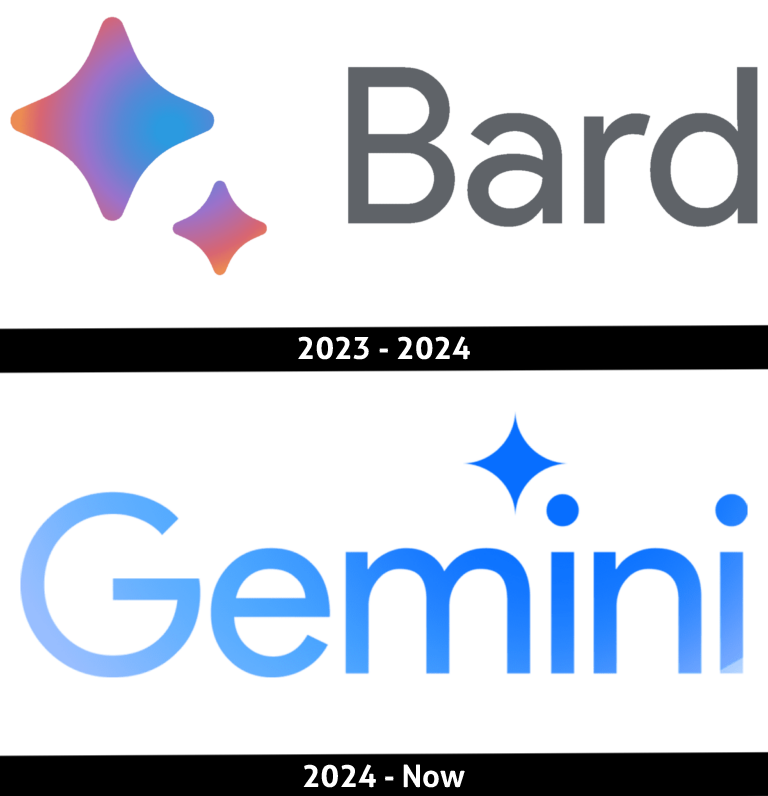
2023–2024: Bard AI Experimental Identity.
The first visual identity associated with the project appeared under the Bard name in early 2023. The Bard AI logo featured abstract star-like shapes rendered in purple and blue gradients. One larger shape was paired with a smaller accent, creating a sense of motion, spark, and discovery.
This logo emphasized creativity and novelty. The gradients suggested innovation and digital depth, while the minimalist sans-serif wordmark reinforced a modern, research-driven aesthetic. As part of Google’s experimental AI phase, Bard’s identity communicated exploration rather than permanence.
2024–Today: Gemini Rebrand and Celestial Symbolism.
With the official transition from Bard to Gemini in 2024, Google introduced a new logo that refined and clarified the brand’s visual language. The Gemini logo retained a celestial theme but simplified its execution. Twin star elements were used to reference the Gemini zodiac sign, symbolizing communication, duality, and interaction.
The typography shifted to a softer, more rounded sans-serif wordmark, rendered in light blue tones associated with trust and clarity. A subtle star accent above one of the characters added a focal point, reinforcing the idea of intelligence and insight without visual complexity.
This redesign positioned Gemini not as an experimental chatbot, but as a core AI system embedded across Google’s ecosystem.
Logo Symbolism: Duality, Communication, and Trust
The Gemini logo symbolism is rooted in abstraction rather than literal imagery. The twin star motif represents dual processing, dialogue, and balance, all fundamental characteristics of conversational and multimodal AI. Unlike aggressive or futuristic AI branding, Gemini’s emblem conveys calm intelligence and reliability.
Color plays a critical role in the logo description. Light blue tones suggest transparency, safety, and approachability, aligning with Google’s emphasis on responsible AI. The absence of harsh contrasts or heavy outlines reinforces accessibility, ensuring the logo integrates naturally across interfaces and devices.
Typography further supports this philosophy. Rounded letterforms reduce visual tension and create a welcoming tone, reinforcing Gemini’s role as an assistant rather than an authority.
From Experiment to Infrastructure
The Gemini logo history illustrates how visual identity can guide perception during periods of rapid technological change. By transitioning from the exploratory Bard branding to the refined Gemini identity, Google signaled a shift from experimentation to long-term commitment.
Within the broader discussion of AI logo heritage and Google’s evolving design language, Gemini stands as a case study in controlled evolution. Its logo meaning, symbolism, and origin align with a future-facing vision where artificial intelligence becomes an invisible yet essential layer of everyday technology.
FAQ: Gemini Logo Meaning and History
What does the Gemini logo represent?
The logo represents duality, communication, and intelligent interaction through abstract celestial symbolism.
When did Bard become Gemini?
Google rebranded Bard as Gemini in early 2024 as part of a broader AI unification strategy.
Why does the Gemini logo use star imagery?
The stars reference the Gemini zodiac sign and symbolize dialogue, balance, and insight.
Is Gemini part of Google’s core products?
Yes, Gemini is designed to integrate across Google’s services, including search and productivity tools.