Carolina Panthers Logo History: Meaning, Symbolism & Brand Heritage

Few NFL franchises have managed to establish such a clear and confident visual identity so early in their existence as the Carolina Panthers. Founded in the early 1990s during a period of league expansion, the Panthers entered professional football without decades of tradition behind them, yet their logo heritage quickly achieved a level of recognition many older teams spent generations refining. From its debut, the franchise embraced a visual language built around power, control, and modernity.
The Carolina Panthers logo history is especially compelling when viewed alongside the streamlined identities explored in the Jacksonville Jaguars logo history and the controlled aggression embedded in the Baltimore Ravens logo meaning. Across the broader landscape of NFL logo history, the Panthers stand out for their restraint: rather than constant reinvention, the franchise committed to a single core symbol and refined it with surgical precision. This approach transformed a young expansion team into a brand with immediate visual authority.
Meaning and History: The Origin of the Carolina Panthers Identity
The Carolina Panthers were officially established in 1993, representing both North and South Carolina, with Charlotte selected as the franchise’s home. From the outset, ownership and designers understood that the team’s identity needed to feel regional yet timeless, fierce yet disciplined. The panther was chosen as the central symbol for its associations with stealth, strength, and predatory focus—qualities well suited to a competitive football brand.
Unlike many franchises that experimented with multiple visual directions during their early years, the Panthers committed to a singular logo concept almost immediately. Introduced in 1995, the original mark arrived fully formed, signaling confidence and long-term intent. The logo meaning was clear from the beginning: dominance without excess, aggression without chaos.
The origin of the Panthers logo heritage reflects a late-20th-century shift in sports branding, where clarity, reproducibility, and emotional impact outweighed illustrative storytelling. This philosophy would define the franchise’s visual language for decades to come.
Carolina Panthers Logo History Timeline
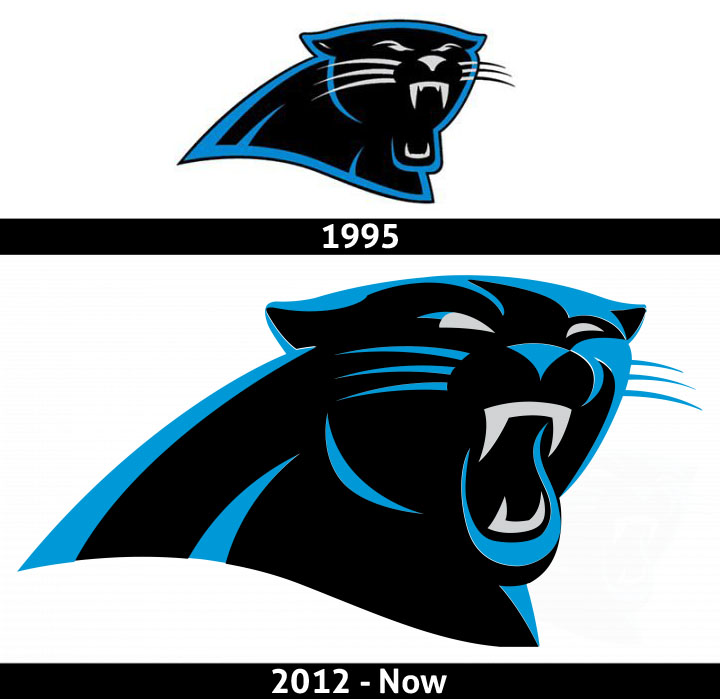
1995–2011: The Original Roaring Panther Emblem.
The first Carolina Panthers logo was introduced ahead of the team’s inaugural NFL season in 1995. It featured the head of a roaring black panther rendered in a three-quarter profile, mouth open and teeth exposed. Thick blue outlines added depth and contrast, while white highlights were reserved for sharp details such as the eyes, teeth, whiskers, and nose. The composition balanced realism with stylization, creating a logo that felt dangerous yet controlled.
This emblem remained unchanged for more than fifteen years, an unusually long lifespan for a debut logo. Its stability established the foundation of Carolina Panthers logo heritage and allowed the mark to become deeply associated with the franchise’s identity.
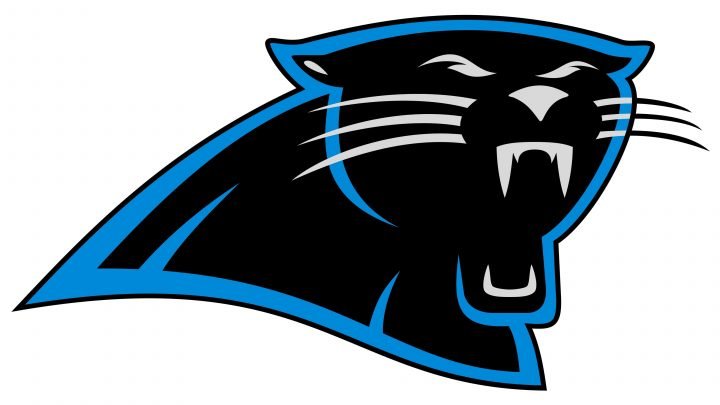
2012–Today: Refined Modern Panther Symbol.
In 2012, the Panthers introduced a refined version of their original logo. Rather than altering the concept, designers focused on precision. Blue contours were thickened, silver-gray strokes were recolored in blue, and facial details were subtly adjusted to intensify the panther’s expression. The whiskers shifted from white to blue, while the eyes gained sharper definition.
These refinements modernized the logo without disrupting brand continuity. The result was a more aggressive and contemporary emblem that maintained instant recognizability, reinforcing the franchise’s commitment to consistency over novelty.
Logo Symbolism: Control, Aggression, and Focus
The Carolina Panthers logo symbolism is built around controlled ferocity. The panther’s forward-facing snarl communicates readiness and dominance, while the absence of a full body emphasizes focus rather than movement. This design choice keeps the logo visually compact and highly adaptable across helmets, uniforms, and digital platforms.
Color plays a critical role in the logo description. Black conveys authority and intimidation, blue introduces stability and regional identity, white provides contrast, and silver adds a subtle note of modern sophistication. Together, these elements create a balanced composition that feels both threatening and refined.
Unlike logos that rely on complex symbolism or narrative elements, the Panthers’ mark succeeds through emotional clarity. It delivers its message instantly, a key factor in its longevity within modern sports branding.
A Case Study in Visual Discipline
The Carolina Panthers logo history demonstrates how a young franchise can achieve lasting brand power through restraint and clarity. By committing early to a strong visual concept and refining it carefully over time, the team avoided the pitfalls of frequent redesigns that often dilute identity.
Within the broader conversation surrounding NFL logo symbolism and the evolution of modern sports branding, the Panthers represent a disciplined approach to logo heritage. Their emblem proves that when the origin, meaning, and execution of a logo are aligned, longevity becomes a natural outcome rather than a goal.
FAQ: Carolina Panthers Logo Meaning and History
What does the Carolina Panthers logo represent?
The logo represents strength, focus, and controlled aggression, embodied by the roaring panther head.
When was the Carolina Panthers logo first introduced?
The original logo was introduced in 1995 and remained largely unchanged until its refinement in 2012.
Why has the Panthers logo changed so little over time?
The original design was strong and timeless, requiring only minor refinements to stay modern and effective.
What do the colors in the Panthers logo symbolize?
Black symbolizes authority and power, blue represents stability and regional identity, white adds clarity, and silver reflects modernity.