Buffalo Bills Logo History: Meaning, Symbolism & Brand Heritage
Few franchises in American professional sports illustrate the relationship between regional identity and visual branding as clearly as the Buffalo Bills. Established in the early era of modern football, the team’s identity has evolved alongside the league itself, reflecting changes in design philosophy, media exposure, and cultural expectations. The Buffalo Bills logo history is not simply a sequence of graphic updates, but a visual narrative tied to perseverance, community pride, and long-term continuity.
Much like the visual evolution explored in the Green Bay Packers logo history or the disciplined consistency seen in the Chicago Bears logo meaning, the Bills’ logo heritage demonstrates how professional sports branding often matures through simplification rather than reinvention. Within the broader NFL logo history, Buffalo stands out for its willingness to abandon complex imagery early and commit to a symbol that could endure across generations.
From illustrative badges rooted in mid-century sports art to one of the most recognizable minimalist marks in the league, the Buffalo Bills logo meaning has been shaped by geography, history, and the emotional bond between team and city.
Meaning and History: The Origin of the Buffalo Bills Identity
The Buffalo Bills franchise was officially established in 1960 as part of the American Football League. The team’s name, revived from earlier Buffalo-based football clubs of the early 20th century, intentionally echoed regional sports heritage while providing a straightforward, powerful identity. From the beginning, the buffalo itself functioned as both a literal and symbolic reference: an animal historically associated with the American frontier, resilience, and the identity of Western New York.
Early logo concepts leaned heavily into narrative illustration. These designs attempted to communicate action, teamwork, and spectacle, mirroring the visual language common in sports branding of the late 1950s and early 1960s. However, as television broadcasting expanded and logos needed to perform at smaller scales, the Bills’ visual identity began to shift toward clarity and immediacy.
The origin of the modern Buffalo Bills logo meaning lies in this transition. Over time, the franchise moved away from storytelling scenes and toward a single, forceful symbol capable of representing speed, strength, and momentum in one glance.
Buffalo Bills Logo History Timeline
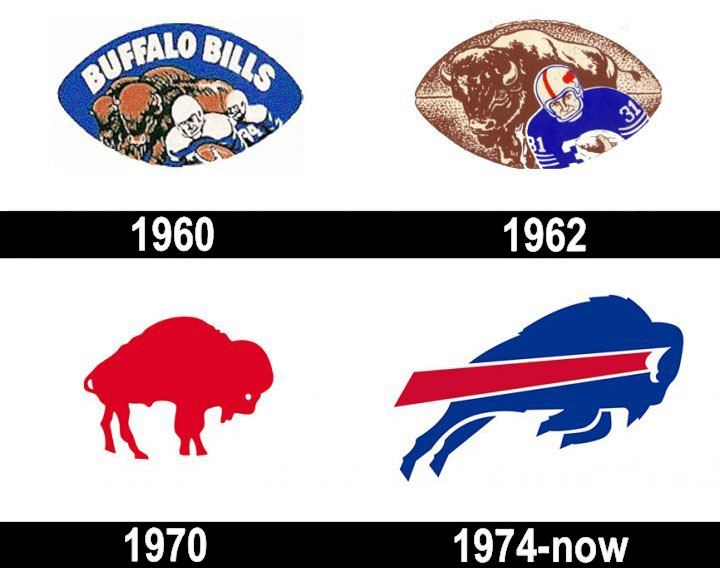
1960–1961: Illustrated Football Emblem Era.
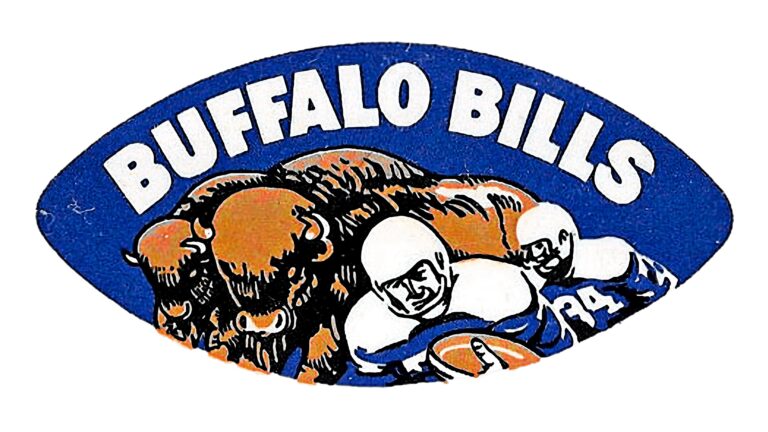
The first official Buffalo Bills logo debuted with the team’s inaugural AFL season. The badge took the shape of a horizontal football, inside which a detailed scene depicted two buffaloes charging behind two football players. A bold “Buffalo Bills” wordmark arched across the top. While visually rich, the logo reflected the illustrative style of its time rather than long-term brand strategy. Its complexity limited scalability and visual clarity.
1962–1969: Transitional Narrative Simplification.
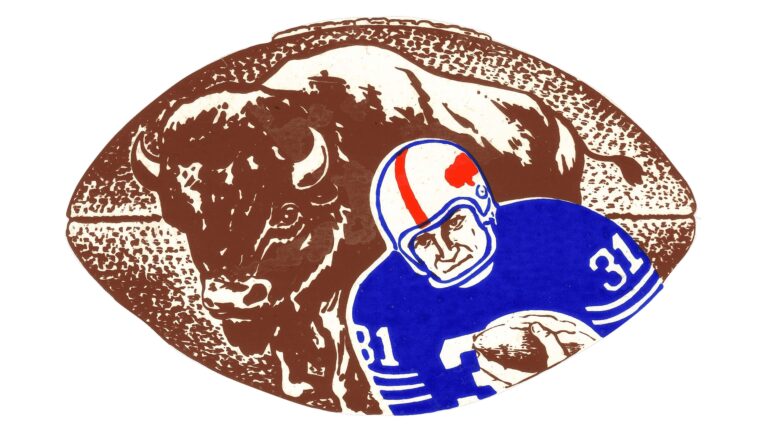
In 1962, the logo was refined while retaining the football-shaped outline. The scene was reduced to a single buffalo and one player, minimizing visual noise while preserving the original concept. The color palette remained earth-toned, with blues added to reinforce team identity. This period represents an experimental phase in the Bills logo history, balancing tradition with the need for simplification.
1970–1973: Minimalist Red Buffalo Mark.
A dramatic shift occurred in 1970 when the franchise abandoned narrative illustration entirely. The new logo featured a flat red buffalo with a simple white eye, stripped of background elements and framing. This version marked the true turning point in Buffalo Bills logo heritage, signaling a modern approach aligned with emerging trends in professional sports branding.

1974–Today: The Charging Buffalo Icon.
The definitive Buffalo Bills logo was introduced in 1974. The red buffalo was recolored in blue, and a bold red diagonal stripe was added, extending from the horn across the body. This single graphic gesture transformed the symbol into one of motion and aggression. Minor refinements have occurred over the decades, but the core composition has remained untouched, solidifying its place as one of the most stable identities in NFL logo history.
Logo Symbolism: Strength, Motion, and Regional Identity
The Buffalo Bills logo symbolism is rooted in abstraction rather than literal storytelling. The buffalo itself represents strength, endurance, and historical ties to the American landscape. The forward-leaning posture communicates momentum, while the diagonal red stripe introduces a sense of speed and impact rarely achieved through static animal symbols.
Unlike earlier versions, the modern logo avoids facial detail. The eye merges into the horn, eliminating distraction and reinforcing the mark’s graphic efficiency. This restraint allows the logo to function equally well on helmets, uniforms, merchandise, and digital platforms.
Color plays a critical role in the logo description. Blue conveys stability and loyalty, red adds intensity and aggression, and white provides contrast and clarity. Together, these elements form a balanced identity that feels both patriotic and timeless.
The Enduring Power of a Simplified Identity
The Buffalo Bills logo history illustrates how long-term brand strength often emerges from decisive simplification. By moving away from illustrative complexity and embracing symbolic abstraction, the franchise created an identity capable of lasting more than five decades with minimal change.
Within the broader landscape of NFL logo heritage and the evolving study of American sports logo symbolism, the Bills stand as a case study in visual discipline. Their logo origin story reinforces a central lesson of brand design: when symbolism is clear and emotionally resonant, consistency becomes an asset rather than a limitation.
For readers exploring how regional identity shapes visual branding, the Buffalo Bills remain a defining example of logo heritage done right.
FAQ: Buffalo Bills Logo Meaning and History
What does the Buffalo Bills logo represent?
The logo represents strength, momentum, and regional identity, using a charging buffalo as a symbol of endurance and determination.
When was the current Buffalo Bills logo introduced?
The current logo was introduced in 1974 and has remained largely unchanged since then.
Why does the logo feature a red stripe?
The red stripe symbolizes speed and forward motion, transforming the buffalo into a dynamic, aggressive figure.
Has the Buffalo Bills logo changed significantly over time?
Yes, early logos were detailed and illustrative, while the modern logo is minimalist and symbolic, reflecting evolving branding standards.