Apple Logo History: Meaning, Symbolism & Heritage
Founded in 1976, Apple has grown from a small California startup into one of the most influential technology companies in the world. Known for its revolutionary hardware — from the Macintosh to the iPhone — as well as its software and digital services, Apple consistently sets the global standard for innovation, design, and user experience.
Every product launch sparks media frenzy, and millions of customers line up to be among the first to experience the newest device. Yet beyond the technology itself, one element has become inseparable from Apple’s identity: its logo.
Minimalistic, symbolic, and instantly recognizable, the bitten apple emblem is one of the most iconic logos in modern history. Its evolution reflects not only Apple’s growth but also a shift in design philosophy that shaped the tech world itself.
Meaning and History
A Brand That Needs No Introduction
Apple is one of the rare companies whose name alone evokes innovation, elegance, and technological progress. The brand transformed not only the tech industry but also modern aesthetics, influencing industrial design, lifestyle branding, and even fashion.
The minimalism for which Apple became famous is also reflected in its visual identity. The Apple logo, first revealed in the late 1970s, was far ahead of its time — a clean, modern silhouette at a moment when most tech companies relied on complex emblems.
Steve Jobs understood before many others that simplicity is the ultimate sophistication. Today, the Apple logo is the most recognizable consumer electronics symbol in the world.
Apple Logo History: Evolution Through the Years
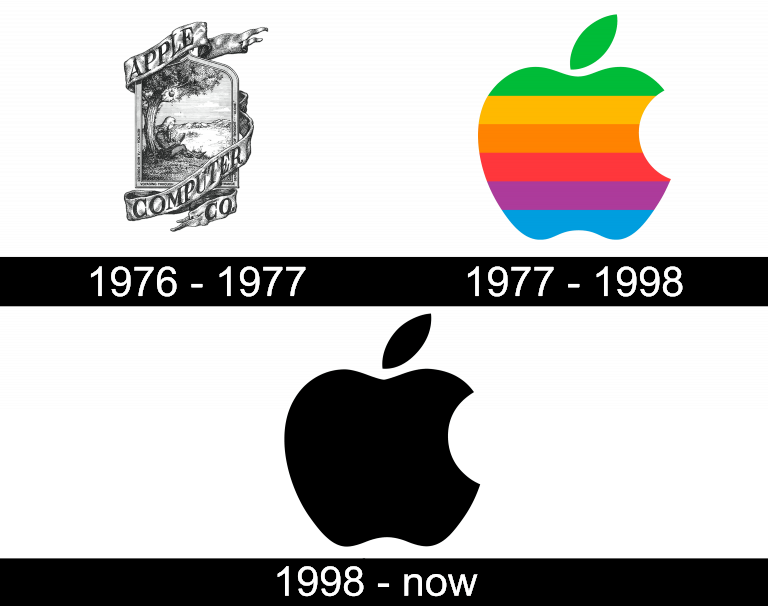
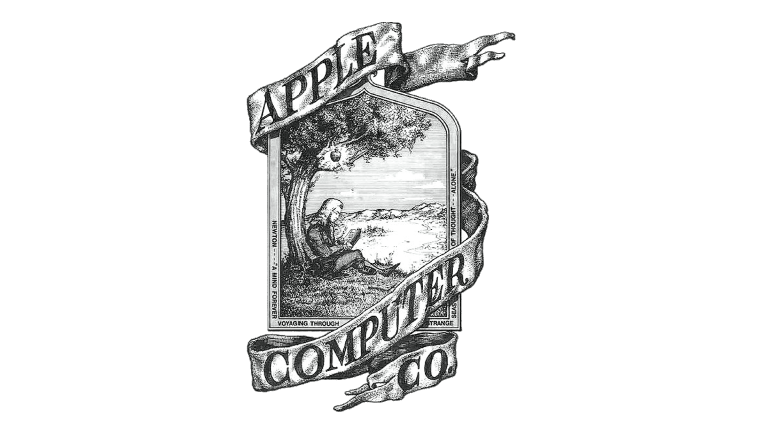
1976–1977: The Newton Crest
Apple’s very first logo was dramatically different from the clean symbol we know today. Designed by co-founder Ronald Wayne, it depicted Isaac Newton reading under an apple tree, framed by a decorative ribbon bearing the words “Apple Computer Co.”
Executed in a bold serif typeface, the intricate illustration looked more like a vintage bookplate than the emblem of a tech company — beautiful, but impractical.
1977–1998: The Rainbow Apple
In 1977, Steve Jobs asked graphic designer Rob Janoff to create a modern, simple logo. The result was the now-legendary bitten Apple silhouette, filled with horizontal rainbow stripes.
The rainbow version symbolized:
-
knowledge
-
creativity
-
diversity
-
the Macintosh’s ability to display color graphics (a technological breakthrough at the time)
This logo remained unchanged until 1998 and became one of the most iconic visual identities in history.
1998–Today: The Monochrome Apple
When Apple introduced the iMac in 1998, the rainbow was replaced by a sleek monochrome version. The silhouette stayed the same, but the colors were simplified to black or silver to match the brand’s minimalist hardware aesthetics.
Since then, the Apple logo has appeared in various finishes:
-
flat black
-
glossy silver
-
metallic chrome
-
glass-themed (2007–2013)
-
aqua-themed (1999–2003)
Despite these stylistic variations, the shape has remained untouched — a testament to the perfection of the original design.
Symbolism
The Bite: More Than a Detail
Steve Jobs later admitted that the idea came to him while on a fruitarian diet after visiting an apple farm. When Rob Janoff created the logo, he added a “bite” to ensure that the apple wouldn’t be mistaken for a cherry or any other fruit.
Over time, the bite accumulated deeper symbolic interpretations:
-
Adam and Eve’s apple of knowledge
-
Human curiosity and the pursuit of understanding
-
A play on words with “byte”, referencing digital information
Regardless of interpretation, the bite makes the silhouette unmistakable.
Mythology and Meaning
The apple is historically a symbol of:
-
life
-
knowledge
-
immortality
From ancient myths to Newton’s moment of discovery, the apple represents enlightenment — fitting perfectly with Apple’s core mission: empowering people through technology.
Icon
In 1977, Janoff’s design replaced the original Newton illustration. The rainbow stripes represented the computer’s ability to display colors — a first for home computing.
By 1984, with the release of the Macintosh, the Apple emblem was so famous that the company decided to use it without any wordmark. That bold move paid off: the icon alone became one of the world’s most recognized corporate symbols.
Today, the Apple icon:
-
is engraved or embossed on devices
-
shifts color depending on the material (aluminum, glass, titanium)
-
maintains the original silhouette from 1977, unchanged for nearly 50 years
Shape and Colors
Shape
The bitten apple silhouette is soft, symmetrical, and perfectly balanced. Its smooth curves and clean lines contribute to the timeless, futuristic aesthetic that defines Apple’s design philosophy.
Colors
After the rainbow era ended in 1998:
-
1999–2003: “Aqua” 3D version
-
2003–2013: Glass-themed version
-
2013–Today: Flat black or silver, depending on context
Each color update aligned with Apple’s industrial design evolution.
Font
Although the Apple logo typically appears without text, Apple’s brand typefaces have included:
-
Apple Garamond (used for decades)
-
Myriad Pro (introduced in the early 2000s)
-
San Francisco (the current typeface used across devices and branding)
The logotype itself is rarely used; the bitten apple icon serves as the primary global identifier.
FAQ
What is the story behind the Apple logo?
The first logo (1976) showed Isaac Newton under an apple tree, designed by Ronald Wayne. In 1977, Steve Jobs hired Rob Janoff to redesign it into the modern bitten apple, which met Jobs’s requirements for simplicity, modernity, and instant recognizability.
Why is Apple’s logo a bitten apple?
The bite differentiates the apple from other fruits and also offers symbolic depth — from the biblical apple of knowledge to the digital pun “byte.”
What is the real Apple logo?
The real Apple logo is the minimalist silhouette of a bitten apple, usually in black or silver. The shape is unchanged since 1977.
5 Facts About Apple You Probably Didn’t Know
1. The First Apple Computer Was Built in a Garage — and Sold Without a Case
The Apple I, built by Steve Wozniak, was sold as a bare circuit board. Buyers had to assemble their own keyboards, monitors, and wooden cases.
2. Apple Almost Had a Completely Different Name
Steve Jobs suggested three names: Apple Computer, Executek, and Matrix Electronics. “Apple” won because it sounded friendly and non-intimidating.
3. The First Logo Designer Left Apple After Only Two Weeks
Ronald Wayne, co-founder and designer of the original Newton crest logo, sold his 10% stake for just $800 — a share now worth tens of billions.
4. The Rainbow Stripes Had Nothing to Do With Social Movements
Many assume the rainbow logo supported inclusivity movements, but it was actually designed to highlight Apple’s ability to display color graphics.
5. Apple Was the First Company to Remove the Logo Text Entirely
By 1984, Apple believed its symbol alone was strong enough to serve as its global identity — a bold move that very few brands could risk at the time.