Portland Trail Blazers Logo History: Meaning, Symbolism & Brand Heritage

The Portland Trail Blazers logo history stands as one of the most distinctive visual narratives in the NBA. While many franchises have reinvented themselves through mascots, color shifts, or radical rebrands, Portland has taken a different path. From the moment the team entered the league in 1970, the Trail Blazers committed to a name and a symbol that felt deeply connected to place, philosophy, and motion. That decision has shaped one of the most recognizable and conceptually unique identities in professional sports.
Unlike franchises that rely on literal imagery, the Blazers built their logo heritage around abstraction. The now-iconic pinwheel symbol does not depict a character, animal, or landmark. Instead, it represents movement, convergence, and competition—ideas that align perfectly with basketball itself. Within NBA logo history, Portland’s identity sits comfortably alongside other concept-driven brands such as the Brooklyn Nets logo history and the New York Knicks logo history, teams that also favored symbolic clarity over narrative illustration. In the broader scope of basketball logo heritage, the Trail Blazers are often cited as a benchmark for originality.
Meaning and History: The Origin of the Trail Blazers Identity
Founded in 1970, the Portland Trail Blazers were named in reference to the pioneers who forged paths westward across the American frontier. The term “trail blazer” implies leadership, exploration, and persistence—qualities that resonated with a city known for doing things its own way. From the outset, the franchise avoided trendy naming conventions, opting instead for something rooted in history and metaphor.
That philosophy carried directly into the logo meaning. Rather than depicting pioneers or landscapes, the team embraced abstraction. The pinwheel emblem, composed of interlocking red and white lines set against black, symbolizes two teams moving in opposite directions toward a shared center. It is a visual metaphor for competition, balance, and perpetual motion. This conceptual depth allowed the Blazers’ logo heritage to remain relevant across decades without requiring fundamental redesign.
Portland Trail Blazers Logo History Timeline
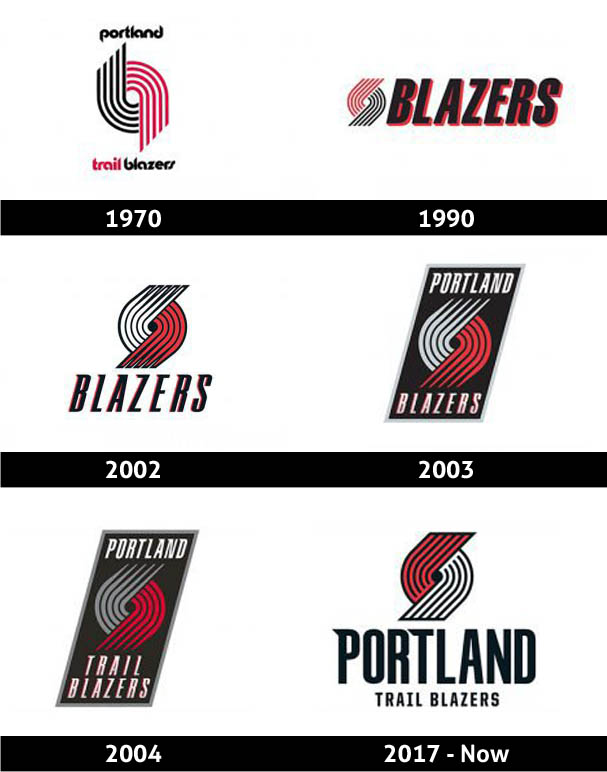
1970–1990: Original Pinwheel Identity and Conceptual Foundations
The original Portland Trail Blazers logo introduced one of the most innovative concepts in NBA branding. The black, red, and white pinwheel symbol sat above a sleek lowercase wordmark rendered in a sharp, modern typeface. The emblem conveyed motion and tension while remaining symmetrical and controlled. This balance between energy and stability established the foundation of Portland’s visual identity and remained largely unchanged for two decades.
1990–2002: Typographic Emphasis and Horizontal Composition
In 1990, the pinwheel emblem was rotated and positioned to the left of an enlarged “Blazers” wordmark. The typography shifted to an italicized sans-serif style in black, accented by a wide red shadow. This update emphasized speed and aggression while preserving the integrity of the original symbol. The composition felt bolder and more assertive, aligning with the franchise’s competitive prominence during the era.

2002–2003: Sharpened Emblem and Symbol-Only Experiment
The 2002 redesign stripped away typography entirely, leaving only the pinwheel symbol. Rendered in black, red, and gray, the lines were sharpened to enhance intensity and edge. While visually striking, this version functioned more as a transitional experiment than a long-term identity, lasting only one season.

2003–2004: Framed Identity and Multi-Level Wordmark
In 2003, the emblem was placed within a black geometric badge, reintroducing typography above and below the symbol. “Portland” appeared in a white custom font with elongated bars, while “Blazers” was rendered in gray with red shadowing. This layered composition added complexity and hierarchy, reflecting early-2000s design trends across NBA logo history.

2004–2017: Name Restoration and Visual Refinement
The 2004 update restored the full “Trail Blazers” name, reinforcing the franchise’s original identity. Lines were refined and thinned, improving elegance and legibility, while the overall composition and color palette remained consistent. This era emphasized professionalism and restraint, allowing the logo to mature without sacrificing recognition.
2017–Today: Modern Simplification and Hierarchical Clarity
The current logo, introduced in 2017, refined the pinwheel once again, placing it on a white background above a refreshed wordmark. “Portland” was capitalized and enlarged, with “Trail Blazers” positioned beneath in a clean sans-serif typeface. The update improved digital versatility and hierarchy while preserving the core symbol that defines the franchise.
Logo Symbolism: Motion, Balance, and Competition
The Portland Trail Blazers logo symbolism is rooted in abstraction rather than narrative. The pinwheel represents two teams moving in opposite directions toward a shared objective, a perfect metaphor for basketball competition. The symmetry of the design suggests balance and fairness, while the sharp angles convey intensity and precision.
Color reinforces this symbolism. Red communicates passion and urgency, black conveys authority and seriousness, and white provides clarity and contrast. The restrained palette has remained consistent throughout most of the franchise’s history, strengthening recognition and reinforcing brand discipline within sports logo history.
A Logo Heritage Defined by Originality and Restraint
The Portland Trail Blazers logo history demonstrates the power of committing to a strong idea and refining it over time. While the franchise has experienced highs and lows on the court, its visual identity has remained a constant—instantly recognizable, conceptually rich, and resistant to trend-driven reinvention.
Within NBA logo history, the Blazers stand as a rare example of a team whose logo feels as modern today as it did decades ago. Their logo heritage is not built on nostalgia or spectacle, but on clarity, symbolism, and trust in original design thinking. That commitment has ensured the Trail Blazers remain visually distinctive in a league defined by constant change.
FAQ: Portland Trail Blazers Logo Meaning and History
What does the Portland Trail Blazers logo represent?
The logo represents competition and motion, symbolized by two teams converging toward a central point.
Why is the Blazers logo so unique in the NBA?
It uses abstract symbolism rather than mascots or literal imagery, making it one of the league’s most concept-driven designs.
When was the current Trail Blazers logo introduced?
The current refined version was introduced in 2017.
Have the Trail Blazers ever changed their name or core symbol?
No. The name and the pinwheel symbol have remained consistent since the franchise was founded.