
San Antonio Spurs Logo History: Meaning, Symbolism & Brand Heritage

The San Antonio Spurs have never needed spectacle to validate success. Their legacy was built quietly, through discipline, patience, and an unwavering commitment to fundamentals. Five championships, sustained excellence across decades, and a system-first philosophy defined not only how the team played, but how it presented itself visually.
The Spurs logo history mirrors this mindset. Rather than chasing trends or dramatic reinvention, the franchise refined a core idea and stayed loyal to it. The result is one of the most stable and recognizable identities in professional sports—proof that restraint, when guided by clarity, can become its own form of power.
Meaning and History: The Roots of the Spurs Identity
The franchise began in 1967 as the Dallas Chaparrals in the ABA, relocating to San Antonio in 1973 and adopting the Spurs name shortly thereafter. That name carried regional symbolism, referencing Western heritage, craftsmanship, and authority. From the beginning, the logo meaning was tied to utility rather than decoration.
Unlike brands built around mascots or characters, the Spurs embraced typography as identity. The spur icon, embedded directly into the wordmark, became the defining symbol of the franchise. This approach aligned naturally with the organization’s basketball philosophy: efficient, functional, and uncompromising.
As the team transitioned into the NBA and later into a dynasty under Gregg Popovich, the logo heritage remained remarkably consistent. The Spurs did not need a loud visual identity to command respect. Their mark communicated seriousness, discipline, and professionalism—values reinforced season after season on the court.
San Antonio Spurs Logo History Timeline
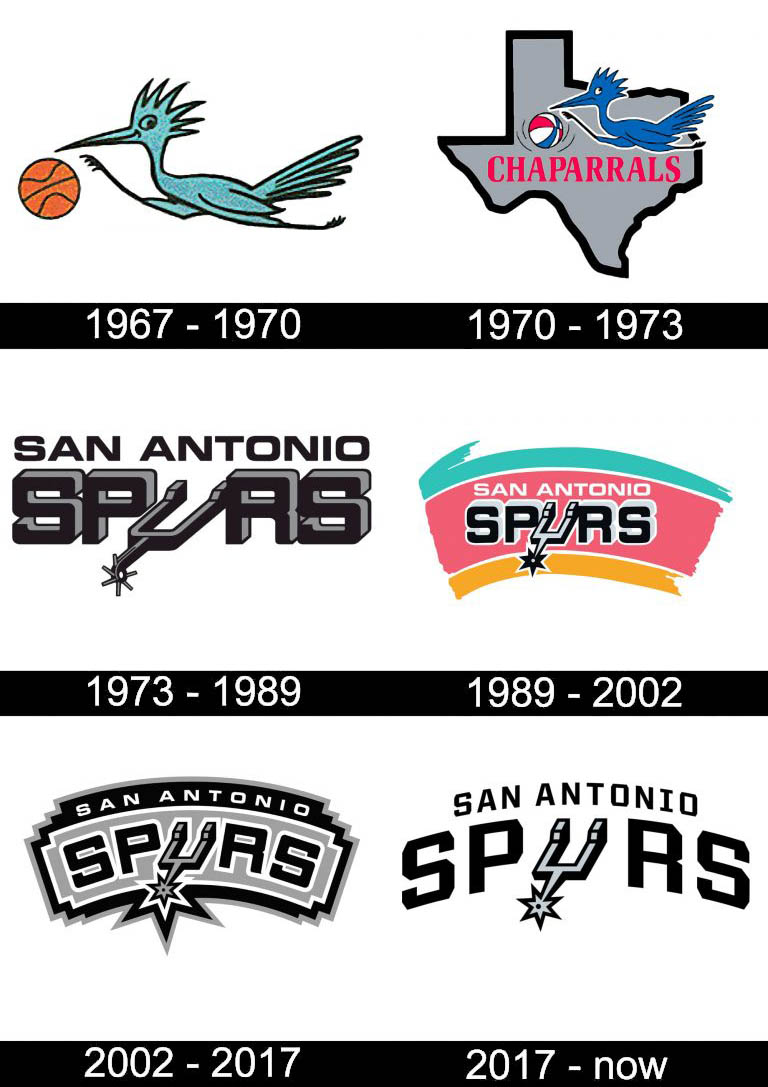
1967 – 1970: The Chaparrals Era
The earliest logo belonged to the franchise’s original identity as the Dallas Chaparrals. This emblem featured a cartoon-like roadrunner-style bird carrying a basketball. Rendered in light blue and orange, the design reflected the playful, experimental nature of early ABA branding.
While energetic, the logo lacked the gravitas associated with long-term identity. Its short lifespan reflects a franchise still searching for direction, both geographically and visually.

1970 – 1973: Refined Chaparrals Identity
A redesign in 1970 introduced cleaner lines and a more structured composition. The bird and basketball were placed within the outline of Texas, and the color palette shifted toward blue, gray, white, and red.
This version suggested a growing seriousness, yet it remained transitional. The identity was still tied to illustration rather than symbolism, limiting its longevity.

1973 – 1989: Birth of the Spurs Wordmark
The relocation to San Antonio in 1973 marked a turning point. The franchise introduced a new logo built entirely around typography. The bold wordmark featured a distinctive spur replacing the letter “U,” instantly establishing a visual signature that remains central today.
Rendered in black and gray, the logo conveyed authority and restraint. This was not a decorative mark, but a declaration of intent. The Spurs identity was now inseparable from its name and its symbol.

1989 – 2002: The Fiesta Era
In 1989, the Spurs introduced a colorful background featuring arched stripes in teal, pink, and yellow—an homage to San Antonio’s cultural vibrancy. While the core wordmark remained intact, the added colors injected personality without compromising identity.
This era produced one of the most beloved Spurs logos, balancing playfulness with strength. Importantly, the spur symbol remained untouched, preserving continuity within experimentation.

2002 – 2017: Minimalism and Maturity
In 2002, the franchise removed the colorful backdrop, returning to a stripped-down aesthetic. The wordmark appeared on a neutral banner, emphasizing legibility and form.
This redesign coincided with the height of the Spurs dynasty. The visual identity mirrored the team’s basketball philosophy during this period: efficient, disciplined, and focused on execution over flair.

2017 – Today: Refined Continuity
The 2017 update preserved all core elements while refining the typeface. The spur-integrated “U” remained the centerpiece, confirming its role as one of the NBA’s most enduring logo symbols.
Today, the full wordmark serves as the global logo, while the stylized “U” functions as a standalone mark across merchandise and digital platforms. This flexible system reinforces recognition without fragmenting identity.
Logo Symbolism: Function Over Flash
The Spurs logo symbolism is rooted in purpose. The spur represents precision, control, and craftsmanship—qualities mirrored in the team’s approach to basketball. Unlike logos built on intimidation or aggression, the Spurs mark communicates confidence through understatement.
The reliance on typography rather than illustration allows the logo to age gracefully. There is no mascot to modernize, no character to reinterpret. The identity remains timeless because it was never designed to chase attention.
Typography and Color Discipline
The Spurs wordmark is often associated with Helvetica Bold, though the actual typeface is custom. Diamond-shaped angles on select letters introduce subtle sharpness, reinforcing the mechanical precision suggested by the spur.
Color plays a supporting role rather than a dominant one. Black conveys authority and seriousness, while silver introduces sophistication and balance. The absence of loud color is intentional, reinforcing the franchise’s minimalist ethos.
San Antonio Spurs Logo Heritage and Identity Philosophy
The Spurs logo heritage stands as a case study in long-term brand discipline. While other franchises cycle through redesigns in search of relevance, San Antonio demonstrated that consistency itself can become a competitive advantage.
This philosophy aligns with broader themes explored across classic NBA logo history, where the most respected identities often change the least. The Spurs logo did not need reinvention—it needed belief.
San Antonio Spurs Logo History and Timeless Restraint
The San Antonio Spurs logo history reflects an organization that values substance over spectacle. From the introduction of the spur wordmark in the 1970s to its refined modern form, the franchise remained committed to clarity, symbolism, and continuity.
In an industry driven by trends, the Spurs chose identity. Their logo stands today not as a relic of the past, but as a reminder that the strongest brands are built patiently, deliberately, and without compromise.
FAQ: San Antonio Spurs Logo Meaning and History
What does the San Antonio Spurs logo represent?
The logo represents precision, discipline, and control, symbolized by the spur integrated into the team’s wordmark.
Why has the Spurs logo changed so little over time?
The franchise prioritized continuity and identity clarity, refining rather than reinventing its core visual elements.
When was the spur symbol introduced?
The spur symbol first appeared in 1973 and has remained central to the logo ever since.
What colors define the Spurs logo?
Black and silver define the primary palette, emphasizing authority, simplicity, and timeless design.