
Washington Wizards Logo History: Meaning, Symbolism & Brand Heritage
Few NBA franchises reflect the complex relationship between sport, place, and identity as clearly as the Washington Wizards. Known today for their red, white, and blue aesthetic and patriotic symbolism, the franchise has undergone one of the most extensive naming and visual identity transformations in league history. From the physical aggression implied by the “Bullets” era to the abstract, civic symbolism of the modern Wizards brand, the team’s logo history mirrors shifting cultural priorities, league sensibilities, and the evolving image of professional basketball in the nation’s capital.
The Wizards’ visual identity is not simply a sequence of redesigns. It is a long narrative of adaptation, restraint, and reinvention, shaped by geography, politics, and changing expectations of what a professional sports brand should represent. Understanding the Washington Wizards logo heritage requires looking beyond aesthetics and into the deeper symbolism that has defined each era.
Meaning and History: From Expansion Team to Capital Franchise
The franchise that would eventually become the Washington Wizards entered professional basketball in 1961. Originally established as the Chicago Packers, the team relocated quickly and underwent multiple identity shifts before settling permanently in Washington, D.C. Each move brought a new name and a new logo, reflecting not only location changes but also broader cultural and branding trends within the NBA.
For decades, the “Bullets” identity dominated the franchise’s public image. While successful on the court—most notably culminating in the 1978 NBA Championship—the name and its violent connotations became increasingly controversial by the 1990s. In a city closely associated with government, diplomacy, and national symbolism, the Bullets name began to feel misaligned with civic values. The eventual transition to the Wizards identity in 1997 marked a deliberate attempt to reposition the franchise as modern, imaginative, and culturally neutral, without erasing its competitive legacy.
Throughout these transformations, the team’s logos served as visual anchors, signaling each shift in philosophy while maintaining continuity through color, typography, and symbolic structure.
Washington Wizards Logo History Timeline

1961 – 1962: The Original Basketball Emblem
The franchise’s first logo appeared during its inaugural season and featured a minimalistic basketball design with a stylized bull’s head embedded into the surface. Executed without lettering, the emblem relied entirely on symbolic strength. The bull suggested power and resilience, while the basketball established immediate clarity of purpose. This design reflected early NBA branding tendencies, where logos functioned more as marks than as fully articulated brand systems.

1962 – 1963: The Zephyrs Identity
During a brief transitional period, the team adopted the Zephyrs name. The corresponding logo introduced custom script lettering in gold, outlined in blue and white. The elongated “Z” became the focal point, emphasizing speed and motion. Although visually dynamic, the design lacked long-term stability and was used for only one season, highlighting the franchise’s unsettled early years.

1963 – 1968: Baltimore Bullets
Following relocation to Baltimore, the Bullets identity took form. The logo featured a white basketball outlined in blue, paired with bold red sans-serif lettering. The composition balanced clarity and aggression, aligning with the physical style of play that would later define the franchise’s most successful era.
1968 – 1969: Symbolic Letterforms
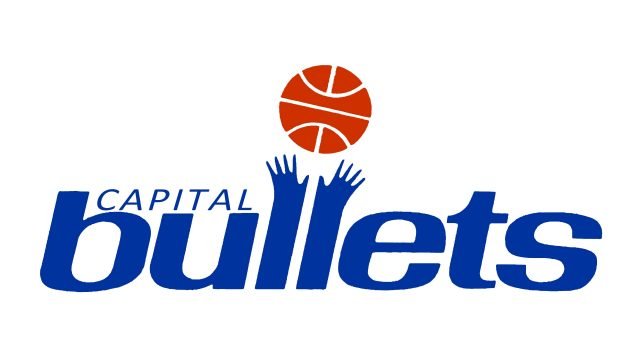
A major redesign introduced a lowercase wordmark where the double “L” in “Bullets” was transformed into two hands lifting a basketball. This concept-driven design represented teamwork and upward momentum. It marked one of the earliest examples of symbolic typography in NBA branding.
1969 – 1973: Color Refinement and Consistency
Subsequent updates focused on refining the color palette rather than altering the structure. Blue tones deepened, orange basketball elements softened, and the overall composition became more balanced. These versions reinforced brand recognition during a period of competitive growth.
1973 – 1987: Capital and Washington Bullets
As the franchise relocated to Washington, the wordmark was updated to reflect the new geography. The core logo structure remained intact, emphasizing continuity during a time of organizational stability. This period culminated in the franchise’s 1978 championship, permanently associating the Bullets visual identity with on-court success.
1987 – 1997: Modernized Typography
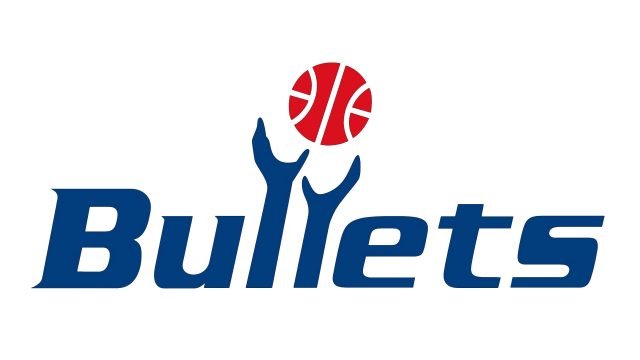
A late-1980s redesign introduced title-case lettering and simplified graphic elements. The hands-and-basketball motif was streamlined, reflecting broader trends toward cleaner, more corporate sports branding.
1997 – 2007: The Birth of the Wizards
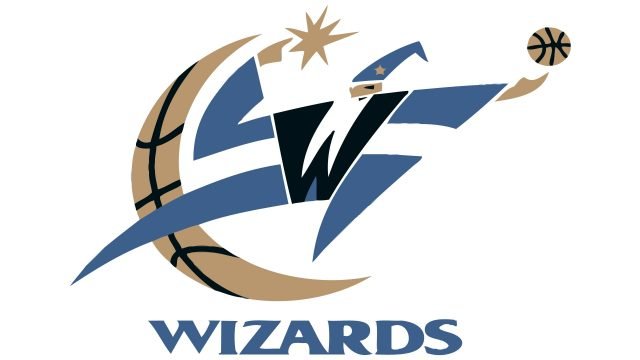
The most significant transformation came in 1997 with the adoption of the Washington Wizards name. The new logo depicted a stylized wizard figure rendered in light blue, accompanied by celestial elements and basketball symbolism. Serif typography added formality, while gold accents suggested mysticism and prestige. This emblem represented a complete philosophical shift away from physical aggression toward imagination and intellect.

2007 – 2011: Refined Color Harmony
A redesign softened the palette and refined details, creating a more elegant and balanced emblem. Blue and gold tones became lighter, while black accents added contrast and strength. The composition gained visual sophistication without abandoning its core elements.
2011 – 2015: Patriotic Realignment
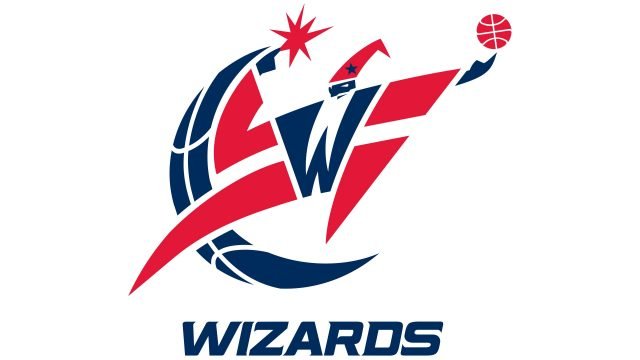
In 2011, the Wizards embraced a red, white, and navy color scheme, aligning the brand more closely with Washington, D.C., and national symbolism. Typography transitioned to italicized sans-serif forms, emphasizing motion and modernity.
2015 – Today: Circular Emblem and Civic Symbolism
The current logo, introduced in 2015, features a circular badge with a stylized basketball framed by red and blue rings. The wordmark wraps around the perimeter, creating a seal-like structure reminiscent of official insignia. This design emphasizes unity, tradition, and civic identity, positioning the Wizards as a permanent fixture of the nation’s capital rather than a transient sports franchise.
Logo Symbolism: From Aggression to Identity
The evolution of the Wizards logo symbolism reflects a broader shift in professional sports branding. Early designs emphasized force and dominance through aggressive imagery and bold typography. Over time, these elements gave way to abstraction, symbolism, and civic references.
The modern Wizards emblem avoids literal representations of magic or wizardry. Instead, it relies on geometry, color, and structure to communicate stability and belonging. The circular form suggests continuity, while the basketball remains central, grounding the brand firmly in the sport itself. The color palette reinforces national associations without appearing overtly political, striking a careful balance between identity and neutrality.
Typography, Color, and Visual Language
Typography has played a critical role in the Wizards’ visual evolution. Early sans-serif wordmarks prioritized readability and impact, while later serif forms introduced sophistication and narrative depth. The current typeface, derived from glyphic serif traditions and heavily customized, balances tradition with modernity, though legibility challenges remain at smaller scales.
The official color palette—red, navy blue, silver, and white—serves as a visual bridge between franchise history and geographic identity. These colors align the Wizards with Washington’s broader visual language while maintaining distinction within the NBA ecosystem.
A Franchise Defined by Adaptation
The Washington Wizards logo history is a study in controlled evolution. Few franchises have undergone as many identity shifts while retaining a coherent narrative. From the raw physicality of the Bullets era to the symbolic restraint of the modern Wizards brand, each logo reflects its time, its audience, and its cultural context.
Today’s emblem does not attempt to recreate past glories or rely on nostalgia alone. Instead, it positions the franchise as an enduring civic institution, capable of growth without abandoning heritage. In the broader context of logo history, logo meaning, and logo symbolism, the Washington Wizards stand as a compelling example of how visual identity can evolve alongside values, geography, and public perception—without losing its core essence.
FAQ: Washington Wizards Logo Meaning and History
What was the Washington Wizards’ original name?
The franchise began in 1961 and was known by several names early on, but its most famous former identity was the Bullets, a name used for decades before the team rebranded as the Washington Wizards in 1997.
Why did the Washington Bullets change their name to the Wizards?
The franchise changed its name in 1997 as part of a wider effort to move away from violent associations connected to the word “Bullets.” The shift was also meant to better align the team’s identity with Washington, D.C., and a more modern, marketable brand image.
What does the current Washington Wizards logo represent?
The current Wizards logo, introduced in 2015, is built as a circular seal featuring a stylized basketball and a red-blue civic frame. Its symbolism leans toward unity, tradition, and location-based identity rather than literal “magic” imagery.
When did the Wizards adopt their current circular logo?
The Wizards adopted the current circular badge in 2015, replacing the previous wordmark-heavy identity from the 2011–2015 period.
What are the main colors of the Washington Wizards logo, and what do they symbolize?
The primary colors are red, navy blue, silver, and white. Together, they reference Washington’s civic identity and the broader American color language, while also projecting stability, professionalism, and heritage.
Did the Wizards ever use a wizard character in their logo?
Yes. After the 1997 rebrand, the Wizards introduced a logo featuring a stylized wizard figure with celestial and basketball elements. That direction was later refined and eventually replaced by the more civic, seal-like approach used today.