Greek Alphabet: Meaning, History, and the 24-Letter Myth

The Greek alphabet didn’t start out with the 24 letters taught in classrooms today. It began as a direct, 22-letter borrowing from the Phoenician script around 800 BC, and a handful of those original letters quietly dropped out of use centuries before the alphabet settled into the form we now recognize.
How did the Greek alphabet actually originate?
Greek writing emerged in the late 9th or early 8th century BC, adapted from the Phoenician script, which the Greeks themselves called “Phoenician letters.” Phoenician was a consonant-only system, and the Greeks’ real innovation was repurposing several Phoenician consonant signs to represent vowel sounds instead, making Greek the earliest known alphabet to systematically write vowels alongside consonants. That single change is what let the alphabet capture spoken language with far more precision than earlier scripts.
Different regions of the Greek-speaking world used slightly different local versions of the alphabet for a few centuries. Historians group these into a “western” (red) group, which fed into the alphabet that became Latin, and an “eastern” (blue) group, which eventually became the standardized Greek alphabet. Athens formally adopted the eastern, Ionic-based version in 403 BC, under the archon Eucleides, replacing the city’s older local script.
Did the alphabet really have 27 letters at some point?
Not quite. Greek started out with all 22 letters it inherited from Phoenician, not 27. Three of those original letters, digamma, qoppa, and san, fell out of everyday use before the alphabet reached its classical form, while a fourth, sampi, survived only as a numeral symbol rather than a letter used in words. The 403 BC Athenian reform is the point historians usually point to for when the 24-letter standard still used today was locked in.
One quirk that has survived intact since antiquity is sigma’s two lowercase forms: σ is used in the middle of a word, while ς appears only at the end, a genuine structural feature of the script rather than a modern stylistic choice.
Did Greek letters really shape the Latin and Cyrillic alphabets?
Yes, though by different routes. The western branch of the early Greek alphabet passed into the Old Italic scripts used on the Italian peninsula and from there into Latin, the ancestor of the alphabet this sentence is written in. Cyrillic took a separate, much later path: it was developed in the 9th century AD, based on Greek uncial script, to write Old Church Slavonic, rather than descending from either of the archaic Greek branches directly.
Do brands like Alfa Romeo and Piaggio actually reference Greek letters?
Less often than people assume. Alfa Romeo is a case in point: “Alfa” isn’t a nod to the Greek letter alpha at all, it’s an acronym. The company was founded in Milan in 1910 as A.L.F.A., short for “Anonima Lombarda Fabbrica Automobili” (Lombard Automobile Factory), and only became “Alfa Romeo” in 1920 after Nicola Romeo took control and added his surname. Piaggio follows the same pattern: the Italian manufacturer is named after its founder, Rinaldo Piaggio, with no connection to the letter Pi.
Delta Air Lines is a genuine, if more complicated, example. The airline traces back to Huff Daland Dusters, a 1925 crop-dusting operation in Macon, Georgia, reorganized as Delta Air Service in 1928 under C.E. Woolman; the “Delta” name itself refers to the Mississippi Delta region where the airline got its start, and the triangular shape of its logo deliberately echoes the Greek letter delta, so the connection is real even if the underlying name comes from a place, not the letter itself.
Omega’s history is more about engineering than symbolism. Watchmaker Louis Brandt founded the company in 1848 in La Chaux-de-Fonds, Switzerland; it was his sons Louis-Paul and César who developed a new interchangeable-parts movement in 1894 that they marketed as the “Omega” calibre, and that model sold well enough that the whole company was renamed Omega Watch Co. in 1903. Why they chose the name “Omega” specifically for that movement isn’t documented in detail, so the popular idea that it was meant to signal “the ultimate, final word” in watchmaking is a reasonable-sounding guess rather than a confirmed company explanation.
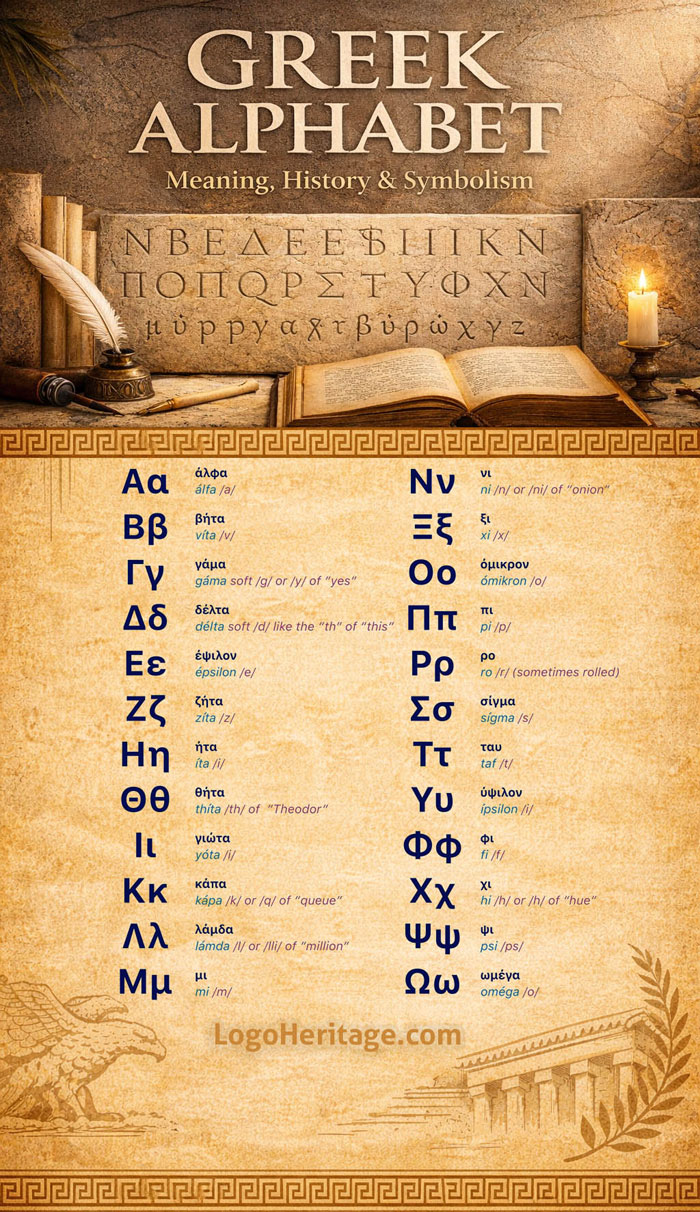
The complete Greek alphabet
| Upper case | Lower case | Name | English equivalent |
|---|---|---|---|
| Α | α | Alpha | a |
| Β | β | Beta | b |
| Γ | γ | Gamma | g |
| Δ | δ | Delta | d |
| Ε | ε | Epsilon | e |
| Ζ | ζ | Zeta | z |
| Η | η | Eta | ē / i |
| Θ | θ | Theta | th |
| Ι | ι | Iota | i |
| Κ | κ | Kappa | k |
| Λ | λ | Lambda | l |
| Μ | μ | Mu | m |
| Ν | ν | Nu | n |
| Ξ | ξ | Xi | ks |
| Ο | ο | Omicron | o |
| Π | π | Pi | p |
| Ρ | ρ | Rho | r |
| Σ | σ / ς | Sigma | s |
| Τ | τ | Tau | t |
| Υ | υ | Upsilon | u / y |
| Φ | φ | Phi | ph / f |
| Χ | χ | Chi | ch / kh |
| Ψ | ψ | Psi | ps |
| Ω | ω | Omega | o (long) |
Quick facts
| Greek alphabet emerged | Late 9th/early 8th century BC, adapted from Phoenician script |
| Original letter count | 22, inherited directly from Phoenician |
| Letters later dropped | Digamma, qoppa, san (sampi kept only as a numeral) |
| 24-letter standard adopted | 403 BC, Athens, under archon Eucleides |
| Influenced Latin via | Western (“red”) Greek variants, through the Old Italic scripts |
| Influenced Cyrillic via | Greek uncial script, 9th century AD, for Old Church Slavonic |
| Alfa Romeo’s “Alfa” | Acronym (A.L.F.A.), not the Greek letter alpha |
Related reading: The history of logos, 10 most recognizable logos in the world, 17 world-renowned brand logos, and Olympic logo history.
Further reading
FAQ: The Greek Alphabet
How many letters are in the Greek alphabet?
24 today. It originally had 22 letters inherited from Phoenician; the 24-letter standard was formally adopted in Athens in 403 BC.
What happened to the Greek alphabet’s missing letters?
Digamma, qoppa, and san fell out of everyday use before the classical 24-letter alphabet took shape; sampi survived only as a number symbol.
Is “Alfa” in Alfa Romeo related to the Greek letter alpha?
No. It’s an acronym for the company’s original Italian name, Anonima Lombarda Fabbrica Automobili.
Does Delta Air Lines’ name come from the Greek letter delta?
Not directly. The name comes from the Mississippi Delta region where the airline began, though its triangular logo does deliberately echo the Greek letter’s shape.
Did Cyrillic come directly from the ancient Greek alphabet?
It’s based on Greek uncial script, but it was created separately in the 9th century AD to write Old Church Slavonic, rather than evolving directly from the archaic Greek branches that shaped Latin.