
Funimation Logo History: Meaning, Symbolism & Brand Heritage
For nearly three decades, Funimation played a central role in shaping how Japanese anime reached Western audiences. Founded in 1994 and based in Texas, the company became synonymous with English dubbing, localization, and global distribution of some of the most influential anime titles ever produced. While its catalog defined generations of viewers, Funimation’s visual identity quietly evolved in parallel, reflecting changes in media consumption, audience expectations, and brand positioning.
Within the broader discussion of logo history, logo meaning, and anime brand heritage, Funimation stands as a textbook example of a media company transitioning from physical distribution to digital-first streaming. Its logo heritage mirrors this journey, moving from complex geometric symbolism to a simplified, emotionally driven wordmark. When viewed alongside platforms such as Crunchyroll logo history, WCOstream logo evolution, or broader streaming platform brand identity, Funimation’s logo evolution reveals how design adapts to cultural and technological shifts.
Meaning and History: From Distribution Studio to Cultural Gateway
Funimation Productions was established in 1994 with a specific mission: to bring Japanese animation to English-speaking audiences through professional dubbing and localization. At a time when anime remained largely niche outside Japan, Funimation helped legitimize the medium in North America.
Over the years, the company became responsible for distributing landmark series such as Dragon Ball, Fullmetal Alchemist: Brotherhood, Attack on Titan, Tokyo Ghoul, and My Hero Academia. These titles did more than entertain; they reshaped global pop culture. As Funimation’s role expanded from distributor to streaming platform, its visual identity had to evolve accordingly.
The Funimation logo meaning was never about heritage or geography. Instead, it focused on emotion, accessibility, and excitement, aligning closely with the expressive nature of anime itself.
Funimation Logo History Timeline
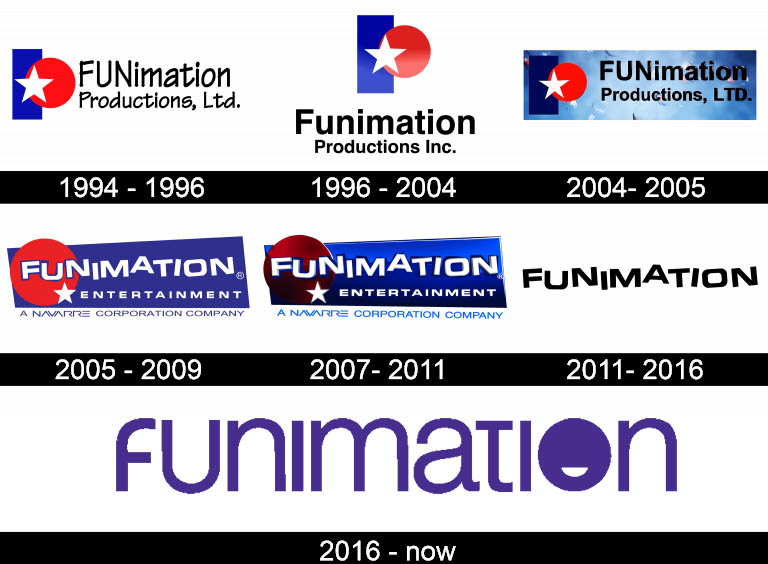
1994–1996: Funimation Productions and Early Geometry
The original Funimation logo combined three geometric elements: a white star in the foreground, a large red circle behind it, and a blue rectangle forming the base. The rectangle initially stood on its narrow edge, creating a vertical emphasis.
This composition loosely resembled an exclamation mark, an intentional nod to excitement, surprise, and entertainment. The company name appeared alongside the emblem in a playful typeface, reinforcing a sense of fun and experimentation characteristic of early anime localization efforts.

1996–2004: Maturity and Structural Balance
In 1996, the logo underwent refinement. The typography became straighter and more restrained, signaling a shift toward professionalism. The company name was typically placed beneath the emblem, though alternative layouts persisted.
Shading effects were introduced, adding depth and visual weight. The geometric symbol remained intact, continuing to function as the brand’s primary identifier during a period of rapid growth.

2004–2005: Subtle Recalibration
The 2004 update adjusted proportions rather than concepts. The geometric elements were repositioned and resized, giving the emblem a refreshed appearance. The wordmark increased in size relative to the symbol, reflecting the growing recognition of the Funimation name itself.
This phase marked the beginning of a gradual shift from emblem dominance to typographic identity.

2005–2009: Funimation Entertainment and Playful Energy
Following a rebrand to Funimation Entertainment, the logo became more expressive. The rectangular base transformed into an irregular quadrilateral, allowing the company name to be placed inside the shape rather than next to it.
The red circle remained prominent, while the white star was reduced in size. Typography became more playful again, aligning with the company’s expanding catalog of youth-oriented anime titles. The logo embraced motion and personality over rigidity.
2007–2011: Depth and Dimensionality
A gradient effect was introduced, giving the logo a three-dimensional appearance. This reflected mid-2000s design trends and the company’s growing presence across multiple media formats, including DVD, Blu-ray, and digital platforms.
2011–2016: The Wordmark Takes Over
In 2011, Funimation made a decisive move. The geometric emblem was removed entirely, leaving only the “Funimation” wordmark. The typography remained familiar, but the focus shifted fully to the name.
A large standalone “F” appeared beneath the wordmark in some applications, hinting at a simplified brand system built around initial recognition rather than symbolic imagery.

2016–2022: Simplification and Emotional Design
The final Funimation logo overhaul arrived in 2016. Letterforms were softened, angles rounded, and spacing refined. Most notably, the letter “o” was replaced with a circular shape resembling a smiling face.
This subtle change transformed the logo’s emotional tone. The brand moved away from abstraction and geometry toward warmth and approachability. Purple became the dominant color, reinforcing creativity, imagination, and calm authority.
This logo remained in use until Funimation ceased independent operations in 2022, following its integration into Crunchyroll.
Logo Symbolism: From Exclamation to Expression
Early Funimation logo symbolism relied on abstract geometry to convey excitement. The star, circle, and rectangle collectively suggested energy and spectacle. Over time, as the brand matured, symbolism became less literal.
The modern logo’s smiling “o” represents emotional connection rather than action. It reflects Funimation’s role as a bridge between cultures, making foreign stories feel familiar and accessible.
This shift mirrors broader trends in media logo evolution, where emotional resonance increasingly replaces visual complexity.
Typography and Color Identity
Funimation’s final wordmark used a custom sans-serif typeface with slightly narrowed proportions. Clean and modern, it balanced friendliness with professionalism. Subtle contour modifications ensured uniqueness without sacrificing legibility.
Purple defined the brand’s final visual era. Long associated with creativity and imagination, the color positioned Funimation as a curator of expressive storytelling rather than a purely technical distributor. Combined with white, the palette conveyed confidence and clarity.
A Logo That Evolved With Its Audience
The Funimation logo heritage reflects the lifecycle of a modern media company. From experimental beginnings to global influence and eventual consolidation, the logo adapted to changing roles, technologies, and audiences.
Within the larger landscape of anime streaming brand identity, logo history, and digital media heritage, Funimation’s visual evolution stands alongside platforms such as Crunchyroll, WCOstream, and other anime-focused services. Its final identity prioritized emotion, simplicity, and connection, qualities that defined its lasting impact.
Though Funimation as a standalone brand has concluded its journey, its logo remains a visual marker of anime’s rise in the global mainstream.
FAQ: Funimation Logo Meaning and History
What does the Funimation logo represent?
The logo represents creativity, accessibility, and emotional connection to anime storytelling.
Why did Funimation remove its geometric emblem?
As the brand matured, it shifted toward a wordmark-focused identity for clarity and recognition.
What does the smiling “o” in the logo mean?
It symbolizes friendliness, approachability, and enjoyment.
What color defined the Funimation brand?
Purple was the primary color, representing imagination and creativity.