
Tata Motors Logo History: Meaning, Symbolism & Brand Heritage

Tata Motors Logo History: Meaning, Symbolism & Brand Heritage
Tata is one of the most influential industrial names in global business, with roots reaching back to 1868 in India. As part of the wider Tata Group, Tata Motors—established in 1954—became the automotive expression of a corporate philosophy built on responsibility, engineering integrity, and long-term legacy. Today, Tata Motors is highly recognizable across Southern Asia, Africa, and the United Kingdom, where its vehicles are associated with durability and pragmatic innovation.
The Tata Motors logo history reflects this ethos with notable restraint. Rather than frequent reinvention, the brand’s visual identity evolved through a small number of decisive redesigns, each aligned with a broader strategic shift. The logo meaning emphasizes stability and forward motion, while the logo symbolism balances heritage with modernity. This disciplined evolution defines Tata’s logo heritage, where continuity reinforces trust across generations.
Meaning and History: The Origin of the Tata Motors Logo
The name “Tata” is commonly associated with the Parsi word for “father,” a meaning that resonates strongly with the group’s values of stewardship and responsibility. From its earliest days, the Tata brand placed quality, ethics, and social contribution at the center of its identity. When Tata Motors emerged as the automotive arm in the mid-20th century, it inherited this value system and translated it into engineering and design.
The logo origin mirrors this inheritance. Tata’s visual identity was conceived to be symbolic rather than decorative, communicating reliability and progress without excessive ornamentation. While the company expanded its automotive portfolio—from commercial vehicles to passenger cars and electric mobility—the logo remained a steady visual anchor, evolving only when necessary to signal a new era.
Tata Motors Logo History Timeline
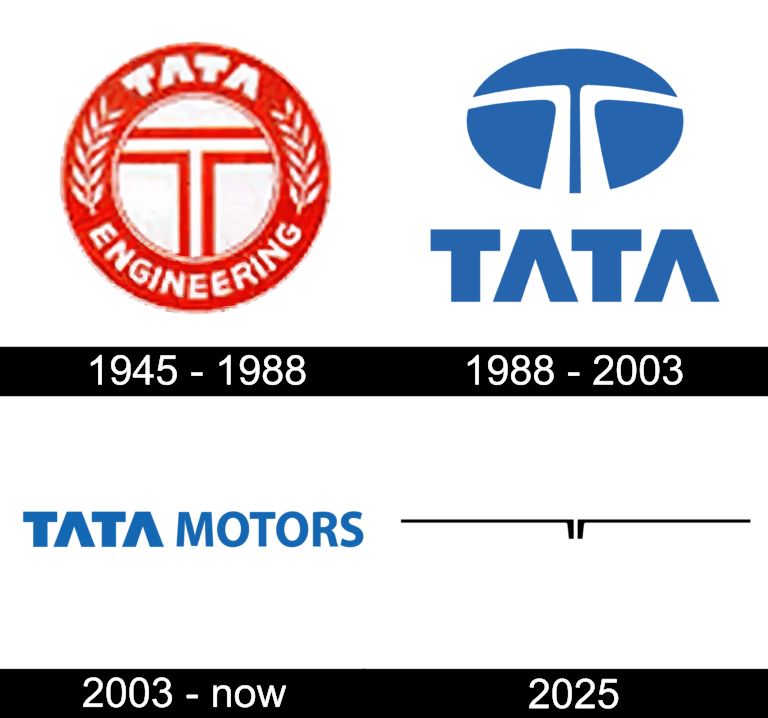
1945–1988: The Monogram and Ornamental Heritage
The earliest Tata logo featured a single letter “T” enclosed within a circular frame. Executed in red and silver, the emblem included a decorative leaf ornament around its border. This design reflected the brand’s early industrial heritage, blending authority with a sense of tradition. The monogram emphasized identity over motion, suitable for a company still consolidating its industrial presence.

1988–2003: The Blue Oval and Corporate Modernization
In 1988, Tata introduced a landmark redesign created by the British branding agency Wolff Olins. The new logo featured a solid blue oval containing two white lines that begin parallel at the bottom and curve upward at right angles to form a stylized “T.” This abstract construction marked a decisive shift toward modern corporate branding.
The blue-and-white color palette symbolized reliability, loyalty, and prosperity, while the bold geometry communicated confidence. On vehicles, the emblem often appeared in a three-dimensional metallic finish, reinforcing a sense of engineering precision and futuristic intent.
2003–Present: Wordmark Integration and Fluid Motion
In 2003, Tata refined its identity by adding a wordmark beneath the emblem. Set in a clean sans-serif typeface reminiscent of Helvetica, the lettering appeared in the same blue as the emblem. Notably, both “A” characters lacked horizontal bars, lending the wordmark a distinctive and contemporary character.
During this phase, the emblem came to symbolize motion and fluidity. The open curves and balanced geometry positioned Tata Motors as progressive and forward-looking, aligning with its expanding global footprint and growing focus on design-led vehicles.
2025 (Tentative): Minimalism and Emblem-Only Identity
In the early 2020s, Tata Group introduced a minimalist logo concept signaling a future-facing identity. The proposed Tata Motors emblem reduces the design to a stylized “T” formed by two mirrored elements. Rendered in flat black on a white background, the badge eliminates lettering entirely.
This concept emphasizes clarity, abstraction, and confidence. Short, bold vertical bars paired with elongated horizontal strokes suggest balance and precision. If adopted fully, this mark would represent Tata’s most radical visual simplification to date, reinforcing maturity and brand recognition without reliance on text.

Logo Symbolism: Stability in Motion
The symbolism of the Tata Motors logo centers on movement guided by control. Across its iterations, the stylized “T” evolved from a static monogram into a dynamic form suggesting flow and progress. The oval enclosure introduced in 1988 provided continuity and protection, while later refinements emphasized openness and adaptability.
In its modern interpretations, the emblem conveys progress without aggression. This restrained symbolism aligns with Tata’s positioning as a manufacturer focused on practical innovation and long-term value rather than short-lived trends.
Typography and Color in the Tata Motors Logo
Typography has played a supportive yet important role in Tata’s identity. The adoption of a neutral sans-serif wordmark reinforced clarity and accessibility, while subtle customizations—such as open “A” forms—added distinction. The recent move toward an emblem-only system underscores confidence in visual recognition.
Color has been equally symbolic. Blue dominated Tata’s modern identity, representing trust, stability, and corporate integrity. Metallic gray versions used on vehicles added a premium, technological feel. The tentative black-and-white future mark signals a shift toward universal minimalism and digital adaptability.
Tata Motors Logo Heritage and Brand Identity
Tata Motors’ logo heritage is defined by strategic patience. Each redesign occurred at a pivotal moment, reflecting shifts in scale, market presence, or technological focus. Rather than erasing the past, new identities built upon familiar forms, allowing customers to recognize continuity amid change.
This approach mirrors the Tata Group’s broader philosophy, where reputation is accumulated over decades rather than manufactured through constant rebranding. The logo functions as a symbol of trust as much as a design asset.
A Legacy Refined, Not Replaced
The Tata Motors logo history illustrates how a global automotive brand can evolve visually without sacrificing its core identity. From ornamental monograms to abstract minimalism, each phase reflects the company’s growing confidence and expanding ambitions.
By preserving symbolic consistency while embracing modern design principles, Tata Motors has built a logo heritage that feels both rooted and future-ready. Its emblem stands not as a trend-driven mark, but as a visual expression of legacy, responsibility, and progress.
FAQ: Tata Motors Logo Meaning, Symbolism, and History
What does the Tata Motors logo represent?
The logo represents reliability, progress, and corporate responsibility, symbolized through a stylized “T” and balanced geometry.
When was Tata Motors founded?
Tata Motors was established in 1954 as part of the Tata Group.
Who redesigned the Tata logo in 1988?
The 1988 redesign was created by the branding agency Wolff Olins.
Why is blue used in the Tata Motors logo?
Blue symbolizes trust, stability, loyalty, and long-term prosperity.
Has Tata Motors changed its logo often?
No. Tata Motors has had relatively few major redesigns, emphasizing continuity and brand heritage.
What is the proposed Tata Motors logo for the future?
The tentative future logo is a minimalist, emblem-only design featuring an abstract “T” rendered in black.