
KAMAZ Logo History: Meaning, Symbolism & Brand Heritage
KAMAZ stands as one of the most recognizable industrial brands to emerge from the Soviet automotive program. Founded in 1969 and headquartered in Naberezhnye Chelny, in the Republic of Tatarstan, the company was created to meet the USSR’s rapidly growing demand for heavy-duty trucks capable of operating in harsh climates and demanding conditions. Over time, KAMAZ evolved from a state-driven industrial project into a global manufacturer, exporting vehicles to more than 80 countries and securing a strong position in international motorsport through its repeated successes at the Dakar Rally.
The KAMAZ logo history reflects this transformation with unusual clarity. From utilitarian industrial symbols to a powerful, expressive emblem, the logo meaning evolved alongside the brand’s expanding ambitions. Each stage of visual development mirrors a shift in identity, from domestic functionality to international recognition and brand heritage. Rather than decorative refinement, KAMAZ’s logo symbolism has always focused on strength, endurance, and motion.
Today, majority-owned by Rostec, KAMAZ represents a fusion of industrial legacy and modern engineering, with a visual identity that continues to communicate resilience and authority.
Meaning and History: The Origin of the KAMAZ Logo
KAMAZ was established in 1969 as part of a centralized Soviet initiative to develop a new generation of heavy trucks. The company’s origin is inseparable from large-scale industrial planning, where clarity of purpose and functionality were more important than branding aesthetics. This mindset strongly influenced the early logo designs, which prioritized instant recognition of purpose over emotional appeal.
As the company matured and began participating in international markets, the role of the logo changed. It no longer served merely as an identifier, but as a symbol of engineering reliability and competitive strength. The shift from Cyrillic-only typography to Latin lettering marked a significant moment in KAMAZ’s logo heritage, signaling its global ambitions.
KAMAZ Logo History Timeline
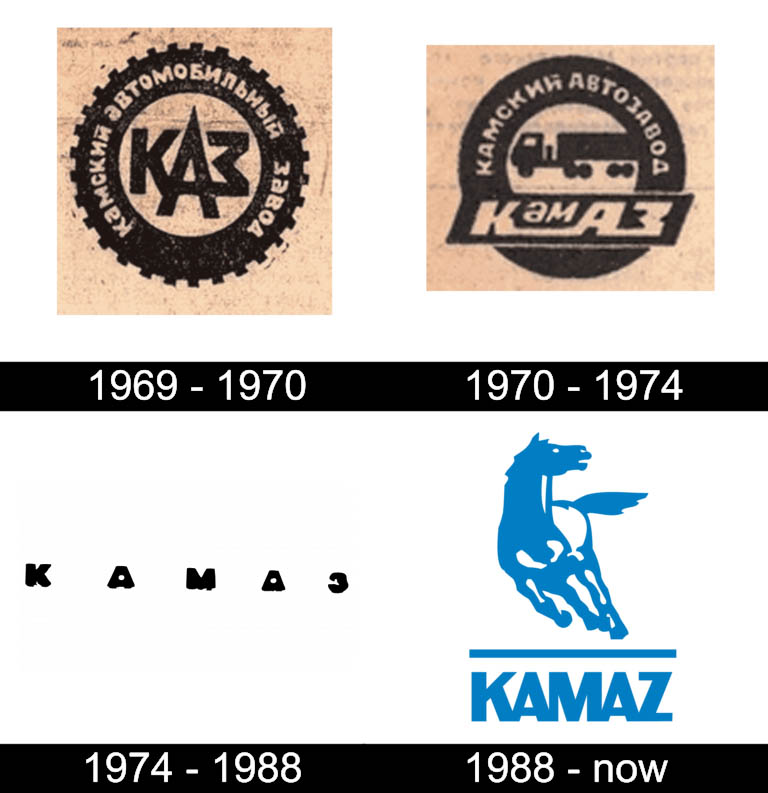
1969–1970: Industrial Identity and Functional Symbolism
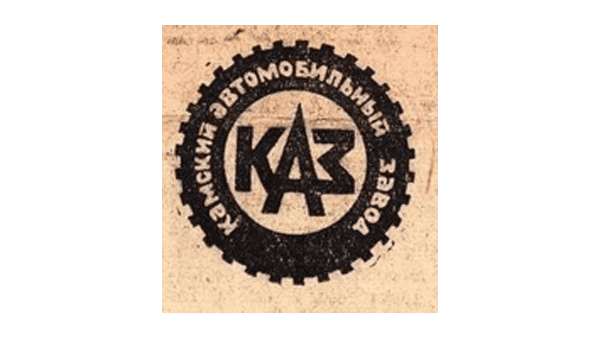
The first KAMAZ logo was introduced shortly after the company’s founding. It featured a bold black off-road tire as the central element, immediately communicating the brand’s focus on heavy vehicles. Inside the tire, the company’s name appeared in Russian, rendered in a simple uppercase sans-serif typeface. The letter “A” was enlarged and positioned prominently, filling the central space and adding visual balance. The logo was utilitarian and direct, reflecting the purely industrial nature of the brand at the time.
1970–1974: Refinement and Vehicle Representation
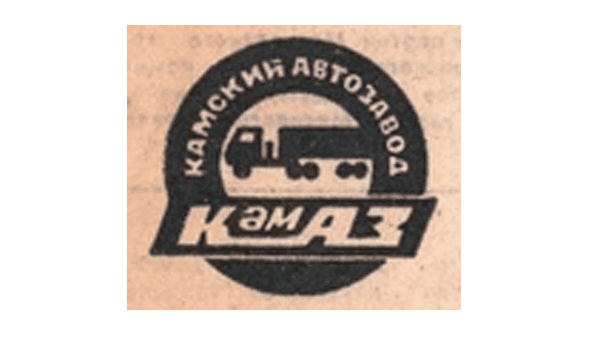
In the early 1970s, the logo was refined to appear cleaner and more structured. The tire’s outer edge became smoother, and the lengthy company name was shortened. A horizontal banner carrying the brand name was introduced in the lower portion of the emblem. The most notable change was the addition of a truck silhouette, replacing the initials previously shown in the center. This version made the company’s activity unmistakable even at a glance.
1974–1988: Confidence Through Typography
In 1974, KAMAZ adopted a radically simplified logo. All graphical elements were removed, leaving only the brand name in Cyrillic. The typography was bold, black, and widely spaced, conveying stability and confidence. This minimalist approach reflected the company’s strong domestic recognition and its focus on large-scale production rather than marketing expression. At this stage, KAMAZ was not yet oriented toward international branding, and the logo clearly addressed a domestic audience.

1988–Present: The Running Horse and Global Identity
In 1988, KAMAZ introduced the most iconic logo in its history. The new emblem featured a running horse rendered in white and blue, symbolizing power, endurance, and relentless forward motion. A horizontal line beneath the horse grounded the figure visually and separated it from the wordmark below. For the first time, the brand name appeared in the Latin alphabet as “KAMAZ,” marking a clear step toward international markets.
The typography shifted to a bold uppercase sans-serif with slightly overlapping letters, reinforcing the sense of mechanical strength and cohesion. This logo remains in use today and has become a defining element of KAMAZ’s global brand heritage.
Logo Symbolism: Strength, Endurance, and Motion
The symbolism of the KAMAZ logo centers on the horse, a universal emblem of power and stamina. Unlike decorative or heraldic horse symbols, KAMAZ’s horse is depicted in full motion, emphasizing endurance rather than elegance. This imagery aligns closely with the brand’s reputation for producing vehicles capable of operating under extreme conditions.
The horizontal line beneath the horse adds a sense of stability and direction, visually anchoring the emblem. Combined with the bold typography, the logo symbolism communicates reliability, momentum, and industrial discipline.
Typography and Color in the KAMAZ Logo
Typography plays a crucial role in reinforcing KAMAZ’s visual identity. The current wordmark uses a heavy sans-serif typeface in uppercase, with compact spacing and subtle overlaps that create a unified, mechanical appearance. This typographic approach avoids ornamentation, focusing instead on clarity and authority.
The blue-and-white color palette further strengthens the logo meaning. Blue conveys reliability, engineering precision, and trust, while white adds contrast and clarity. Together, these colors reflect professionalism and technical competence, qualities essential for a global truck manufacturer.
KAMAZ Logo Heritage and Brand Identity
KAMAZ’s logo heritage is built on evolution through necessity rather than stylistic experimentation. Each redesign corresponded to a shift in the company’s role, from domestic supplier to international competitor. Despite these changes, the brand has consistently avoided decorative excess, maintaining a visual language rooted in strength and purpose.
The current logo functions as a symbol of both industrial legacy and competitive achievement, reinforced by KAMAZ’s repeated victories in endurance motorsport events.
An Emblem Forged by Industry
The KAMAZ logo history tells the story of a brand shaped by industrial demand, technical resilience, and global ambition. From the utilitarian tire emblem of its early years to the powerful running horse that defines it today, the logo’s evolution mirrors the company’s journey.
By embracing symbolism that reflects endurance and strength, KAMAZ has built a logo heritage that resonates across borders and markets. It stands as a visual testament to a brand that values function, reliability, and sustained performance over fleeting design trends.
FAQ: KAMAZ Logo Meaning, Symbolism, and History
What does the KAMAZ logo represent?
The logo represents strength, endurance, and forward motion, symbolized by a running horse.
When was KAMAZ founded?
KAMAZ was founded in 1969 in Naberezhnye Chelny, Russia.
Why did KAMAZ change its logo in 1988?
The redesign marked a shift toward international markets and introduced a more expressive symbol of power and motion.
What does the horse in the KAMAZ logo symbolize?
The horse symbolizes stamina, reliability, and the ability to perform under extreme conditions.
Why is the KAMAZ name written in Latin letters today?
The use of Latin lettering reflects the brand’s global expansion beyond domestic markets.
Who owns KAMAZ today?
KAMAZ is majority-owned by the Russian state corporation Rostec.