
TikTok Logo History: Meaning, Symbolism & Brand Heritage
Video blogging has evolved far beyond casual entertainment. What began as simple user-generated clips has grown into a global creative economy, driven by algorithms, music, and short-form storytelling. While platforms like YouTube defined the early structure of video content, the emergence of TikTok marked a decisive shift in how audiences create, discover, and consume visual media.
At the heart of this transformation lies a logo that feels inseparable from the experience itself. The TikTok emblem is not a decorative afterthought but a visual extension of sound, rhythm, and motion. In a remarkably short time, it has become one of the most recognizable symbols of the digital era, establishing a strong and coherent logo heritage despite the platform’s relative youth.
Meaning and History: The Origin of the TikTok Logo
The origin of TikTok is closely connected to its parent company, ByteDance, founded in 2012 by software engineer Zhang Yiming. ByteDance built its reputation on advanced recommendation algorithms designed to surface content based on behavior rather than popularity—a principle that would later define TikTok’s global success.
TikTok itself was launched in 2016, initially as Douyin for the Chinese market. The platform was conceived as a space for short, music-driven videos, allowing users to synchronize visuals with sound in a highly intuitive way. International expansion followed shortly after, accelerating significantly once ByteDance acquired and merged with Musical.ly, transferring its global user base into the TikTok ecosystem.
From the beginning, TikTok’s identity emphasized accessibility and creative freedom. Its algorithm promoted new creators alongside established ones, encouraging experimentation and rapid cultural diffusion. This philosophy shaped the visual identity as well. The logo introduced in 2016 was designed to feel energetic and unconventional, reflecting not a corporate platform but a living, reactive environment. Notably, the logo has remained almost unchanged since its debut, underscoring the strength of its original concept.
TikTok Logo History Timeline
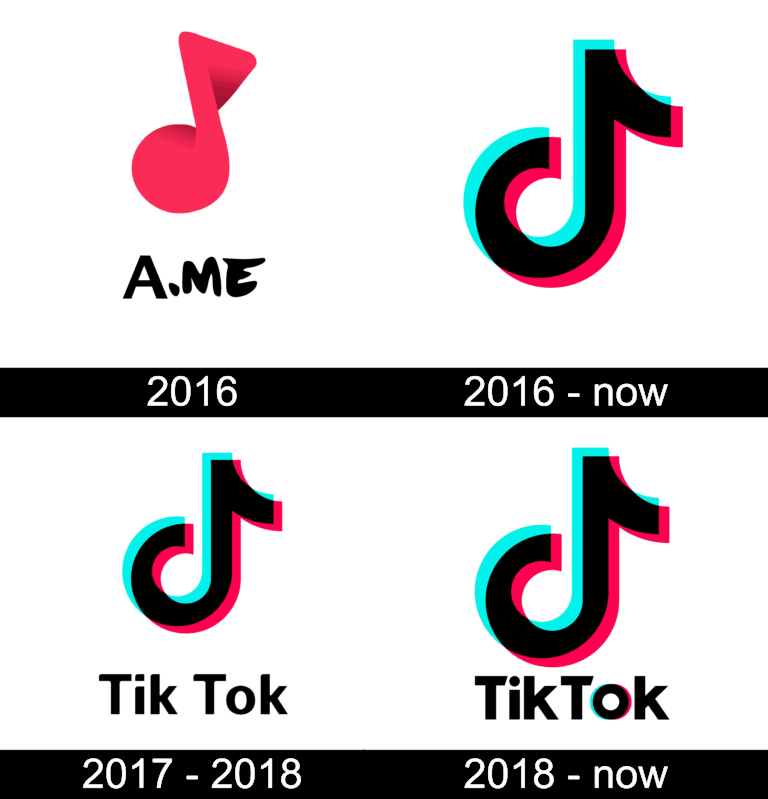
2016: Early Identity and the A.me Phase
Before adopting the TikTok name internationally, the platform briefly operated under the title “A.me.” The early logo featured a bright, three-dimensional musical note paired with a mixed-style wordmark. This experimental design reflected a product still searching for its final form and positioning.
This phase lasted only a few months. The rapid rebranding to Douyin domestically and TikTok globally marked the transition from prototype to scalable platform.

2016–Today: The D-Note as a Core Symbol
With the launch of TikTok, the platform introduced its defining emblem: a stylized musical note shaped like a lowercase “d.” This form directly referenced “Douyin,” preserving the platform’s original identity even as it expanded beyond China.
The symbol stood out due to its layered neon outlines, which created a subtle visual vibration. Unlike traditional flat logos, the TikTok emblem appeared dynamic, almost animated, even in static form. This design choice aligned perfectly with the platform’s focus on music, rhythm, and motion.
2017–2018: Introduction of the Wordmark
As TikTok gained international traction, a wordmark was added to accompany the emblem. Initially, “Tik” and “Tok” appeared as two distinct parts, emphasizing the rhythmic nature of the name. The typography was intentionally rounded and soft, avoiding sharp or corporate aesthetics.

2018–Present: Refinement Without Redesign
In 2018, the wordmark was subtly refined. Letter spacing was adjusted, shapes were standardized, and color accents were integrated—particularly within the “o,” which visually echoed the circular motion of the emblem. Despite these changes, the core identity remained intact. The emblem and wordmark could now function independently, a crucial feature for mobile-first branding.
Logo Symbolism: Sound, Motion, and Expression
The TikTok logo symbolism is rooted in sensory experience rather than literal representation. At its core, the musical note reflects the platform’s emphasis on sound as a creative foundation. Music is not a background element on TikTok—it is structural, shaping trends, formats, and cultural moments.
The offset neon outlines introduce a sense of vibration, reportedly inspired by the atmosphere of live concerts. This visual distortion suggests movement, resonance, and participation. Rather than depicting technology or media tools, the logo communicates emotion and energy, allowing it to remain relevant regardless of changes in devices or formats.
This abstraction is central to the logo’s success. By avoiding explicit references to cameras or screens, TikTok created a symbol that feels timeless despite its digital context.
Typography and Color in the TikTok Logo
The TikTok wordmark uses a bold geometric sans-serif typeface designed for clarity on small screens. Rounded terminals soften the lettering, making it approachable and expressive rather than rigid or institutional.
Color is equally important to the logo’s identity. The combination of black with neon cyan and pink creates high contrast and instant recognition. The layered color treatment enhances the illusion of depth, reinforcing the idea of sound waves and visual rhythm. While alternative color versions exist for different backgrounds, the black-and-neon configuration remains the most iconic and central to the brand’s visual language.
TikTok Logo Heritage and Digital Brand Identity
Although TikTok is a relatively young platform, its logo heritage has developed with remarkable speed. By committing to a single strong visual idea and resisting frequent redesigns, TikTok achieved a level of recognition that many older brands struggle to maintain.
The logo’s endurance lies in its alignment with the platform’s purpose. It does not merely identify TikTok—it embodies the experience of using it. In a digital landscape defined by constant reinvention, this consistency has become a defining strength.
TikTok Logo Meaning and Evolution: Conclusion on Brand Heritage
The TikTok logo history demonstrates how a modern brand can establish lasting visual identity without decades of evolution. Built around sound, motion, and emotional resonance, the logo’s meaning and symbolism reflect the platform’s core values of creativity and accessibility.
By refining rather than replacing its emblem, TikTok has secured a place in contemporary logo heritage. The result is a symbol that feels immediate yet enduring—a rare achievement in the fast-moving world of digital media.
FAQ: TikTok Logo Meaning, Symbolism, and History
What does the TikTok logo represent?
The logo represents music, motion, and creative energy, expressed through a vibrating musical note.
Why is the TikTok logo shaped like a musical note?
The note reflects the platform’s origins in music-driven short video content.
Has the TikTok logo changed over time?
Only through minor refinements. The core emblem introduced in 2016 remains unchanged.
Who created the TikTok logo?
The designer has never been publicly credited.
What is the origin of the TikTok logo symbol?
The symbol is based on a stylized “d” musical note, referencing Douyin, TikTok’s original name in China.