National Geographic Logo: The Yellow Border
The National Geographic logo is a solid yellow rectangle set beside a bold black wordmark. The rectangle comes from the magazine’s cover border, which dates back to 1910, while the logo as most people know it today was built for the National Geographic Channel, launched internationally in September 1997 and in the United States in January 2001.
Why is the National Geographic logo a yellow rectangle?
The yellow rectangle began as a border on the cover of National Geographic magazine, introduced in February 1910 around an oak leaf border illustration. The oak leaf detail was dropped in 1979, leaving the plain yellow border that is still used on the magazine today. When National Geographic built a television channel in the 1990s, that border became the basis for a standalone logo: a solid yellow rectangle used on its own as a frame, separate from any wordmark.
Who founded National Geographic?
National Geographic magazine was established on 13 January 1888 by a group that included Gardiner Greene Hubbard, who became the National Geographic Society’s first president. The first issue appeared later that year, sent to the Society’s charter members. The Society owned and ran the magazine on its own until 2015.
When did the National Geographic Channel launch, and who designed its logo?
The National Geographic Channel first launched internationally on 1 September 1997, reaching the UK and Ireland through BSkyB, Scandinavia through Telenor, and Australia through Foxtel, before launching in the United States on 7 January 2001 as a joint venture between National Geographic and Fox Cable Networks. According to several design-history write-ups, the logo built for the channel, pairing the yellow rectangle with a wordmark, was created by the branding agency Chermayeff & Geismar, known for identities including NBC’s peacock and Chase Bank’s octagon.
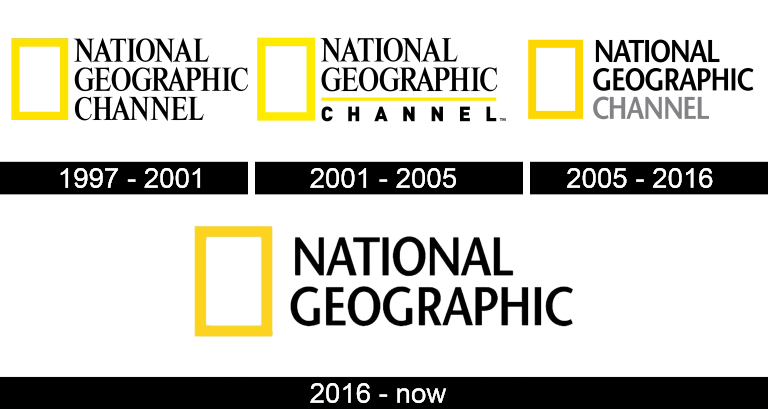
1997-2001: the first Channel logo
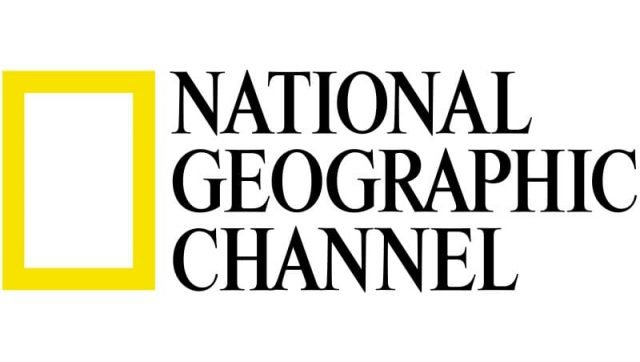
The earliest National Geographic Channel logo set a yellow rectangular frame to the left of a three-line wordmark reading “National Geographic Channel” in a serif typeface, a design built to read as editorial and authoritative.
2001-2005: a sans-serif update
Around the time of the US channel launch, the serif lettering was replaced with a cleaner sans-serif typeface, and the word “Channel” was set in gray rather than black, giving the mark a lighter, more contemporary feel as the brand expanded into American television.
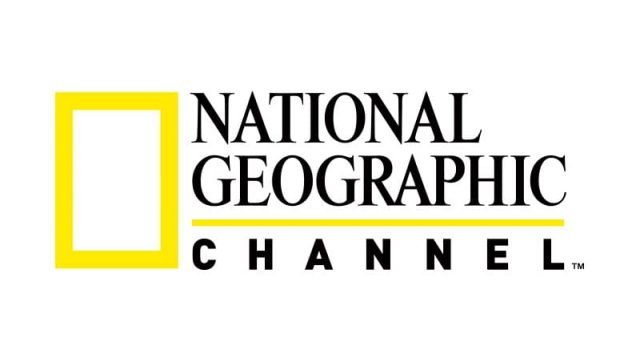
2005-2016: serif and sans-serif side by side
The 2005 version brought serif type back for “National Geographic” while keeping “Channel” in a bold sans-serif, with a thin yellow line separating the two. This combination lasted over a decade and became one of the most widely seen versions of the logo.
2016 to today: dropping “Channel”
On 14 November 2016 the network dropped “Channel” from its name, becoming simply “National Geographic,” and the logo moved fully to sans-serif lettering in black capitals next to the unchanged yellow rectangle. This is the version still used across the magazine, television, and digital platforms today.
Who owns National Geographic now?
The National Geographic Society ran the magazine alone until September 2015, when it moved publishing and media operations into National Geographic Partners, a joint venture that gave 21st Century Fox a 73% controlling stake for $725 million. Disney announced its acquisition of 21st Century Fox’s entertainment assets, including that stake, in December 2017, and the deal closed on 20 March 2019. National Geographic Partners is now split 73% to Disney and 27% to the nonprofit National Geographic Society, with Disney handling day-to-day operations.
Quick facts
| Magazine founded | 13 January 1888, Washington, D.C. |
| Yellow border introduced | February 1910 (magazine cover) |
| Channel launched internationally | 1 September 1997 (UK, Scandinavia, Australia) |
| Channel launched in the US | 7 January 2001, with Fox Cable Networks |
| “Channel” dropped from name | 14 November 2016 |
| Disney acquisition completed | 20 March 2019 |
| Current ownership | 73% Disney, 27% National Geographic Society |
Other media and broadcast logos: Disney, BBC, and CNN.