
MINI Logo History: Meaning, Symbolism & Brand Heritage
MINI is far more than a small car brand. Since its creation in the late 1950s, it has grown into a cultural symbol of smart design, efficiency, and individuality. Originally developed to answer Britain’s need for affordable, fuel-efficient vehicles, MINI quickly transcended its utilitarian roots and became a design icon. Its compact proportions, clever engineering, and unmistakable personality made it a favorite far beyond the United Kingdom.
Visual identity has always played a crucial role in shaping MINI’s global perception. From fragmented beginnings under different manufacturers to the refined and unified emblem introduced after its acquisition by BMW, the MINI logo history mirrors the brand’s evolution from necessity-driven engineering to lifestyle-oriented automotive design. Today, the MINI logo stands as a symbol of freedom, agility, and timeless British character.
Meaning and History of the MINI Logo
MINI was created in 1958 by Alec Issigonis for the British Motor Corporation, at a time when fuel shortages and economic pressures demanded smaller, more efficient cars. Early on, MINI vehicles were produced under different names and manufacturers, including Morris and Austin, which resulted in inconsistent branding and multiple visual identities.
For decades, MINI lacked a standardized logo. Only after BMW acquired the brand in 2000 did MINI receive a unified visual system. The modern emblem was designed to respect the brand’s heritage while aligning it with BMW’s premium automotive standards. As a result, the MINI logo meaning is deeply tied to motion, freedom, and intelligent simplicity.
MINI Logo Evolution Timeline
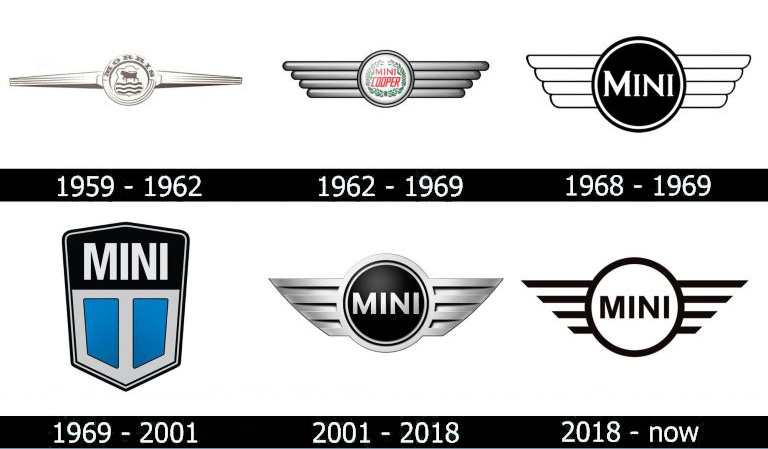
1958 – 1962: Fragmented Origins Under Morris and Austin
The earliest MINI cars were sold as the Morris Mini Minor and the Austin Seven. Each model carried its own logo, reflecting the identity of its manufacturer rather than a unified MINI brand.
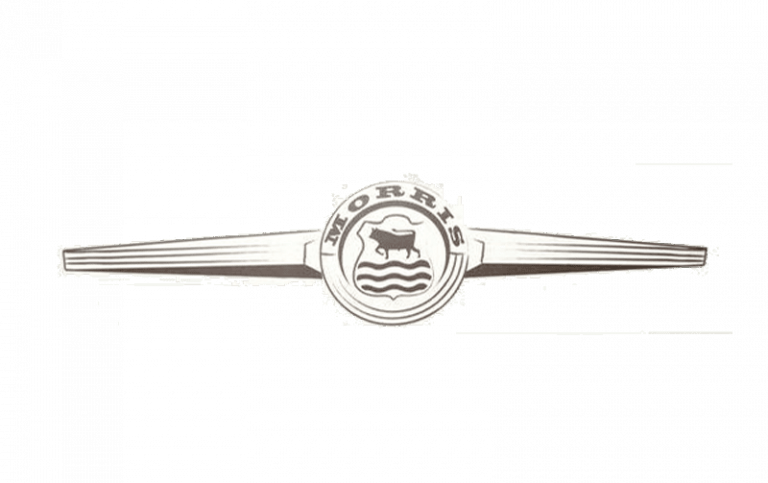
The Austin Seven badge featured a cursive handwritten wordmark topped with a traditional coat of arms, evoking British heritage and craftsmanship. The Morris Mini emblem, by contrast, consisted of a circular shape with arrows extending to both sides. This circular motif would later become the foundation of the modern MINI emblem, even though, at the time, there was no intention of creating a lasting brand symbol.
1962 – 1969: The Birth of the Winged Concept
In the early 1960s, John Cooper joined the project and introduced the iconic Mini Cooper. Alongside the performance upgrade came a more confident visual identity.
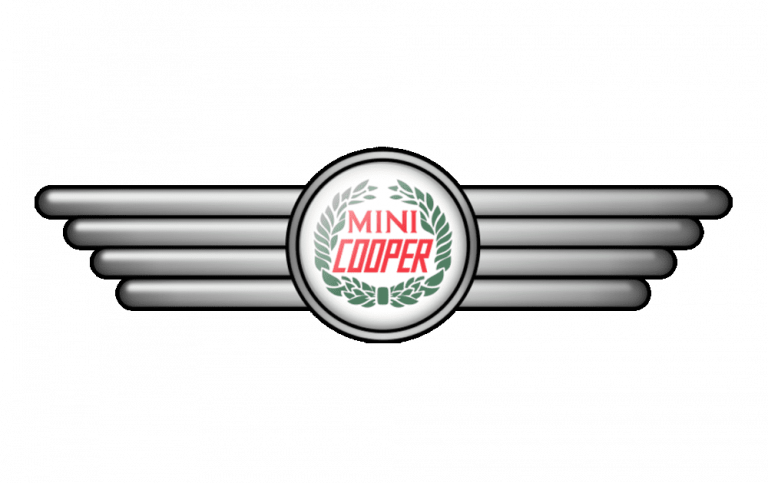
The 1962 logo introduced a circular badge with bold “Mini Cooper” lettering inside and wide, squared wings extending horizontally. This was the first time wings appeared in the brand’s visual language, symbolizing speed, agility, and racing spirit. This design laid the groundwork for the MINI logo heritage that would later be revived and refined.
1968 – 1969: Minimalism Takes Shape
By 1968, the MINI logo began to adopt a cleaner and more modern appearance. The emblem was simplified into a solid black circle outlined in black and white, with bold white “MINI” lettering inside. The first “M” was enlarged, giving the wordmark a distinctive rhythm.
The wings were reduced in size and rendered as outlined forms with white interiors. Typography shifted to a serif style with thick strokes and sharp, thin serifs, adding sophistication while preserving strength. This version marked MINI’s transition toward a more timeless and recognizable identity.
1969 – 2001: The Hexagonal Era Under Rover Group
After being acquired by the Rover Group, the brand officially adopted the name MINI in 1969. A completely new logo was introduced and remained in use for more than three decades.
This emblem featured a silver-framed hexagon divided into two sections. The upper half contained a black background with a bold white MINI wordmark, while the lower half was split into turquoise segments separated by a thick white vertical line. The symmetrical geometry and metallic frame gave the logo a modern, industrial feel that reflected the era’s design trends.
Although visually distinct, this logo moved away from the winged concept and focused more on abstract structure than motion.
2001 – 2018: BMW Revives the Winged Emblem
When BMW acquired MINI in 2000, the brand underwent a major transformation. The iconic winged logo returned in 2001, now executed with premium materials and three-dimensional depth.
The new emblem featured a black circular center outlined in silver, flanked by sharp metallic wings. The MINI wordmark was rendered in a clean sans-serif typeface, projecting confidence and precision. This redesign successfully combined heritage and modernity, aligning MINI with BMW’s design philosophy while preserving its playful spirit.
2018 – Today: Flat Design and Modern Heritage
In 2018, MINI refined its logo once again, embracing flat design principles. The three-dimensional effects were removed, and the palette was reduced to monochrome.
The wings became more angular and graphic, emphasizing clarity and boldness. The simplified two-dimensional emblem reflects digital adaptability while honoring the historic winged symbol. This current version reinforces MINI’s identity as a modern brand rooted in strong visual heritage.
MINI Logo Symbolism
The MINI logo symbolism is centered on freedom, motion, and individuality. The wings represent speed and independence, while the circle symbolizes unity, balance, and precision engineering.
Unlike aggressive automotive logos, MINI’s emblem feels friendly yet confident. It communicates movement without intimidation, reflecting the brand’s focus on driving pleasure rather than brute power. This symbolic balance is a key element of MINI logo meaning.
Typography and Color
Typography in the MINI logo has evolved from decorative serif styles to clean, modern sans-serif lettering. The current wordmark is simple, bold, and highly legible, reinforcing the brand’s focus on clarity and design efficiency.
Color has been intentionally restrained. While earlier versions explored red, turquoise, and metallic tones, the modern logo relies on black, white, and silver. This neutral palette enhances versatility and supports MINI’s positioning as both playful and premium.
MINI and the Endurance of Intelligent Design
The MINI logo history is a testament to the power of thoughtful evolution. From inconsistent early branding to one of the most recognizable automotive emblems in the world, MINI’s visual identity reflects its journey from practical necessity to design icon.
By embracing its winged heritage and refining it for modern audiences, MINI has created a logo that is both timeless and contemporary. Its logo heritage perfectly mirrors the brand itself: compact, clever, and unmistakably original.
MINI Logo FAQ
What does the MINI logo symbolize?
The logo symbolizes freedom, speed, and individuality through its winged design.
When was the MINI logo standardized?
The logo became standardized after BMW acquired MINI in 2000.
Why does the MINI logo have wings?
The wings represent motion, agility, and the joy of driving.
What colors are used in the MINI logo today?
The current logo uses a monochrome black-and-white palette.
Who owns the MINI brand now?
MINI is owned by BMW Group.