
H&M Logo History: Meaning, Symbolism & Brand Heritage
H&M is one of the most influential names in global fast fashion. Founded in Sweden in 1947, the brand grew from a single women’s clothing store into an international retail giant with thousands of locations across continents. Its promise has always been clear: fashion-forward design at accessible prices, available to people of all ages and backgrounds.
While H&M constantly refreshes its collections, collaborations, and store concepts, its visual identity has remained remarkably consistent. The bold red H&M logo is instantly recognizable worldwide and has become a symbol of affordable style. The H&M logo history is a story of restraint, confidence, and brand dominance, where simplicity evolved into one of the strongest examples of modern logo heritage.
Meaning and History of the H&M Logo
The origins of the H&M brand are deeply embedded in its name. The company was originally founded as Hennes, which means “Her” in Swedish, reflecting its early focus on women’s clothing. In 1968, Hennes merged with Mauritz Widforss, a retailer specializing in men’s apparel, transforming the brand into Hennes & Mauritz.
When the name was shortened to H&M later that same year, it became more than an abbreviation. It turned into a symbolic representation of women’s and men’s fashion united under one brand. The H&M logo meaning has always revolved around inclusivity, accessibility, and youthful energy, values that continue to define the brand’s global appeal.
H&M Logo Evolution Timeline
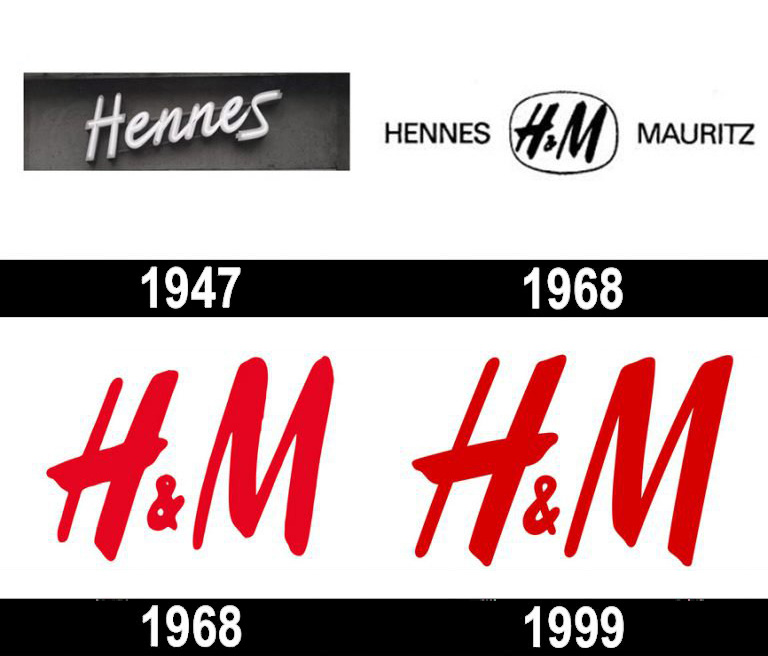
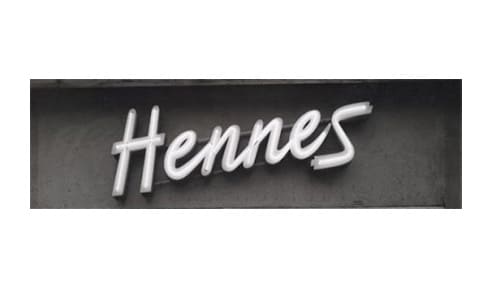
1947 – 1968: The Handwritten “Hennes” Era
The earliest logo in H&M logo history dates back to 1947, when the company operated under the name Hennes. The logo consisted of a single handwritten wordmark set in title case. Slightly diagonal and bold, the lettering felt personal, friendly, and confident.
Rendered in monochrome, this logo reflected the modest beginnings of the brand and its close connection to everyday consumers. Its informal character helped establish trust and accessibility during H&M’s formative years.
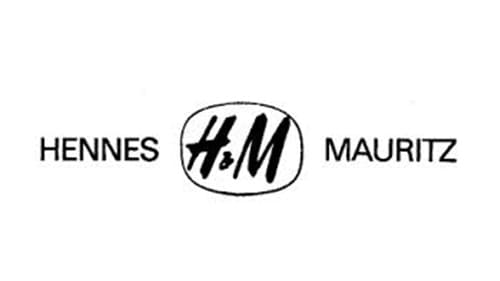
1968: Transition to Hennes & Mauritz
In 1968, following the merger with Mauritz Widforss, the brand briefly adopted a more complex logo. The new identity featured a traditional sans-serif nameplate, with “Hennes” and “Mauritz” separated by an “H&M” monogram enclosed in a rounded frame.
The monogram reused the handwritten style of the earlier logo but with refined contours. This transitional design lasted only a short time, as the company quickly recognized the strength of the shortened H&M name.
1968 – 1999: The Birth of the Iconic H&M Monogram
Later in 1968, the brand introduced what would become its most iconic logo. The new H&M mark consisted solely of two bold, handwritten capital letters, “H” and “M,” connected by a small ampersand.
Rendered in bright red, the logo felt energetic, youthful, and expressive. The smooth, flowing strokes gave it a welcoming character, while the vivid color ensured instant visibility. This version became a cornerstone of H&M logo heritage and remained virtually unchanged for more than three decades.
1999 – Today: Refinement Without Reinvention
In 1999, H&M refined its logo rather than reinventing it. The red color was slightly darkened, giving the brand a more mature and confident appearance. The letter contours were cleaned up and straightened, making the logo sharper and more professional.
Despite these refinements, the overall structure remained untouched. This continuity reinforced brand recognition and proved that a strong logo does not require constant redesign. The current H&M logo stands as a textbook example of timeless logo heritage in fast fashion.
H&M Logo Symbolism
The symbolism of the H&M logo lies in its simplicity. There are no icons, patterns, or decorative elements, only letters. The ampersand connects two worlds: women’s and men’s fashion, individuality and inclusivity, affordability and trend awareness.
While often criticized for being too minimal, the H&M logo demonstrates how brand strength can elevate simplicity into symbolism. Its logo meaning comes not from visual metaphors, but from decades of cultural presence and consumer trust.
Typography and Color
Typography is the foundation of the H&M visual identity. The logo uses a custom italic, handwritten-style typeface that conveys movement and spontaneity. One of its defining features is the unusually wide horizontal bar of the “H,” which adds distinctiveness and balance to the composition.
Color plays an equally critical role. The bright red palette represents passion, youthfulness, and energy. It ensures visibility in crowded retail environments and reinforces H&M’s positioning as a vibrant, trend-driven brand. Few fashion logos rely so heavily on a single color, and even fewer succeed as convincingly.
H&M and the Strength of Minimalist Logo Heritage
The H&M logo history proves that consistency can be more powerful than complexity. By committing to a single visual idea and refining it carefully over time, H&M created one of the most recognizable logos in modern retail.
Its logo heritage reflects the brand’s confidence, accessibility, and global reach. In an industry defined by constant change, H&M’s visual identity stands as a reminder that simplicity, when supported by strong brand values, can become iconic.
H&M Logo FAQ
What does the H&M logo stand for?
The H&M logo stands for Hennes & Mauritz, representing women’s and men’s fashion combined.
Why is the H&M logo red?
Red symbolizes energy, youth, passion, and visibility, aligning with H&M’s fast fashion identity.
Has the H&M logo changed much over time?
No, the logo has remained largely consistent since 1968, with only minor refinements.
What font is used in the H&M logo?
H&M uses a custom handwritten-style italic typeface created specifically for the brand.
Why is the H&M logo so simple?
The simplicity reflects brand confidence and ensures instant recognition worldwide.