Taco Bell Logo History: Meaning, Symbolism & Brand Heritage

Taco Bell has always occupied a unique position in the fast-food landscape. Known for its unconventional menu ideas, playful marketing, and bold interior designs, the brand has never been afraid to experiment. Yet, when it comes to its visual identity, Taco Bell has followed a surprisingly disciplined and consistent path. While menus, locations, and campaigns have evolved dramatically, the logo has remained remarkably stable, allowing the brand to build one of the most recognizable symbols in the global restaurant industry.
At the heart of Taco Bell’s logo history lies a single, enduring element: the bell. Even people who have never eaten at Taco Bell instantly recognize the symbol. This longevity is no accident. It is the result of careful evolution, where modernization never erased familiarity. Taco Bell’s logo heritage demonstrates how a strong central symbol can anchor a brand through decades of cultural and visual change.
Meaning and History of the Taco Bell Logo
Taco Bell was founded in 1962 in the United States, but interestingly, the bell itself did not appear in the logo for more than twenty years. Early branding focused primarily on typography, reflecting the design sensibilities of the time rather than building a distinct visual symbol.
The introduction of the bell in the mid-1980s marked a turning point. It transformed Taco Bell from a name into an instantly identifiable brand. From that moment forward, the logo meaning became inseparable from the bell symbol, which functioned as both a literal reference to the company’s name and a visual call to action. Over time, Taco Bell refined its logo to stay contemporary, but it never abandoned the bell, solidifying its place in the brand’s logo heritage.
Taco Bell Logo Evolution Timeline
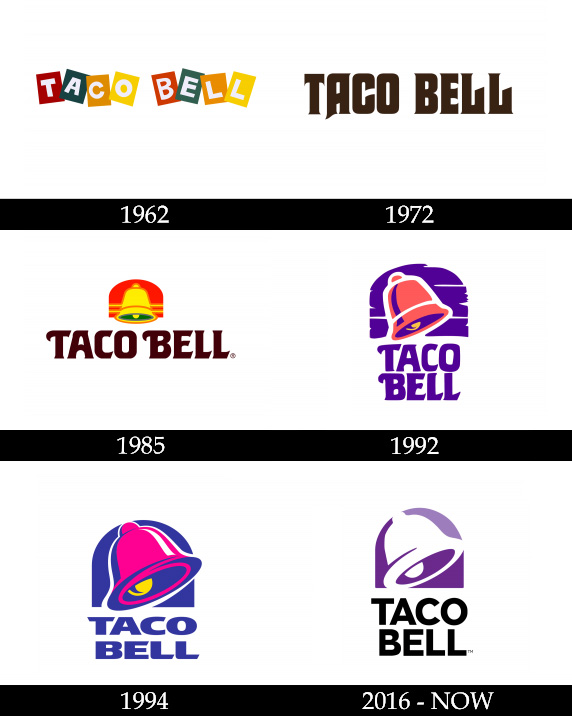
1962 – 1972: Colorful Blocks and Early Experimentation
The earliest Taco Bell logo reflected a cheerful, almost playful approach to branding. Introduced in the early 1970s, this design featured a composition of colorful squares, each tilted at different angles and containing white sans-serif lettering. Shades of burgundy, green, yellow, and orange dominated the palette, symbolizing energy, passion, and the variety of ingredients offered by the restaurant.
This logo emphasized vibrancy and fun rather than cohesion, serving as an exploratory phase in Taco Bell logo history. While visually engaging, it lacked a unifying symbol that could anchor long-term recognition.

1972 – 1985: A Clean Wordmark Without Symbolism
In 1972, Taco Bell shifted toward a more restrained and mature identity. The logo became a monochrome wordmark set in a custom all-caps typeface with elongated strokes, diagonal cuts, and subtle sharp serifs. This design introduced elegance and modernity but removed all graphical elements.
Although clean and professional, this phase lacked a visual hook. The absence of a symbol meant the brand was recognizable primarily through its name, setting the stage for the transformational redesign that followed.

1985 – 1994: The Arrival of the Bell Icon
The year 1985 marked a defining moment in Taco Bell logo history. For the first time, the bell appeared as a central visual element. Rendered in red, yellow, and green, the bell sat above a bold black wordmark written in a decorative custom typeface with elongated initial letters and sharp diagonal cuts.
This design gave Taco Bell a clear visual identity. The bell was no longer just implied by the name; it became the brand’s most powerful symbol, instantly recognizable and emotionally engaging.

1992 – 1994: A Secondary Logo That Redefined the Palette
In 1992, Taco Bell introduced a secondary logo that would later influence its long-term visual direction. The bell was enlarged and colored pink, placed against a purple background formed by a curved, abstract shape with white accent lines.
The wordmark appeared beneath the emblem in purple, arranged across two lines. This version leaned heavily into playfulness and youth culture, aligning with the brand’s evolving audience and setting the foundation for future color choices.
1994 – 2016: Refinement and Long-Term Consistency
The 1994 redesign refined the previous concept and became one of the longest-lasting versions in Taco Bell’s logo heritage. The pink and purple palette was intensified, contours were smoothed, and the typography was updated to a thick, bold, all-caps style with angled cuts.
This logo balanced edginess with clarity and remained in use for more than two decades. For many consumers, this version remains the definitive Taco Bell logo, deeply embedded in cultural memory.
2016 – Today: Minimalism and Modern Confidence
In 2016, Taco Bell introduced a cleaner, more minimalist logo. The color palette was simplified to purple, white, and black. The bell became more abstract and streamlined, placed above a black wordmark set in a neat, modern sans-serif typeface.
This update reflected digital-first design principles while preserving the iconic bell. The result is a logo that feels contemporary yet unmistakably Taco Bell, reinforcing continuity within the brand’s logo history.
Taco Bell Logo Symbolism
The symbolism of the Taco Bell logo is direct and effective. The bell serves as a literal representation of the brand’s name and functions as a visual signal, much like a bell calling attention or inviting people in.
Over time, the bell evolved from a decorative element into a simplified icon, but its meaning remained constant. Some viewers interpret the lower contours of the emblem as resembling a stove damper or architectural shape, but at its core, the symbol remains unmistakably a bell. This clarity is a key reason the logo has endured as a cornerstone of Taco Bell’s logo heritage.
Typography and Color
Typography in the Taco Bell logo has evolved alongside design trends while maintaining boldness and legibility. Earlier custom typefaces featured decorative cuts and elongated strokes, while the current wordmark uses a clean, all-caps sans-serif typeface with traditional proportions and modern restraint.
Color has played an equally important role. Purple became the brand’s signature color in the 1990s, signaling creativity, individuality, and boldness. In the current logo, purple is paired with white and black, creating a balanced palette that feels confident and contemporary without overwhelming the design.
Taco Bell and the Strength of Symbol-Driven Logo Heritage
The Taco Bell logo history is a powerful example of how consistency can coexist with evolution. While the brand has reinvented its menu, marketing, and customer experience, its logo has remained anchored by a single enduring symbol.
By refining rather than replacing the bell, Taco Bell built a logo heritage rooted in recognition and trust. Its visual identity proves that when a symbol is strong enough, it can carry a brand across generations without losing relevance.
Taco Bell Logo FAQ
What does the Taco Bell logo represent?
The Taco Bell logo represents the brand’s name and identity through the bell symbol, which serves as a visual call to attention and recognition.
When did the bell first appear in the Taco Bell logo?
The bell was first introduced in the Taco Bell logo in 1985.
Why is purple used in the Taco Bell logo?
Purple represents creativity, individuality, and boldness, aligning with Taco Bell’s playful and unconventional brand personality.
How many times has the Taco Bell logo been redesigned?
The Taco Bell logo has gone through several refinements since the 1960s, with major redesigns occurring in 1972, 1985, 1994, and 2016.
Has the bell always been part of the Taco Bell logo?
No, the bell was not part of the original logo and only became a central element more than two decades after the brand was founded.