Lexus Logo: The L in an Oval
Lexus is Toyota’s luxury vehicle division, launched in the United States in September 1989 with a single car: the LS 400. The brand grew out of a secret Toyota program and, within two years of launch, was already outselling established European luxury marques in the US market. Today Lexus sells vehicles in more than 90 countries and territories and fields a lineup of sedans, coupes, and crossover SUVs built around hybrid and electrified powertrains.
Origins: Project F1 and the Birth of Lexus
Lexus traces back to August 1983, when Toyota chairman Eiji Toyoda challenged his engineers to build “the best car in the world,” with no fixed budget and no deadline. The resulting program was known internally as the F1 project (also referred to as the “Circle-F” project) and was led by chief engineer Ichiro Suzuki. The F1 team built roughly 450 complete prototype vehicles and about 900 prototype engines, and logged around 2.7 million kilometers of testing on the way to a finished car. The design was frozen in May 1987 after a development budget reported to exceed $1 billion, and production of the resulting sedan began on May 15, 1989, at Toyota’s Tahara plant in Japan.
The car to come out of this program, the LS 400, debuted publicly at the North American International Auto Show in Detroit in January 1989, shown as a 1990 model. That Detroit unveiling is often conflated with the brand’s actual retail debut, but the two are several months apart: Lexus dealerships did not open for business, and the LS 400 did not go on sale to US customers, until September 1, 1989, at a base price of about $35,000, through a new network of 81 dealers.
The 1989 Recall That Shaped Lexus’s Reputation
Three months after launch, Lexus faced an early test. In December 1989, acting on only a handful of customer complaints, about defective wiring linked to an overheating third brake light, along with isolated reports of a sticking cruise-control switch and weak battery connections, Lexus issued a voluntary recall covering all 8,000 LS 400s sold in the US up to that point. Rather than asking owners to bring cars into a dealership, Lexus and its dealers arranged to collect each car, repair it, wash it, and return it, often providing a loaner in the meantime, with the entire campaign completed within about three to four weeks. In at least one documented case, a dealer outside Detroit flew technicians out and rented garage space to service owners 150 miles away rather than make them travel.
Lexus US general manager Dave Illingworth later said the company treated the recall as an opportunity to build customer loyalty from day one rather than a problem to minimize. The episode did not slow the new brand down: by July 1990, Lexus had briefly overtaken both Mercedes-Benz and BMW in US sales, though Mercedes retook the lead the following month. The recall is still frequently cited in the auto industry as an early example of a company using a product problem to build trust rather than lose it.
Overtaking the Established Luxury Brands
Lexus’s rise in the US market happened quickly. By the end of 1991, its second full year of sales, Lexus had moved ahead of both BMW and Mercedes-Benz in US unit sales, becoming the top-selling imported luxury car brand in the country with 71,206 vehicles sold that year. Both German brands saw sharp sales declines after the LS 400 launched, with BMW’s US sales falling roughly 29 percent and Mercedes-Benz’s falling roughly 19 percent in the surrounding period. By 2000, Lexus had become the best-selling luxury vehicle brand in the United States outright, a position it held for ten consecutive years until BMW reclaimed the top spot in 2011, followed shortly after by Mercedes-Benz.
Logo Design: The Emblem and the 1989 Wordmark
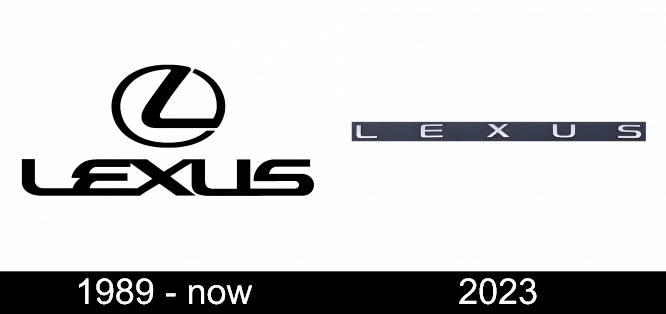
Lexus’s emblem, an oval enclosing a stylized letter L, was designed in 1988 ahead of the brand’s launch, and paired the following year with a heavy, widely spaced uppercase “LEXUS” wordmark to form the logo used at launch in 1989. That combination of oval emblem and bold wordmark remained the brand’s primary visual identifier for more than three decades.
1989-Present: The Launch Identity
The emblem and wordmark introduced for the LS 400’s 1989 launch carried the brand through its rise past BMW and Mercedes-Benz in the early 1990s, its decade-long run atop the US luxury sales charts starting in 2000, and its expansion into SUVs, hybrids, and a dedicated performance “F” line of vehicles. It remains in use on most Lexus vehicles today, unchanged in its core proportions since 1989.
2023: A New Wordmark
In 2023, Lexus introduced its first logo update since 1989: a new standalone typographic wordmark using custom, widely spaced sans-serif capital letters. The oval L emblem itself was not changed or retired. Lexus had already begun phasing the plain “LEXUS” lettering onto the rear of vehicles in place of the emblem starting with the 2022 NX, a shift the brand’s global head of marketing, Brian Bolain, described as a signal that “change is coming to Lexus,” tied to the brand’s move toward electrified and battery-electric models. The 2023 wordmark update extended that same lettering-first approach into Lexus’s broader brand identity, giving the company a typographic mark it could use independently of the oval emblem across digital and marketing contexts.
Lexus Today
Lexus now sells vehicles in more than 90 countries and territories, with regional operations including centers in Plano, Texas, and Brussels, Belgium. The current lineup spans sedans and coupes, including the ES, IS, LS, LC, and RC, alongside a crossover and SUV range that includes the LBX, UX, NX, RZ, RX, TX, GX, and LX. Hybrid powertrains are now standard or available across most of the lineup, and the RZ is Lexus’s first dedicated battery-electric model. The LBX, launched in 2023, was the brand’s first entry into the B-segment, aimed at smaller global markets.
Quick Facts
| Parent company | Toyota Motor Corporation |
| Internal development project | “F1” (also called “Circle-F”), started August 1983 |
| First model | LS 400 |
| Public debut | January 1989, North American International Auto Show, Detroit |
| US retail launch | September 1, 1989, through 81 dealers |
| Emblem designed | 1988 (oval with stylized “L”) |
| Launch logo (emblem + wordmark) | 1989 |
| Major logo update | 2023 (new standalone typographic wordmark; emblem unchanged) |
| Markets served | 90+ countries and territories |
FAQ
When was Lexus actually launched?
Lexus was unveiled publicly in January 1989 at the Detroit auto show, but US retail sales did not begin until September 1, 1989.
What was the Lexus “F1” project?
F1 was Toyota’s internal codename for the secret program, started in August 1983, that developed the LS 400 and launched the Lexus brand.
Why is the 1989 LS 400 recall considered important to Lexus’s history?
In December 1989, Lexus voluntarily recalled all 8,000 LS 400s sold at that point over minor wiring and brake light issues, picked up and repaired the cars at no cost within weeks, and used the episode to build an early reputation for customer service rather than damage its new brand.
Did Lexus really overtake BMW and Mercedes-Benz in US sales?
Yes. By the end of 1991, Lexus had passed both brands to become the top-selling imported luxury car brand in the US, and by 2000 it had become the best-selling luxury brand overall, a title it held until 2011.
Did the Lexus logo change in 2023?
Yes. In 2023 Lexus introduced a new standalone typographic wordmark in a custom sans-serif capital letter style. The oval L emblem used since 1988 was not replaced.