
Acer Logo History: Meaning, Symbolism & Brand Heritage

Acer stands today as one of the most influential technology brands in the world, a company whose trajectory mirrors the evolution of the global electronics industry itself. Founded in 1976 in Taiwan by Stan Shih, his wife Carolyn Yeh, and their partners, the company began under the name Multitech and grew steadily in an era when personal computing was still in its infancy. Over the decades, Acer has transformed from a small contract manufacturer into a global innovator, shaping markets in personal computers, monitors, gaming systems, virtual reality devices, and enterprise hardware.
The essence of Acer’s corporate philosophy—captured in the long-standing slogan “explore beyond limits”—extends naturally into its visual identity. Each stage of the brand’s evolution reflects shifts in technological culture, industrial design, and corporate ambition. The Acer logo is more than a typographic mark; it is a timeline that charts the company’s transformation, revealing how a single brand has adapted to new demands in engineering, mobility, and digital lifestyle.
This article examines the complete logo history of Acer, the symbolism behind its changing forms, and the heritage that shaped one of the world’s most recognizable technology identities.
Meaning and Symbolism of the Acer Logo
Throughout its history, Acer has favored visual identities that project clarity, precision, and forward movement. Whether through hexagonal modularity or streamlined lowercase typography, the brand’s emblem consistently expresses ideas of versatility, innovation, and technological momentum.
The modern Acer wordmark, with its slanted curvature and bright green palette, represents motion, clarity, and sustainable progress. It is a logo designed to feel contemporary without unnecessary ornamentation—an aesthetic mirrored in the company’s approach to product design.
Green serves as a visual theme woven across multiple decades. Combining the energy of yellow and the calm of blue, the color signifies freshness, originality, and the balance between performance and environmental responsibility. It conveys both dynamism and stability, aligning with Acer’s identity as a tech company committed to pushing boundaries while remaining accessible to a global consumer market.
Brand Heritage: From Multitech to a Worldwide Technology Leader
Acer’s early years provide important context for understanding the brand’s visual evolution. Under the name Multitech, the company established itself not only as a manufacturer but as an engineering-driven organization focused on versatility. Originally producing a variety of electronic components and early microprocessor systems, Multitech positioned itself as a pioneer within Taiwan’s fast-growing tech landscape.
The company formally adopted the name Acer in 1987—a Latin-derived term meaning “sharp,” “skilled,” or “able.” This linguistic shift captured the brand’s transition into a more international role, with a name that could resonate globally and symbolize precision and excellence.
By the 1990s and early 2000s, Acer grew into a significant global force, acquiring key PC brands and entering markets previously dominated by American and Japanese manufacturers. The company became known for its aggressive pricing strategy, wide distribution channels, and ability to innovate rapidly. Parallel to this acceleration, Acer adopted visual identities that communicated agility and modernity.
Today, Acer’s global presence spans laptops, gaming (Predator), displays, servers, VR devices, cloud services, and education technology—each division connected to the central brand identity shaped over nearly five decades.
Acer Logo History and Evolution Timeline
1976 – 1983: Multitech’s Modular Identity
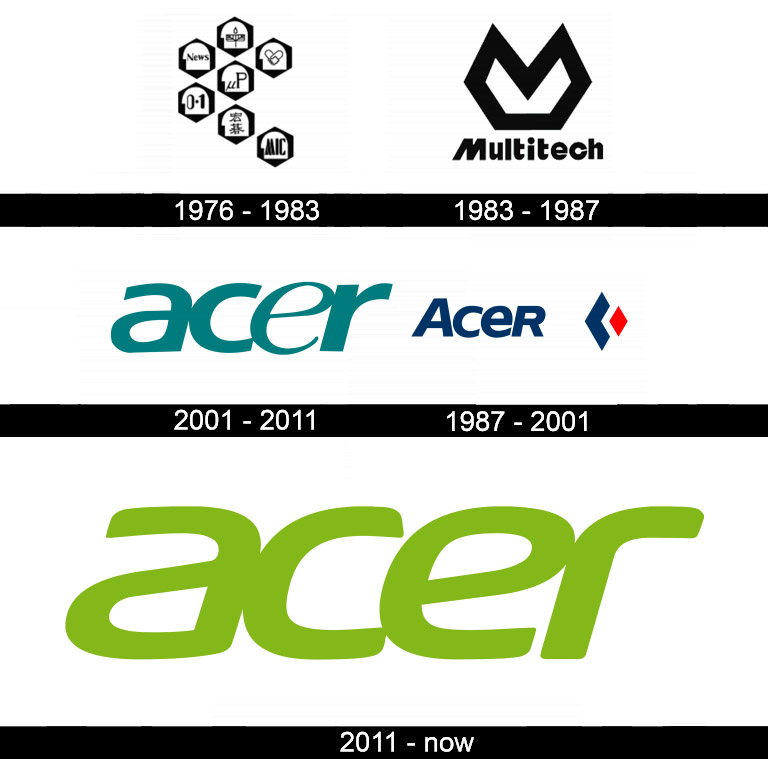
The original Multitech logo was a structured and technical emblem composed of seven black hexagons, each containing a different symbol. This configuration suggested modularity and wide-ranging capabilities, highlighting the company’s early focus on multitasking systems and diverse technological functions. The monochrome approach emphasized engineering seriousness and professionalism.

1983 – 1987: A Futuristic Shift in Form and Color
The 1983 redesign brought a more modern vision. Multitech adopted a blue and white palette, introducing a bold sans-serif wordmark paired with a geometric icon resembling a stylized heart. This emblem symbolized innovation and a strong, cohesive identity. The softened yet angular typography showed a company positioned at the edge of the emerging personal computing revolution.

1987 – 2001: Rebirth as Acer and the Era of Symbolic Geometry
With the introduction of the Acer name in 1987, the brand embraced a distinctly modern look. The wordmark was italicized and bold, signaling movement and ambition. Accompanying the text was a geometric symbol: an arrow-like form on the left and a rhombus on the right. This combination suggested direction, precision, and performance. The color palette included purple and burgundy—unusual choices at the time—signaling differentiation in a rapidly expanding PC market.
2001 – 2011: A Modern, Friendly Identity in Green
The 2001 redesign shifted Acer into a new visual era, introducing the now-famous lowercase logotype in green. This version had smoother contours, rounded edges, and a thinner, elegant “e” that injected personality into the design. The logo presented Acer as approachable, contemporary, and user-oriented—qualities aligned with the mass adoption of personal computing.

2011 – Today: A Stronger, Brighter Expression of Innovation
The most recent redesign retains the lowercase approach but introduces a more confident and contemporary typeface. The forms are thicker, the curves more assertive, and the slant slightly more pronounced. The shift to a lighter, brighter green reinforces Acer’s focus on energy, creativity, and modern digital lifestyles.
The result is a logo that balances familiarity with progress—a clean, futuristic expression of the brand’s ongoing evolution.
Typography and Color
Acer’s typography has always leaned toward geometric sans-serif forms, designed for clarity across screens, packaging, and hardware surfaces. The modern typeface maintains rounded corners and fluid curves, optimizing readability and conveying a sense of friendly reliability.
Color remains one of the defining features of Acer’s identity. The vivid green signifies innovation, freshness, and environmental awareness, supporting the company’s brand message as it expands into sustainable technologies, ultra-efficient hardware, and forward-looking computing solutions.
The Legacy and Identity of the Acer Logo
The Acer logo embodies the company’s journey from a small Taiwanese electronics firm to a global technology innovator. Each redesign reflects a new chapter in the evolution of consumer technology—moving from modular engineering to streamlined digital lifestyles.
Minimal, dynamic, and instantly recognizable, the modern Acer logo expresses both confidence and accessibility. Its bright green color speaks to the brand’s vitality, while its smooth, slanted forms symbolize motion and creativity. More than a visual mark, the logo encapsulates Acer’s long-standing mission to empower users and inspire progress across all digital experiences.
FAQ: Acer Logo, History and Symbolism
What does the Acer logo represent?
The Acer logo represents innovation, energy, and forward momentum. Its slanted, rounded typography suggests movement, while the green color symbolizes freshness, creativity, and modern technological progress.
Why is the Acer logo green?
Green reflects a blend of energy and calmness, capturing Acer’s balance between high performance and user-friendly design. It also reinforces the company’s commitment to originality and forward-thinking solutions.
How has the Acer logo changed over time?
The logo evolved from the complex, modular Multitech designs to a streamlined lowercase wordmark. Each redesign emphasized increased simplicity, approachability, and global appeal.
When did Acer adopt its current name?
The company changed its name from Multitech to Acer in 1987, marking its transition into an international brand.
What industries does Acer operate in today?
Acer works across multiple sectors including personal computing, gaming, monitors, enterprise servers, cloud solutions, education technology, and virtual reality hardware.