MoneyGram Logo History: Meaning, Symbolism & Brand Heritage

The MoneyGram logo has long represented a promise of speed, reliability, and global connectivity. Built around the idea of making money transfers accessible to everyone, the emblem conveys the brand’s mission: to move funds quickly and safely across borders, regardless of distance or local banking limitations. As one of the world’s most recognized remittance companies, MoneyGram’s identity has evolved in step with its technological advancements and its expanding international reach. Each chapter in its logo history reflects a new stage in the company’s ambition to become a universal bridge between people.
MoneyGram Brand Overview
MoneyGram’s origins date back to 1940, when Travelers Express was founded in Minneapolis. In the early decades, the company focused on money orders and domestic transfer solutions, establishing itself as a reliable partner for individuals and businesses. A strategic collaboration with the Greyhound bus network during the 1960s dramatically expanded its national footprint, embedding the brand into everyday financial routines across the United States.
A new era began in 1980, when a change in ownership led to system upgrades and a broader range of financial services. By 1988, the company stepped confidently into international markets, forming alliances with global banks and laying the foundation for a worldwide remittance network.
In 1998, Travelers Express merged with MoneyGram Payment Systems, creating a unified brand under the MoneyGram name. The early 2000s saw a significant digital transformation, as the company implemented online transfers and modernized backend processes. By 2004, MoneyGram became an independent publicly traded entity, and expansion across Asia and Africa followed shortly after, driven by increasing global demand for secure P2P payments.
The aftermath of the financial crisis prompted internal restructuring and improvements to risk management frameworks. Between 2012 and 2013, mobile transfer capabilities were introduced, reflecting the rise of fintech and shifting customer behavior. Innovation continued with the integration of blockchain technology through its collaboration with Ripple in 2017 and 2018. A major milestone occurred in 2021 when Madison Dearborn Partners acquired MoneyGram, enabling new investment and strategic direction. From 2023 to 2024, the brand strengthened both its digital platforms and its physical presence in international markets, maintaining its role as a lifeline for millions worldwide.
What MoneyGram Represents
MoneyGram is one of the world’s leading providers of person-to-person payments and cross-border transfers. Operating in over 200 countries and territories, it serves a diverse global community, including migrant workers supporting families, individuals without access to traditional banking, and consumers who depend on fast, secure financial connectivity. Its omnichannel structure—combining mobile apps, online services, retail locations, post offices, and corner stores—ensures accessibility regardless of location or income level.
This dual identity, both digital and physical, plays a defining role in the evolution of its logo heritage.
Meaning and History of the MoneyGram Logo
1940 – 1997: The Travelers Express Foundation
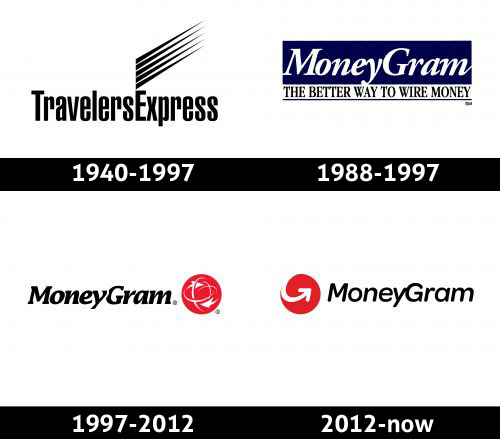
The earliest chapter of MoneyGram’s visual identity began with Travelers Express, whose 1940 logo laid the groundwork for the brand’s future symbolism. The design featured sharp, rising rays positioned above the letter “E,” forming the stylized image of a flag. This upward motion visually expressed the idea of speed, momentum, and direction—an early acknowledgment of the brand’s commitment to efficient transfers.
Black stripes resembling opposing arrows reinforced the concept of movement, exchange, and the flow of money. The typography was rigid and disciplined, with capital letters separating key words, creating a sense of order and operational reliability. This initial identity perfectly matched the company’s early positioning as a structured, trustworthy financial service provider.

1988 – 1997: The Blue Flag Era
The transition to a new visual identity in 1988 corresponded with the company’s growing international ambitions. The new emblem resembled a flag-shaped rectangle, a symbol of stability and institutional strength. The MoneyGram name appeared in a flowing white script atop a blue background, accompanied by a reassuring slogan that reinforced service quality.
By echoing the appearance of a bank card—particularly through the use of a white stripe suggestive of a magnetic strip—the logo emphasized technological reliability and secure processing. The blue color highlighted modernity and trust, signaling the company’s evolution toward digital financial services.

1997 – 2012: The Global Red Sphere
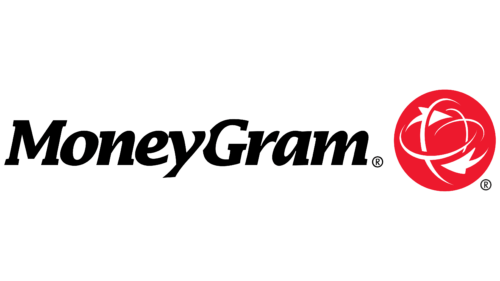
As MoneyGram Payment Systems expanded into more than 100 countries, the logo embraced a new, unmistakably global visual language. A bright red sphere became the centerpiece of the identity, symbolizing worldwide reach and continuous motion. Inside the circular frame, swirling patterns suggested rapid circulation, echoing the flow of money across borders.
The wordmark, italicized and positioned boldly to the left, reinforced a sense of momentum and strategic growth. The red palette, vibrant and urgent, underscored the brand’s rapid rise in the remittance industry and its reputation as a fast, dynamic transfer network.
2012 – Present: The Modern Arrow
The current MoneyGram logo marks a decisive shift toward a cleaner, more digital-friendly aesthetic. The iconic red sphere remains, but the internal swirls have been replaced by a strong, minimalist white arrow that curves upward. This arrow captures the essence of progress, acceleration, and connectivity, reflecting the company’s transformation into a technologically advanced global platform.
The wordmark to the right features thin, rounded letters in a contemporary style that communicates ease, accessibility, and user-friendliness. The balance between the spherical emblem and the light typography creates a harmonious identity suited for mobile apps, websites, and modern digital environments.
The Enduring Legacy of the MoneyGram Logo
The evolution of the MoneyGram logo mirrors the company’s journey from a domestic money-order provider to a globally recognized fintech leader. Each redesign represents a shift in vision—first toward nationwide reliability, then international expansion, and finally global digital relevance. Through every transformation, the logo has remained anchored in the themes of speed, connection, and trust. Today, the red sphere and upward arrow stand as a universal symbol of financial empowerment, bridging distances and enabling millions to stay connected across continents.
MoneyGram Logo FAQ
What does the MoneyGram logo symbolize?
The red sphere represents global reach, while the white upward arrow signifies speed, progress, and constant movement—core attributes of MoneyGram’s services.
Why is the MoneyGram logo red?
Red conveys energy, urgency, and action, capturing the immediacy and dynamic nature of money transfers.
When was the modern MoneyGram logo introduced?
The current design was launched in 2012, marking a clean, modern shift suitable for digital platforms.
How has the MoneyGram logo changed over time?
It transitioned from structured black typography to a blue flag motif, then to a global red sphere, and finally to a digital-ready symbol defined by an arrow.
What does the arrow inside the logo represent?
The arrow signifies upward movement and efficiency, suggesting fast, seamless transfers across borders.