
Carlsberg Logo History: Meaning, Symbolism & Brand Heritage
Carlsberg stands among the most respected names in the global brewing industry, a brand whose identity has expanded far beyond its Copenhagen origins. Founded in 1847 by J.C. Jacobsen, Carlsberg quickly became known not only for the quality of its beer, but also for its scientific contributions to modern brewing. The company funded laboratories, pioneered advances in yeast cultivation, and transformed brewing into a discipline defined by precision. Today, Carlsberg operates on nearly every continent, maintaining its position as a leader in innovation while honoring traditions refined over more than 175 years.
Throughout this journey, the Carlsberg logo has remained a vital part of the brand’s cultural and commercial identity. Its distinctive script, crowned insignia, and deep green palette form one of the most recognizable visual signatures in the beverage industry. The story behind that logo — and its evolution — mirrors the brand’s evolution itself: steeped in heritage, shaped by craftsmanship, and refreshed through careful refinement rather than radical reinvention.
Carlsberg Meaning and Symbolism
The Carlsberg logo is rooted in Danish craftsmanship, national pride, and deep respect for tradition. The iconic wordmark was designed in 1904 by Thorvald Bindesbøl, one of Denmark’s most influential industrial designers, who combined flowing organic curves with subtle asymmetry to create a vibrant, almost living script. The lettering preserved the artist’s hand-drawn style, a decision that gave the brand an immediate sense of warmth and authenticity.
The crown, added above the wordmark, signifies the brewery’s appointment as official supplier to the Royal Danish Court — a distinction that elevated Carlsberg’s perception in Denmark and abroad. The stylized hop leaf, placed above the “R,” pays homage to the ingredients at the heart of brewing craftsmanship. Together, these elements communicate heritage, mastery, and trustworthiness.
Carlsberg’s color palette plays an equally important symbolic role. Deep green represents freshness and natural purity, while white offers clarity and balance. Gold and red — used in the crown — evoke excellence, prestige, and a proud connection to the monarchy. The brand’s palette remains one of the most consistent and instantly recognizable in the beer world.
Carlsberg Logo History & Evolution Timeline
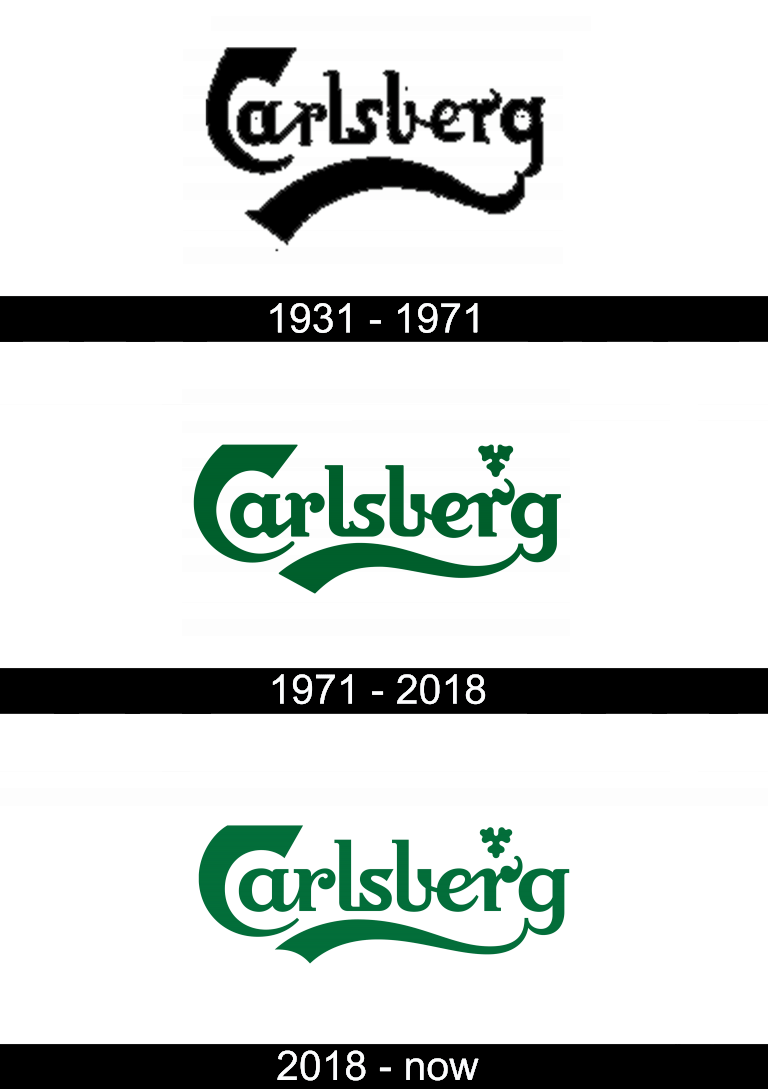
1931 – 1971: The First Modern Script
The logo introduced in the early 1930s established the foundation of the Carlsberg identity as we know it today. Although drawn in black rather than green, the wordmark revealed the distinct cursive form, elongated tails, and sweeping underline that would become synonymous with the brand. This version balanced boldness with elegance, cementing Carlsberg’s new visual language well into the mid-20th century.

1971 – 2018: The Green Icon Takes Shape
After decades of internal use, Bindesbøl’s 1904 hand-drawn script finally became the brand’s official global logo in 1971. Rendered in a deep forest green, the inscription was paired with the hop-leaf emblem above the “R,” reinforcing the brand’s connection to agriculture and brewing craftsmanship. This iteration established the Carlsberg look that dominated global packaging, advertising, and signage for nearly fifty years. When reversed to white on green, the logo took on an icy, refreshing quality ideal for premium beer marketing.
2018 – Today: A Contemporary Refinement
The 2018 redesign aimed not to replace tradition, but to refine it. The wordmark became lighter and more contemporary, with smoother curves, thinner lines, and improved balance. The hop-like flourish atop the “R” became more leaf-like, creating harmony between natural symbolism and modern clarity. The green hue also shifted to a brighter, fresher tone, strengthening shelf visibility and conveying vitality. The result is a logo that respects its heritage while evolving for a digital-first, global market.
Design Analysis
The Carlsberg logo is a masterclass in expressive typography. The lettering is entirely custom and unreplicable; although it loosely echoes script-like fonts such as Aligarch Semi Bold or Gestura Semi Bold, its contours and proportions are deeply unique. The exaggerated tails of the “C,” “R,” and “G” lend rhythm to the composition, while the wavy underline binds the entire wordmark in a dynamic flourish.
Visually, the logo bridges the gap between organic craft and industrial precision. Its curves feel alive — almost botanical — reflecting the natural origins of beer. But the disciplined arrangement and consistent geometry communicate mastery and reliability. Few brands balance tradition and modernity as skillfully as Carlsberg.
Carlsberg Brand Heritage
Carlsberg’s identity is inseparable from its scientific and cultural contributions. From developing pH measurement methods to donating pure yeast strains to brewers worldwide, the brand helped elevate brewing from craft to research-driven discipline. This spirit of innovation sits at the core of its visual identity: refined, cultured, proud, and distinctly Danish. The persistence of the Bindesbøl script demonstrates the company’s belief that heritage is not an obstacle to progress, but a foundation for it.
Font & Color
The Carlsberg lettering has no commercial equivalent. Its handcrafted curves reflect early 20th-century Danish design sensibilities — ornamental yet disciplined, expressive yet functional. The characters vary in weight, creating a lively texture that draws the eye across the entire wordmark.
The color palette remains anchored in deep green and white, with gold and red reserved for the royal crown. Green symbolizes freshness, harmony, and the natural world, while white conveys clarity and purity. The crown’s metallic tones elevate the logo into a realm of tradition, excellence, and prestige. When combined, these colors create a visual identity that feels both historic and evergreen.
The Enduring Power of a Heritage Logo
The Carlsberg logo stands as one of the most enduring and respected identities in the beverage industry. Its longevity comes not from radical reinvention, but from thoughtful refinement. By preserving Bindesbøl’s hand-drawn script and its symbolic elements, Carlsberg has safeguarded its visual heritage while subtly evolving to meet contemporary expectations. Today, the logo communicates everything the brand represents: craftsmanship, Danish pride, scientific excellence, and confidence born from more than 175 years of brewing mastery.
FAQ: Carlsberg Logo & Brand Identity
Why does the Carlsberg logo include a crown?
The crown signifies Carlsberg’s long-standing relationship with the Royal Danish Court, where it served as an official supplier. It symbolizes prestige, tradition, and national heritage.
Who designed the original Carlsberg wordmark?
The script was created in 1904 by Danish industrial designer Thorvald Bindesbøl, whose handwritten style remains the foundation of the letterforms used today.
Why is Carlsberg associated with the color green?
Green represents purity, freshness, and natural ingredients — themes central to Carlsberg’s brewing philosophy. It also mirrors the color of the brand’s iconic bottles.
What is the leaf-like symbol above the “R”?
It is a stylized hop leaf, representing one of beer’s essential ingredients and emphasizing Carlsberg’s connection to agriculture and brewing tradition.
Has the Carlsberg logo changed often?
Only periodically and always without abandoning its core script. The most significant refinements occurred in 1931, 1971, and 2018, each aiming to modernize without erasing tradition.