Chevron Logo History: Meaning, Symbolism & Brand Heritage
Few American corporate identities carry as much historical weight as Chevron. Its logo tells a story that stretches from the dawn of the U.S. petroleum industry to one of the world’s most powerful energy conglomerates. Before the company adopted the name Chevron Corporation in 2013, its lineage had already passed through several legendary predecessors — Pacific Coast Oil Company, Standard Oil, and the Mobil–Exxon sphere that shaped worldwide energy markets. Through each era, the Chevron emblem preserved a distinct visual DNA: angular ribbons, patriotic colors, and a sense of industrial confidence that grew along with the company itself.
The modern Chevron logo appears deceptively simple — two layered chevrons, one blue and one red, beneath a friendly sky-blue wordmark. Yet behind this contemporary softness lies a century of redesigns, mergers, and shifting public perceptions. Tracing its evolution reveals not only the history of an oil giant but also the evolution of American graphic design.
Logo History and Evolution Timeline
1879–1906: The Pacific Coast Oil Identity
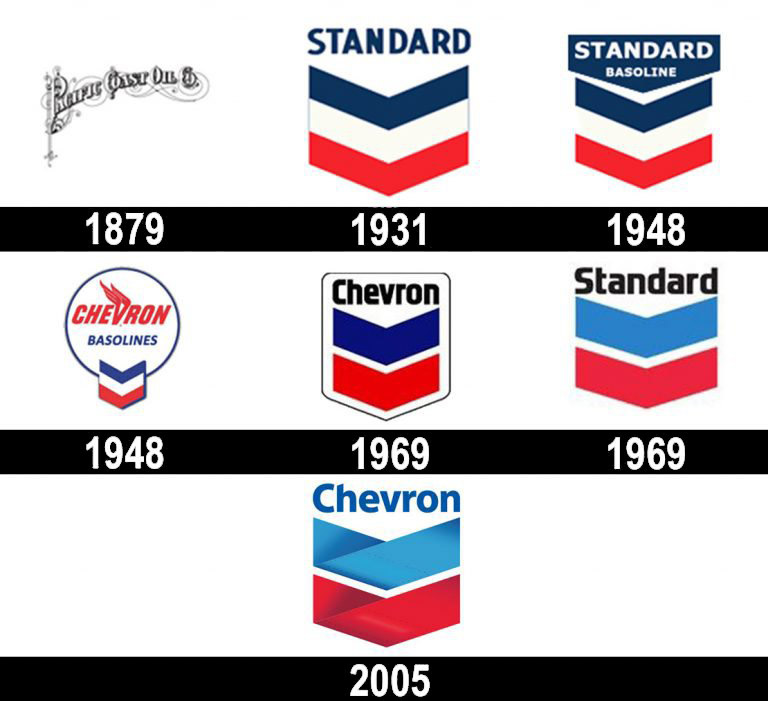
The earliest ancestor of the Chevron logo dates to 1879, created for Pacific Coast Oil Company. It bore the ornate typography typical of 19th-century branding — a diagonally arched white wordmark outlined in black, standing against a pale circular medallion framed with decorative flourishes. The serifed lettering communicated refinement and trustworthiness, qualities crucial during a period when petroleum was still an unfamiliar product to many households.
1906–1931: The Standard Oil Era and the First Chevron Shapes
When Pacific Coast Oil merged with Standard Oil in 1906, the visual identity began shifting toward a more modern aesthetic. For the first time, the brand introduced the now-iconic tricolor chevron shape — a downward-pointing emblem in red, white, and blue. The company name appeared above this geometric form, written in a bold blue sans-serif. It was the beginning of a visual language that would eventually define the Chevron brand.
1931–1948: Clean Geometry and Industrial Modernism
By 1931, the chevron symbol was refined yet again. The wordmark atop the emblem adopted a tighter, more contemporary sans-serif, and the logo overall embraced a cleaner, geometric look that reflected the industrial optimism of the early 20th century. Simplicity and legibility were becoming essential design values as oil and gasoline branding expanded across service stations nationwide.
1948–1969: The Birth of a Classic Chevron Emblem
The 1948 redesign brought a significant shift in composition. The logotype turned white and was placed over a dark blue rectangular block whose lower edge tapered into a point, echoing the chevron shape beneath it. At the same time, another important emblem was introduced: a circular badge encasing the tricolor chevron and a red italicized “Chevron” wordmark with distinctive wing-like extensions on the letter “V”. These wings added a sense of motion and progress — an emblem well-suited for the booming postwar automobile era.
1969–2006: Pure Chevron Geometry
The late 1960s marked the turning point toward the modern era of simplicity. The logo was stripped back to two stacked chevrons, one blue and one red, placed inside a white vertical rectangle with rounded corners and a fine black outline. Above it, the Chevron wordmark was set in a clean black title-case sans-serif. This was the foundation of the Chevron symbol as the world recognizes it today.
2005–Today: The Contemporary Chevron Badge
In 2005, the logo was refined into the glossy, gradient-rich emblem still in use. The black border disappeared, the chevron segments gained modern shading for depth, and the wordmark adopted a soft sky-blue tone with rounded sans-serif letterforms. The redesign captured early-21st-century digital aesthetics while preserving the unmistakable structure of the 1969 mark. It is this visual continuity — a layered chevron motif and patriotic palette — that maintains brand recognition across continents.
Meaning & Symbolism
The Chevron emblem draws directly from the traditional chevron shape used in heraldry and military insignia. Historically, the chevron denotes rank, protection, and upward movement — a fitting symbol for a corporation built on engineering innovation and infrastructural expansion. For Standard Oil and later Chevron, the downward-pointing arrangement also evoked stability and groundedness, hinting at deep geological roots and resource extraction.
Through the decades, the red and blue ribbons have also served as subtle nods to the American flag. This patriotic palette strengthened the brand’s identity in a domestic energy market where competition was fierce and national loyalty mattered.
Each redesign simplified the visual elements but preserved the symbolic language of strength, heritage, and motion. The chevron shape itself became synonymous with reliability and energy, ultimately outliving its parent companies as Standard Oil dissolved into multiple successors.
Font & Typography
Typography plays a quiet but essential role in Chevron’s visual identity. The current wordmark resembles Myriad Pro Bold, a sans-serif created by Robert Slimbach and Carol Twombly. Its rounded terminals and clean geometric structure project friendliness and accessibility — a deliberate contrast to the corporation’s industrial nature.
Earlier logos favored condensed sans-serifs with sharp angles that reinforced a rigid, mechanical tone. As Chevron entered the digital age, the typography softened, aligning with global branding trends that favored humanized, approachable forms.
Notably, the letter “h” in the logotype was subtly altered from its Myriad origins to maintain a proprietary look. This blend of familiarity and customization is emblematic of corporate typography strategies in the 21st century.
Color Palette
The Chevron palette is one of the most consistent in the oil industry. Across more than a century, the company has relied on variations of red, blue, and white. Blue symbolizes stability, trust, and expertise — essential traits for an energy provider. Red communicates power, energy, and forward momentum. White supports clarity and reinforces the geometric structure of the emblem.
In 2005, the company introduced gradient shading, giving both blue and red segments a slight three-dimensional sheen. The shades shifted toward lighter, more digital-friendly tones while maintaining continuity with the brand’s longstanding tricolor tradition.
Chevron’s Logo as a Story of American Industry
The Chevron logo is more than a corporate badge — it reflects the evolution of the American energy sector. From ornate 19th-century typography to the sleek digital emblem used today, every transformation mirrors a shift in industry, technology, and public expectations. Yet the essence has remained remarkably stable: angled stripes, patriotic colors, and a sense of motion and confidence.
Chevron’s visual identity stands as one of the longest-running examples of design continuity in corporate America, a true testament to the power of a strong symbolic foundation.
Chevron Logo FAQ: History, Meaning, Symbolism & Brand Heritage
What does the Chevron logo mean?
It symbolizes strength and heritage through its stacked chevron shapes, referencing both heraldic insignia and the company’s own product line dating back to the Standard Oil era.
Why is the company called Chevron?
“Chevron” was originally the name of a product line within Standard Oil. Over time the name became so recognizable that the corporation adopted it.
What is Chevron’s emblem based on?
The emblem is based on the layered, downward-pointing chevrons historically used in military insignia, combined with a patriotic red, white, and blue palette.
When was the current Chevron logo introduced?
The contemporary gradient version debuted in 2005.
What is Chevron’s slogan?
The brand’s current slogan is “Human Energy,” reflecting its emphasis on innovation and human-driven progress.