Whiskas Logo History: Meaning, Symbolism & Brand Heritage
Few pet food brands have built such a strong emotional and visual bond with their audience as Whiskas. Instantly recognizable through its feline silhouette and unmistakable purple palette, Whiskas represents one of the most successful long-term branding stories in the global pet food industry. Within cat food logo history, the brand stands as a prime example of how a single visual idea—executed consistently—can evolve without losing identity.
Much like the carefully managed brand evolution seen in Purina logo history or the mass-market familiarity associated with Pedigree logo heritage, Whiskas built its recognition by refining rather than reinventing. Its logo history reflects a balance between emotional warmth, playfulness, and large-scale brand discipline under the Mars corporate umbrella.
Meaning and History: From Kal Kan to Whiskas
Whiskas traces its origins back to 1936 in the United States, when it was first introduced under the name Kal Kan. At the time, the product focused on canned pet food and gradually expanded its reach as consumer attitudes toward pet nutrition evolved. The rebranding to Whiskas in the late 1980s marked a strategic shift toward a more global, emotionally resonant identity specifically tailored to cat owners.
The name Whiskas itself evokes softness, familiarity, and affection—qualities reinforced through the brand’s visual language. Throughout its history, Whiskas relied on a single central symbol: the cat’s head. Rather than depicting a full animal or detailed illustration, the brand chose a simplified silhouette, allowing universal recognition across cultures and markets.
As ownership transitioned fully under Mars, Incorporated, Whiskas benefited from global distribution and research resources, while maintaining a visual identity rooted in friendliness and trust.
Whiskas Logo History Timeline
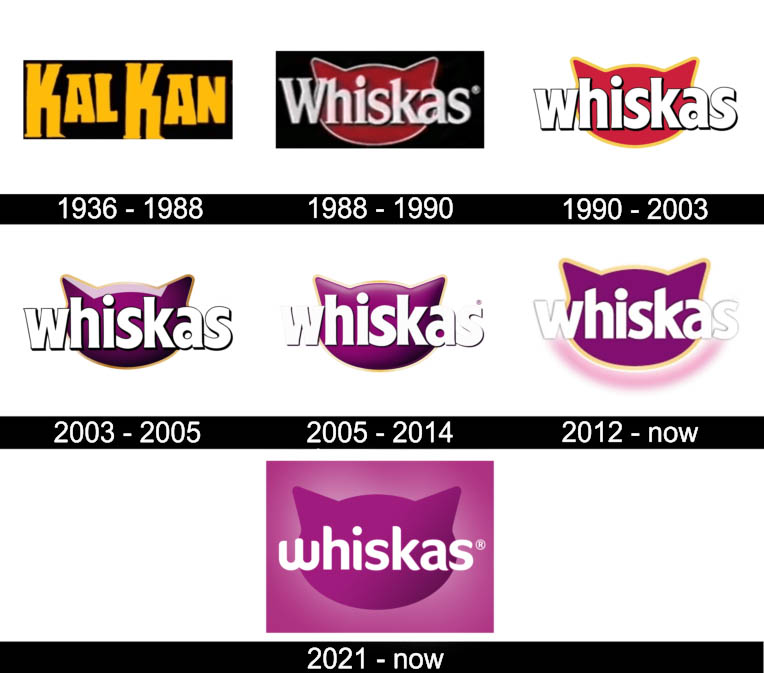
1936 – 1988: Kal Kan Origins
Before the Whiskas name existed, the brand operated as Kal Kan. The early visual identity was product-focused and utilitarian, reflecting the era’s emphasis on function rather than emotional branding. While these logos lacked the iconic elements seen today, they laid the groundwork for future transformation.

1988 – 1990: The Birth of Whiskas
The first logo following the rebrand to Whiskas introduced the now-familiar cat’s head. Rendered in dark red with a subtle three-dimensional silver outline, the emblem sat against a black background. Over it appeared the white “Whiskas” wordmark in a narrow serif typeface.
This version leaned toward elegance and premium positioning, signaling a clear departure from the brand’s earlier, more utilitarian roots.
1990 – 2003: Bold Color and Accessibility
In 1990, Whiskas embraced a brighter and more modern aesthetic. The cat head became flat, executed in scarlet red and outlined with a thick yellow border. The background shifted to white, dramatically improving visibility and shelf impact.
Typography changed significantly. The brand name appeared in lowercase, using a bold sans-serif typeface. White letters with black outlines and soft gray shadows added depth while maintaining friendliness. This version firmly established Whiskas as a mass-market yet distinctive brand.
2003 – 2005: Dimensional Refinement
The 2003 redesign introduced a three-dimensional approach once again. The red cat head transitioned to a purple gradient, and the thick yellow outline was reduced to a fine contour. The wordmark retained its structure, but thinner outlines lightened the overall appearance.
This iteration marked the beginning of purple becoming Whiskas’ defining color.
2005 – 2014: Purple Consolidation
Throughout this period, Whiskas continued refining proportions and gradients, reinforcing purple as the brand’s core color. The logo became more cohesive, balancing playfulness with polish. These adjustments prepared the identity for a more simplified future.
2012 – Today / 2014 Refinement
Around 2014, the logo was refined rather than redesigned. The cat head returned to a flat execution, accompanied by a soft, blurred purple arc beneath it, adding warmth and movement. The wordmark remained white but adopted a simpler, more confident sans-serif typeface.
This version strengthened legibility and emotional clarity across global markets.
2021 – Today: Subtle Modernization
The most recent update focused on micro-adjustments. Proportions were tightened, curves softened, and contrast optimized for digital environments. Despite these refinements, the logo remained unmistakably Whiskas, preserving its feline silhouette and purple dominance.
Whiskas Logo Symbolism: Affection, Familiarity, and Care
Whiskas’ logo symbolism revolves around emotional connection. The cat head silhouette is intentionally simplified, allowing cat owners to project familiarity and affection onto the image. It avoids aggression or realism, favoring friendliness and approachability.
Purple plays a crucial symbolic role. Often associated with care, calmness, and a sense of premium quality, it differentiates Whiskas from competitors while reinforcing a nurturing tone.
The consistent presence of the cat head across decades created a visual shorthand for feline nutrition and trust.
Typography and Color Philosophy
Typography evolved from serif elegance to modern sans-serif confidence. The lowercase execution softens the brand voice, making it feel conversational rather than authoritative.
The color palette—dominated by two shades of purple, supported by white and yellow accents—creates balance between richness and lightness. Purple communicates care and distinction, white ensures clarity, and yellow adds warmth and energy.
Whiskas Logo Heritage and Global Recognition
Whiskas’ logo heritage demonstrates the effectiveness of disciplined repetition. By preserving its core symbol and color identity, the brand achieved global recognition without visual fatigue. This strategy mirrors patterns seen across cat food logo history and the broader Mars pet brand heritage, where emotional familiarity drives long-term loyalty.
Whiskas Logo History and Emotional Branding
The Whiskas logo history reveals how a brand can evolve visually while remaining emotionally consistent. From its early days as Kal Kan to its current global presence, Whiskas refined its identity through color, form, and typography without abandoning its core symbol.
Within the wider context of pet food logo history and mass-market brand heritage, Whiskas stands as a benchmark for emotional clarity. Its logo continues to communicate care, companionship, and reliability—values that resonate deeply with cat owners across generations.
FAQ: Whiskas Logo Meaning and History
What does the Whiskas logo represent?
The logo represents affection, care, and familiarity through a simplified cat head silhouette and soft color palette.
Why is purple used in the Whiskas logo?
Purple conveys care, calmness, and premium quality while differentiating the brand from competitors.
Has the Whiskas logo changed over time?
Yes, but changes were gradual refinements that preserved the core cat head symbol.
Who owns the Whiskas brand?
Whiskas is owned by Mars, Incorporated.