Warner Bros Logo History: The $110 Billion Deal Reshaping the Studio
Warner Bros is in the middle of its biggest corporate change in decades: on 23 April 2026, shareholders of Warner Bros. Discovery approved a $110 billion acquisition by Paramount Skydance, the end point of a bidding battle that also included a December 2025 Netflix offer of $72 billion for the studio and streaming business, with the deal’s antitrust trial scheduled for March 2027.
How did Warner Bros actually end up being sold to Paramount?
Warner Bros was founded by brothers Harry, Albert, Sam, and Jack Warner, with the shield logo first introduced in 1925. Sam Warner, who pushed hardest for the studio’s sound-film experiments, died on 24 October 1927, the day before “The Jazz Singer” premiered, the film that is often credited with launching the sound era in Hollywood.
The single biggest gap the old version of this article never mentioned at all is the studio’s corporate ownership history in the decades since. Warner Communications merged with Time Inc. in 1990 to form Time Warner. In 2001, Time Warner merged with America Online to form AOL Time Warner, a deal widely regarded as one of the most disastrous mergers in corporate history; the company dropped “AOL” from its name and reverted to Time Warner in 2003. AT&T acquired Time Warner in 2018, renaming it WarnerMedia, before spinning it off in April 2022 to merge with Discovery, Inc. and form Warner Bros. Discovery.
That company is now being sold again. After a bidding war that saw Netflix offer $72 billion for the studio and streaming operations in December 2025, Paramount Skydance’s competing bid won out: on 27 February 2026, Paramount Skydance confirmed a deal to acquire all of Warner Bros. Discovery at an enterprise value of $110 billion, and shareholders approved the merger on 23 April 2026, with a federal antitrust trial scheduled for March 2027 before the deal can close.
Logo evolution
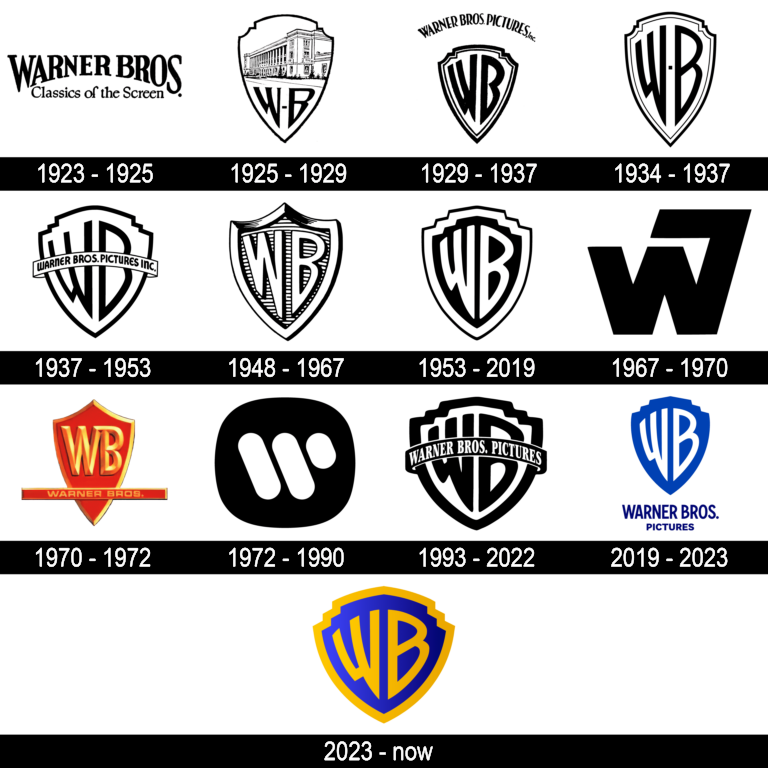
1923-1925: the first typographic identity
The earliest logo was a simple arching wordmark in a bold serif typeface with the cursive tagline “Classics of the Screen,” with no shield or monogram yet.
1925-1929: the shield appears
In 1925, the year Warner Bros introduced its first synchronized-sound features, the studio adopted the first version of its crest, a detailed illustration of the studio building above a stylized “WB” monogram, the foundation of the brand’s visual identity ever since.
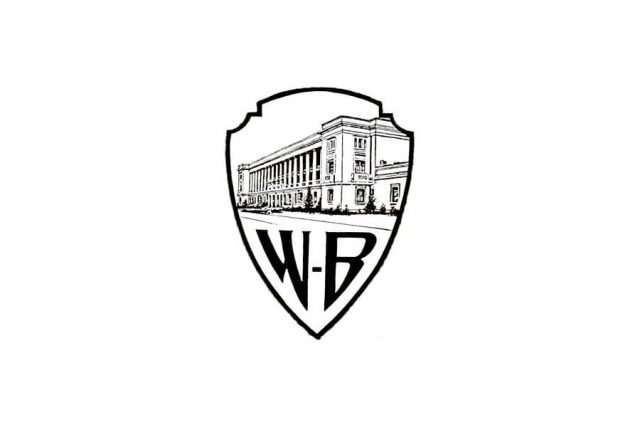
1929-1937: a bolder monogram
By 1929, the building illustration was removed, the “WB” letters became bolder and taller, and an arched “Warner Bros Pictures” inscription appeared above the shield.
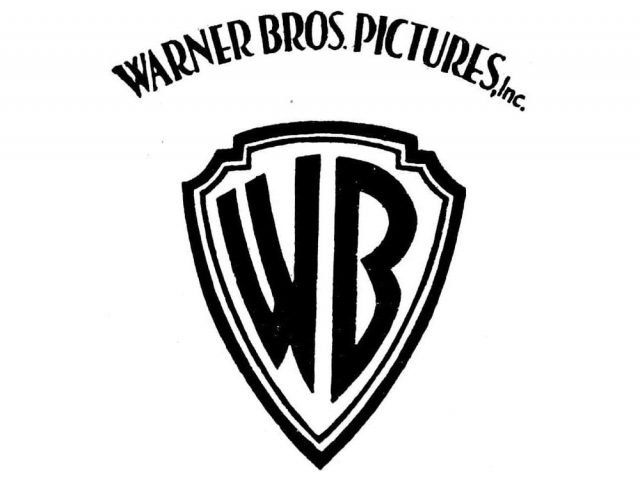
1934-1937: cleaner lines
A simplified 1934 version thinned the outlines and dropped additional lettering, used alongside the earlier design across marketing materials.
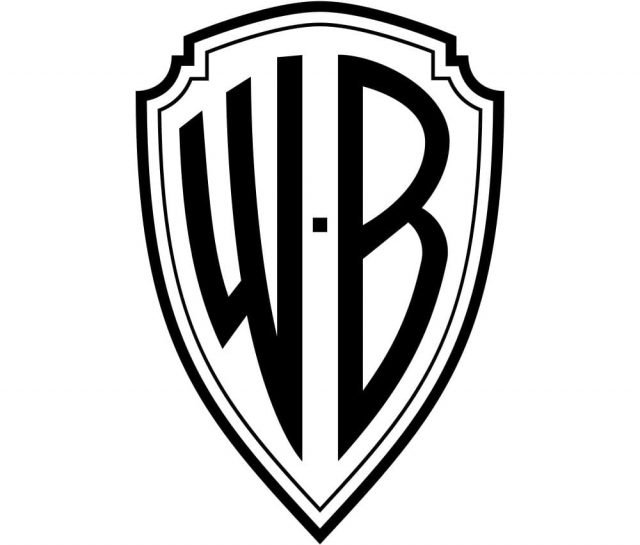
1937-1953: the banner era
In 1937, the shield gained an arched banner cutting through the middle, carrying the studio name, one of the more recognizable designs of the era.
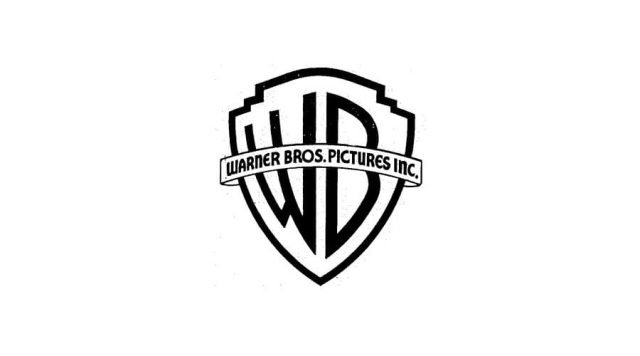
1948-1953: horizontal stripes
The postwar version added fine horizontal stripes to the shield’s interior and thickened the monogram and outline, reflecting the studio’s growing international reach.
1953-1967: the classic black-and-white crest
Introduced in 1953, this flat black shield with white lettering became the version most associated with the studio’s Golden Age output, legible, bold, and used for the longest stretch of any single design.
1967-1970: the W7 era
Following the 1967 Warner Bros-Seven Arts merger, the studio briefly used a geometric “W7” monogram, a sharp departure from the shield tradition that lasted only a few years.
1970-1972: a red and gold revival
By 1970, the shield returned, now rendered in red and gold with a straight horizontal banner holding the company name.
1972-1990: the Saul Bass design
Designer Saul Bass created a minimalist emblem in 1972, a black rounded rectangle with a white three-line “W,” used for more than a decade and still cited by designers as one of the studio’s most distinctive marks.
1993-2019: the modernized shield
The 1993 update thickened the monogram, widened the shield, and refined the banner in black and white, the version seen across the home-video era.
2019-2023: a blue digital identity
In 2019, Warner Bros introduced a bright blue reinterpretation of the 1953 shield, stripped of its outline for a cleaner look on digital platforms, coinciding with the studio’s push into streaming under WarnerMedia.
2023-today: a gold and blue revival
The latest redesign, by Chermayeff, Geismar & Haviv, uses a subtle blue gradient with the monogram and border in gold and removes the banner entirely, echoing the 1993 design with a more premium finish.
Logo symbolism
The shield shape evokes a coat of arms, tying the brand to the Warner family’s founding and to Hollywood’s sense of tradition. Black-and-white versions signal classic-Hollywood elegance, blue reflects the studio’s digital and streaming era, and gold is used for a sense of prestige.
Typography and color
Typography has moved from decorative serif wordmarks in the 1920s to the bold block monogram used since the 1950s, with Saul Bass’s 1970s redesign the clearest break from tradition. The palette has shifted from black-and-white to blue-and-gold combinations as the brand has modernized.
Quick facts
| Founded | 1923, by Harry, Albert, Sam, and Jack Warner |
| Sam Warner’s death | 24 October 1927, a day before “The Jazz Singer” premiere |
| Time Warner formed | 1990 merger with Time Inc. |
| AOL Time Warner | 2001-2003, reverted to Time Warner |
| AT&T acquisition | 2018, renamed WarnerMedia |
| Warner Bros. Discovery formed | 8 April 2022 |
| Paramount Skydance acquisition | Confirmed 27 February 2026 at $110 billion; shareholders approved 23 April 2026 |
Related reading
Further reading
FAQ
Who founded Warner Bros?
Brothers Harry, Albert, Sam, and Jack Warner founded the studio in 1923; Sam Warner died on 24 October 1927, a day before “The Jazz Singer” premiered.
Is Warner Bros being sold?
Yes. Paramount Skydance confirmed a deal to acquire Warner Bros. Discovery at a $110 billion enterprise value on 27 February 2026, approved by shareholders on 23 April 2026, with an antitrust trial scheduled for March 2027.
What happened with AOL and Time Warner?
Time Warner merged with America Online in 2001 to form AOL Time Warner, widely seen as one of the worst corporate mergers in history, and the company dropped “AOL” from its name in 2003.
What does the Warner Bros shield represent?
It evokes a coat of arms, tied to the founding Warner family and to Hollywood tradition.