Vinted Logo History: From Mano Drabužiai to an €8 Billion Marketplace
Vinted started as a Lithuanian site called “Mano Drabužiai,” my clothing, built by a woman trying to clear out an overflowing wardrobe during a move. It’s now worth billions of euros and operates across more than two dozen countries, and the logo’s shift toward plain lowercase type tracks that growth almost exactly.
How did Vinted actually start?
Vinted was founded in 2008 in Vilnius, Lithuania, by Milda Mitkutė and Justas Janauskas. The idea came from a practical problem: Mitkutė needed to sell clothes while moving house, and Janauskas built a website to help her and others trade clothing directly. The site originally launched under the name Mano Drabužiai (“My Clothing”) before adopting the Vinted name as it expanded internationally, first into Germany in 2010 and the United States in 2015.
The mid-2010s brought real financial strain, and the company narrowed its focus back to core European markets to survive. That reset worked: with backing from investors including Insight Venture Partners, Sprints Capital, and later Lightspeed Venture Partners, Vinted became Lithuania’s first technology unicorn in 2019, raising €128 million at a €1 billion valuation.
How big is Vinted now?
Vinted has grown largely through acquisition and expansion rather than staying a single-market platform. It bought the Dutch resale site United Wardrobe in 2020, merged the German platforms Kleiderkreisel and Mamikreisel, and acquired the Danish platform Trendsales in 2024. By 2024, Vinted operated in more than 26 markets, reported revenue of €813.4 million (up 36% from 2023), and posted a net profit of €76.7 million, a 330% increase year over year. In 2026, a secondary share transaction valued the company at €8 billion.
Logo evolution
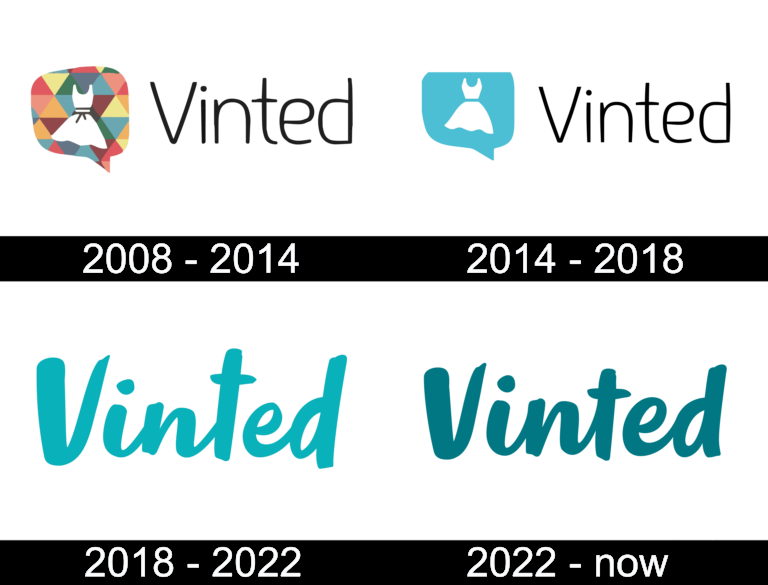
2008-2014: the patchwork dress-form emblem
Vinted’s earliest logo paired its wordmark with a mosaic-style emblem shaped like a dress form, filled with colorful geometric fragments in red, yellow, blue, and green. It leaned on illustration to suggest variety and reuse, in keeping with the site’s early, more experimental identity.

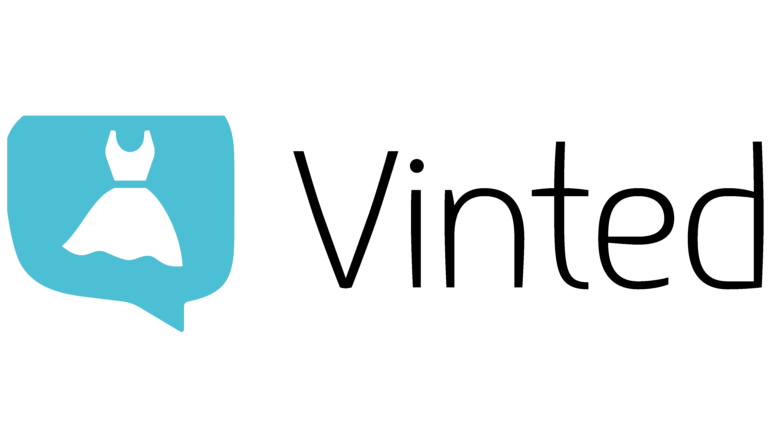
2014-2018: the speech-bubble mark
In 2014, Vinted introduced a turquoise speech bubble containing a white dress silhouette next to a black wordmark, shifting the emphasis from the range of items on the platform toward the idea of buyers and sellers communicating directly.
2018-2022: wordmark only
The 2018 redesign dropped the emblem entirely, leaving a teal wordmark with softer, rounded strokes. This coincided with Vinted’s broader push into new European markets and its climb toward unicorn status.
2022-today: lowercase wordmark
The current logo refines the 2018 version further, switching to fully lowercase letters in the same teal, a typographic choice meant to read as informal and approachable rather than corporate.
Quick facts
| Founded | 2008, Vilnius, Lithuania |
| Founders | Milda Mitkutė and Justas Janauskas |
| Original name | Mano Drabužiai (“My Clothing”) |
| Unicorn status | 2019, €1 billion valuation |
| 2024 revenue | €813.4 million |
| 2026 valuation | €8 billion (secondary share transaction) |
| Current logo introduced | 2022 (lowercase wordmark) |
Related reading
Further reading
FAQ
What was Vinted originally called?
Mano Drabužiai, Lithuanian for “My Clothing,” before it adopted the Vinted name as it expanded beyond Lithuania.
Who founded Vinted?
Milda Mitkutė and Justas Janauskas, in 2008 in Vilnius, Lithuania. Mitkutė’s own need to sell clothes while moving house was the original idea behind the site.
When did Vinted become a unicorn?
In 2019, after raising €128 million at a €1 billion valuation, making it Lithuania’s first technology unicorn.
When did Vinted switch to its current lowercase logo?
In 2022, refining a wordmark-only design first introduced in 2018 after the brand dropped its earlier illustrated emblems.