
Telus Logo History: Meaning, Symbolism & Brand Heritage

Telus stands as one of Canada’s most recognizable telecommunications brands, built at the intersection of public infrastructure, privatization, and consumer technology. Unlike many global telecom companies that adopted purely abstract identities, Telus developed a logo system that blends expressive symbolism with typographic stability. Its logo history reflects not only corporate growth, but also the broader transformation of telecommunications in Canada from state-controlled utilities to competitive consumer services.
Much like the evolution seen in Bell Canada logo history or the long-standing visual discipline behind Rogers Communications logo history, Telus’ logo heritage demonstrates how consistency, rather than constant reinvention, can establish long-term trust. The brand’s visual identity matured alongside its services, retaining its core structure while adapting its tone to changing consumer expectations.
Meaning and History: The Origin of the Telus Identity
Telus was founded in 1990 as Telus Corp., created by the government of Alberta to manage the privatization of Alberta Government Telephones. In its earliest phase, the company functioned as a holding structure rather than a consumer-facing brand. This context explains why early identity decisions focused on institutional clarity rather than marketing appeal.
A defining moment in Telus’ origin came with the acquisition of Edmonton Telephones Corporation. This consolidation positioned Telus as the sole telephone service provider in Alberta and created the need for a unified national-facing identity. By 1996, Telus emerged as a consumer brand, requiring a logo meaning that could balance technological sophistication with public trust.
From the beginning, Telus’ logo description avoided overt industrial imagery. Instead, it relied on abstract symbolism to suggest connectivity, signal transmission, and forward motion, aligning closely with the evolving nature of telecommunications services.
Logo Symbolism: Signal, Motion, and Reliability
Telus logo symbolism is notable for its contrast. The emblem is light, fluid, and almost organic, while the wordmark is heavy, grounded, and deliberately restrained. This duality reflects the brand’s positioning: advanced technology delivered through reliable infrastructure.
The emblem consists of two key elements. The first is a sharp, upward-angled needle rendered in deep purple, often interpreted as an antenna or transmission mast. Its diagonal orientation suggests progress, reach, and aspiration. The second element is a green loop encircling the needle, which can be read as a signal wave, orbit, or flow of data.
Together, these shapes form a metaphor for connectivity. The loop represents communication in motion, while the needle anchors it, symbolizing precision and control. This interpretation aligns directly with Telus’ core services, making the emblem a functional expression of brand purpose rather than a decorative mark.
The wordmark reinforces this symbolism through restraint. Its straightforward sans-serif construction conveys stability, allowing the emblem to carry expressive weight without overwhelming the identity.
Telus Logo History Timeline
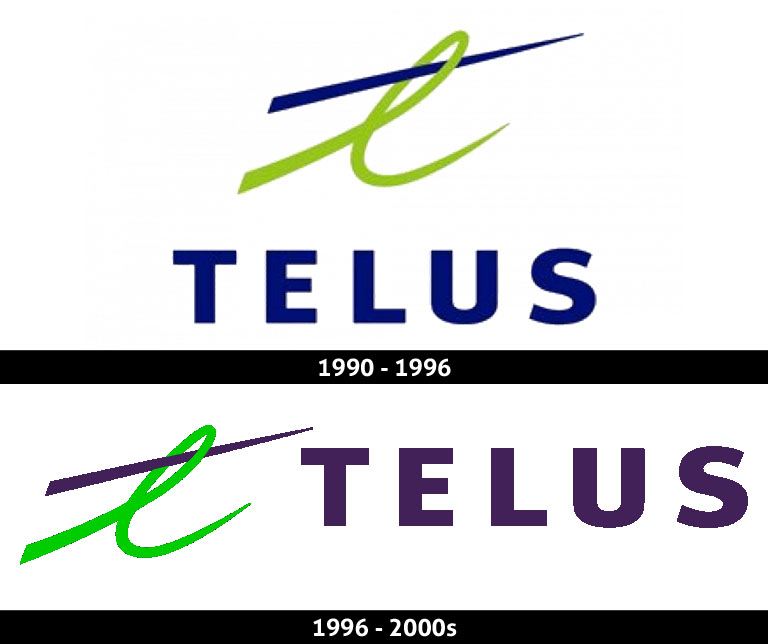
1990–1996: Corporate Formation Without Consumer Identity
During its earliest years, Telus operated primarily as a holding entity overseeing the transition from public to private telecommunications infrastructure. At this stage, the company did not rely on a strong consumer-facing logo system. Visual identity was secondary to regulatory and structural concerns.
1996–2000s: Establishment of the Core Telus Logo
In 1996, following the integration of Edmonton Telephones Corporation, Telus introduced a unified brand identity. This logo marked the first true expression of Telus as a consumer telecommunications company.
The design combined a light, abstract emblem with a bold wordmark. The emblem featured a purple needle rising diagonally, encircled by a bright green loop. This contrast created immediate visual interest while remaining conceptually tied to signal transmission and connectivity.
The wordmark, set in a strong sans-serif typeface, provided balance and authority. Its simplicity ensured legibility and conveyed reliability, a critical factor for a national telecommunications provider. This version proved so effective that its structure remained virtually unchanged for decades.

2000s–Present: Color Refinement and Brand Maturity
While the shape and composition of the Telus logo remained consistent, subtle refinements were made to the color palette over time. The purple became richer and more saturated, lending the brand a more contemporary and approachable tone. The green accent retained its vibrancy, preserving the emblem’s sense of motion and energy.
These adjustments allowed Telus to modernize its appearance without disrupting recognition. The logo meaning stayed intact, while its emotional tone evolved to suit an increasingly competitive and consumer-driven telecommunications market.
Typography and Color: Balance Between Expression and Stability
Typography plays a deliberately secondary role in the Telus logo description. The wordmark uses a clean, bold sans-serif typeface, officially supported by Helvetica Neue in brand guidelines. Its role is to anchor the identity, ensuring clarity and consistency across applications.
Color carries much of the brand’s expressive power. The deep purple conveys creativity, sophistication, and technological depth, while the vivid green introduces freshness and accessibility. Set against a white background, this palette achieves high contrast without appearing aggressive, reinforcing Telus’ position as both innovative and dependable.
Telus Logo Heritage and Telecommunications Identity
The Telus logo history illustrates how a telecommunications brand can maintain visual continuity while adapting emotionally to changing markets. By preserving its emblematic structure and refining its color palette, Telus built a logo heritage rooted in recognition, symbolism, and trust.
Within the broader context of telecommunications logo heritage, Telus stands out for its willingness to embrace abstraction without sacrificing meaning. Its logo symbolism communicates connectivity, motion, and reliability in a way that remains relevant decades after its introduction, proving that strong foundational design can outlast shifting industry trends.
FAQ: Telus Logo Meaning and History
What does the Telus logo symbolize?
The Telus logo symbolizes connectivity and signal transmission, combining an abstract antenna form with a looping signal element.
Why does the Telus logo use purple and green?
Purple conveys innovation and technological depth, while green represents energy and communication flow.
Has the Telus logo changed significantly over time?
No, the core structure has remained consistent since 1996, with only color refinements introduced.
What font does Telus use in its logo?
Telus uses a clean sans-serif typeface, supported by Helvetica Neue in its official brand guidelines.