Discord Logo: Clyde and the 2021 Redesign
Discord began as the side effect of a failed video game. Jason Citron and Stanislav Vishnevskiy built a mobile game called Fates Forever in 2014, and the game itself never found a large audience. The voice and text chat tools they built so players could coordinate during matches turned out to be more useful than the game. The two founders shut the game down and rebuilt the chat layer into a standalone app, which launched in May 2015 as Discord.
Like the community messaging history covered in WhatsApp’s logo history, Discord’s logo has stayed close to its original gaming roots even as the platform grew into general-purpose chat for millions of communities outside gaming.
Meaning and History
Citron had already sold an earlier company, OpenFeint, before starting the studio that became Hammer & Chisel with Vishnevskiy. Fates Forever, released in 2014, was meant to bring a multiplayer online battle arena game to mobile devices. The game did not take off commercially, but its in-app voice chat solved a real problem Citron had run into himself: existing voice chat tools for PC gaming were unreliable and hard to set up. The team pivoted away from the game and focused entirely on the chat product, releasing Discord in May 2015.
The name itself is a deliberate contrast to what the product does. A discord is a disagreement or a lack of harmony, and the founders chose it as a wry counterpoint to a platform built to help people communicate and stay in sync while playing games together.
Growth, Funding, and Platform History
Discord’s user base grew quickly after launch. The company has reported tens of millions of users within its first few years, climbing into the hundreds of millions of registered accounts by the early 2020s, and it has reported figures in the tens of millions for daily active users in more recent company updates. Funding followed a similar trajectory: investors in Discord’s early and later rounds have included Benchmark, Tencent, Greenoaks Capital, Sony Interactive Entertainment, and Dragoneer, among others. A funding round in late 2018 valued the company at roughly 2 billion dollars. In 2021, after reported acquisition talks with Microsoft at around 10 billion dollars did not result in a deal, Discord raised additional funding that valued the company at approximately 15 billion dollars.
The platform’s growth also brought scrutiny. Discord servers were used by organizers of the 2017 “Unite the Right” rally in Charlottesville, which led the company to ban a number of extremist communities from the platform. In the years since, Discord has removed servers tied to harassment, hate speech, and other policy violations, and it has faced regulatory penalties in some jurisdictions over data handling. These episodes are part of the platform’s public record and are mentioned here because they shaped how Discord’s trust and safety policies evolved, not because they relate to the logo itself.
Logo Symbolism
The figure at the center of the Discord logo is an abstract, white or purple game-controller shape. Discord’s own team has given this character a name, Clyde, and it functions as the platform’s mascot in addition to appearing in the logo. Depending on how someone looks at it, the shape can also read as a stylized face, with the rounded controller buttons doubling as eyes and a smiling mouth.
Discord’s signature color, informally called “blurple” by the community and the company, sits between blue and purple. The combination was chosen to suggest both the calm, trustworthy associations of blue and the creative, playful associations of purple, fitting for a platform built around shared hobbies and communities.
Logo History Timeline
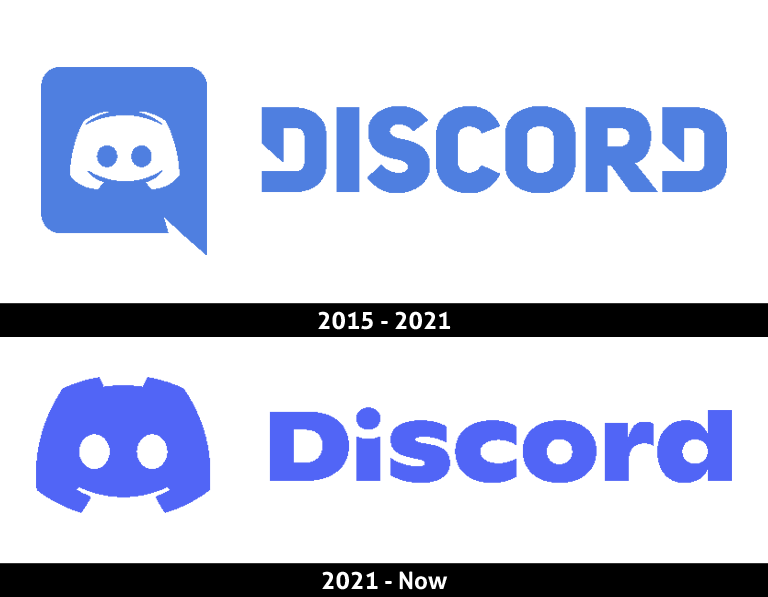
2015 to 2021. Discord’s original logo placed a white controller-shaped figure inside a purple speech bubble, with the controller’s rounded joystick shapes doubling as eyes and a smile. The accompanying wordmark used a bold, geometric sans-serif typeface with diagonal cuts across the vertical strokes of the letter “D,” giving the logotype an angular, gaming-oriented feel.
2021 to present. For its sixth anniversary in May 2021, Discord retired the speech-bubble frame entirely. The controller figure, Clyde, was redrawn with smoother, more rounded contours and recolored in purple, set directly against a plain background rather than inside a bubble shape. The wordmark was widened and set in a more conventional typeface, and the negative space arched above the lowercase “i” was shaped to read as a subtle smile. Discord described the update as an attempt to make the brand feel friendlier and more approachable, and the company also brightened its color palette at the same time. The change drew a mixed reaction from longtime users, many of whom objected to the new typeface more than to the redrawn mascot.
Quick Facts
| Founded | 2015 |
| Founders | Jason Citron and Stanislav Vishnevskiy |
| Headquarters | San Francisco, California |
| Current logo introduced | May 2021 |
| Mascot name | Clyde |
FAQ
Who created Discord?
Discord was created by Jason Citron and Stanislav Vishnevskiy. It grew out of the in-game chat feature built for their earlier mobile game, Fates Forever, and launched as a standalone app in May 2015.
What does the Discord logo represent?
The logo shows an abstract, controller-shaped figure named Clyde. It represents Discord’s roots as a tool built for gamers to talk to each other, and its rounded shapes are designed to also read as a simple, friendly face.
Is the shape in the Discord logo an animal?
No. It is a stylized game controller, though its ambiguous outline has led some users to describe it informally as looking like a face, a mask, or a creature. Discord refers to the figure as Clyde.
Has the Discord logo changed over time?
Yes. The original 2015 logo placed Clyde inside a purple speech bubble with an angular wordmark. In May 2021, for Discord’s sixth anniversary, the company removed the speech bubble, smoothed out Clyde’s shape, and widened the wordmark into the version used today.
Why is the platform called Discord?
The name is an intentional contrast to the product’s purpose. A discord means disagreement or a lack of harmony, chosen as a wry counterpoint to a platform built to help people stay in sync while gaming or chatting together.