
Telegram Logo History: Meaning, Symbolism & Brand Heritage

Telegram is one of the most distinctive messaging platforms of the modern digital era, built around speed, privacy, and functional simplicity. Launched in the early 2010s, the application quickly positioned itself as an alternative to mainstream messengers by prioritizing security, scalability, and user control. Its logo history reflects this philosophy clearly, relying on a universal visual metaphor and minimal stylistic intervention rather than frequent redesigns.
Much like the clarity-driven approach seen in WhatsApp logo history or the community-focused evolution behind Discord logo history, Telegram’s logo heritage is rooted in purpose. The brand’s visual identity was never meant to impress through complexity, but to communicate freedom, speed, and reliability at a glance.
Meaning and History: The Origin of the Telegram Identity
Telegram was created in 2013 by Pavel Durov, the founder of VKontakte, at a time when concerns about digital privacy and centralized control were rapidly increasing. Initially conceived as an experiment, the platform gained massive global attention in 2014 after a major WhatsApp outage prompted millions of users to seek an alternative. That single event accelerated Telegram’s growth and reinforced its positioning as a resilient and independent communication tool.
From the outset, Telegram’s identity emphasized efficiency and openness. Unlike platforms built primarily around social interaction or monetization, Telegram focused on infrastructure, speed, and scale. This mindset shaped the logo meaning directly, favoring a symbol that communicates movement and delivery rather than conversation or community.
The brand avoided heavy narrative symbolism. Instead, it adopted a single, universally understandable image that could work across cultures, languages, and political environments.
Logo Symbolism: Freedom, Speed, and Direction
Telegram logo symbolism centers on the paper plane, a timeless metaphor for sending messages quickly and freely. Unlike envelopes or speech bubbles, which imply conversation or correspondence, the plane suggests motion, distance, and independence. It reinforces Telegram’s promise of fast message delivery without barriers.
The plane’s forward-leaning orientation adds a sense of direction and progress, subtly implying efficiency and technological confidence. Its clean, geometric construction avoids ornamentation, reflecting the platform’s no-friction approach to communication.
The circular background enhances balance and harmony, while also functioning effectively as an app icon. The logo description is intentionally neutral and minimal, allowing the symbol to remain relevant regardless of feature expansion or shifts in digital trends.
Telegram Logo History Timeline
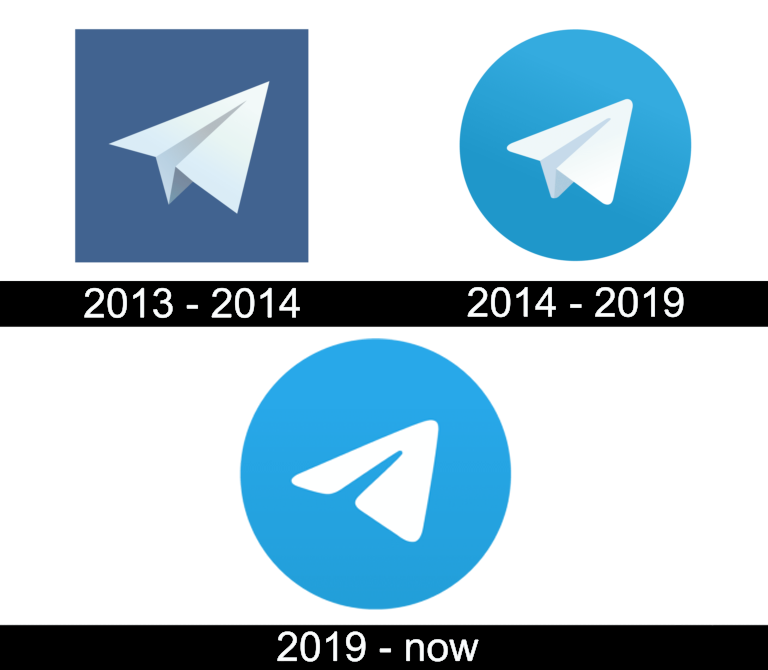
2013–2014: Early Experimentation and Angular Structure
The first Telegram logo appeared in 2013 and featured a white paper plane set against a dark blue square. The angular format mirrored early mobile design trends and matched the sharp, pointed geometry of the plane itself. While visually effective, this version reflected Telegram’s experimental phase rather than a finalized brand system.
Despite its short lifespan, this logo established the core symbolic element that would define Telegram’s identity moving forward.

2014–2019: Circular Simplicity and Global Recognition
In 2014, Telegram introduced the circular logo that would become globally recognizable. The background shifted to a lighter sky-blue tone, while the paper plane was refined with smoother lines and softer angles. This update significantly improved friendliness and visual balance, making the logo more approachable without sacrificing clarity.
This version accompanied Telegram’s rapid international expansion and became synonymous with secure, fast messaging. Its longevity underscores the effectiveness of the design.

2019–Today: Refinement and Visual Confidence
The current Telegram logo preserves the established concept with subtle refinements. The paper plane lines became bolder and smoother, increasing visibility across high-resolution screens. The color palette remained unchanged, reinforcing continuity within Telegram’s logo heritage.
Occasionally, a wordmark is paired with the emblem when needed. The typography is a clean sans-serif with generous spacing, ensuring readability while staying visually secondary to the icon.
Typography and Color: Minimalism with Intent
Telegram’s visual identity relies almost entirely on its emblem. When typography is used, it remains understated, avoiding stylistic dominance. This restraint ensures that the symbol remains the primary brand identifier.
Color plays a critical role in the logo meaning. The light blue background conveys openness, trust, and calmness, while white reinforces clarity and security. This combination avoids both the corporate rigidity of darker palettes and the emotional intensity of warmer tones, positioning Telegram as neutral, reliable, and user-focused.
Telegram Logo Heritage and Digital Independence
The Telegram logo history demonstrates how a single, well-chosen symbol can support long-term brand growth without constant redesign. By committing early to a clear metaphor and refining it gradually, Telegram built a logo heritage that feels stable, modern, and universally legible.
Within the broader context of messaging and platform logo heritage, Telegram stands out for its disciplined minimalism. Its logo meaning aligns closely with the platform’s core values of freedom, speed, and privacy, proving that simplicity, when paired with purpose, can sustain global recognition.
FAQ: Telegram Logo Meaning and History
What does the Telegram logo represent?
The logo represents fast and free communication, symbolized by a paper plane in motion.
Why does Telegram use a paper plane as its logo?
The paper plane symbolizes message delivery, speed, and independence, aligning with Telegram’s core functionality.
Has the Telegram logo changed over time?
Yes, but only subtly. The core symbol introduced in 2014 remains intact, with minor refinements for clarity.
Who created Telegram?
Telegram was created in 2013 by Pavel Durov as a secure and scalable messaging platform.