
Southwest Airlines Logo History: Meaning, Symbolism & Brand Heritage

Within modern aviation logo history, few identities are as emotionally driven and instantly recognizable as that of Southwest Airlines. Built around warmth, accessibility, and customer-centric values, the Southwest logo stands apart from the restrained corporate aesthetics typical of legacy carriers. From its earliest wordmark to the contemporary heart emblem, the airline’s visual language has consistently communicated approachability rather than hierarchy.
Much like the human-centered branding explored in JetBlue logo history or the long-term refinement seen in Alaska Airlines logo heritage, Southwest Airlines developed a visual identity that favors emotional symbolism over institutional authority. Positioned within the broader aviation branding evolution, its logo reflects not only changes in design trends, but also the company’s unwavering focus on care, simplicity, and trust.
Meaning and History: The Origin of the Southwest Airlines Logo
Southwest Airlines was founded in 1971 with a radically different philosophy from most U.S. air carriers. Designed as a low-cost airline with a strong emphasis on customer experience, the company built its brand around friendliness, efficiency, and human connection. This philosophy directly shaped the logo meaning from the very beginning.
Unlike airlines that relied on national symbols, globes, or abstract geometry, Southwest gradually embraced the heart as its core emblem. The heart logo symbolism reflects care, empathy, and emotional connection, values that became central to the airline’s culture. Over time, the color palette evolved into a visual metaphor for the sky itself, reinforcing the airline’s connection to travel while maintaining a uniquely personal tone.
Southwest Airlines Logo History Timeline
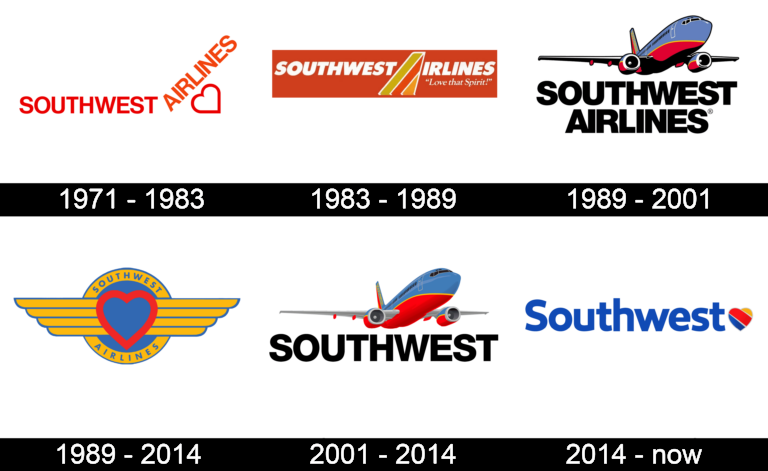
1971–1983: Expressive Typography and Early Emotional Cues
The first Southwest Airlines logo introduced in 1971 relied primarily on typography. A bold red sans-serif wordmark appeared in uppercase letters against a white background, with “Southwest” aligned horizontally and “Airlines” placed diagonally beneath it. A contoured heart emblem accompanied the composition, subtly hinting at the emotional positioning that would later define the brand.
This early logo description emphasized accessibility and informality, aligning with Southwest’s disruptive entry into the aviation market.

1983–1989: Bold Color Blocks and Graphic Confidence
In 1983, Southwest introduced a dramatically different visual concept. The logo became a horizontally oriented rectangular banner dominated by red, with a gold and orange trapezoid placed at its center. The wordmark shifted to bold, slanted white lettering rendered in an extra-bold geometric sans-serif typeface.
This redesign reflected confidence and momentum, signaling the airline’s rapid growth while retaining a vibrant and energetic personality.

1989–2001: Illustration and Motion-Centered Identity
The 1989 redesign marked another sharp stylistic shift. The new logo featured a detailed illustration of a flying airplane rendered in blue and red, outlined in black. Positioned above a two-level black wordmark in a modern geometric sans-serif, the emblem introduced literal motion into the visual identity.
This period emphasized dynamism and expansion, aligning with Southwest’s growing route network and operational scale.

1989–2014: Emblematic Heritage and Customer Affection
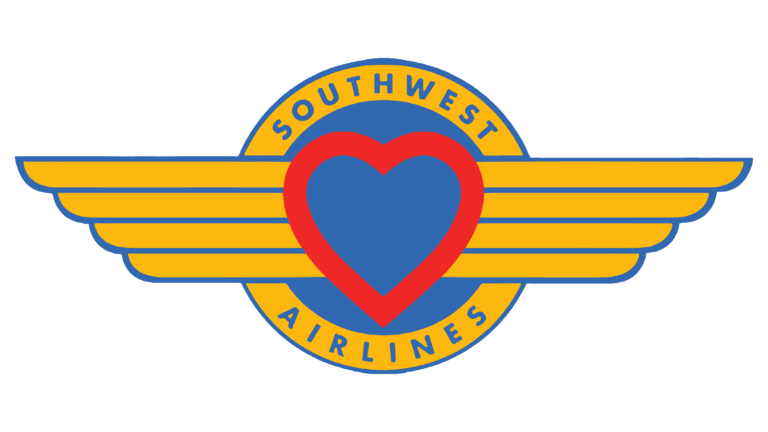
Later in 1989, Southwest adopted a more emblematic approach. A gold circular badge formed the centerpiece of the logo, flanked by elongated stylized wings. At the center of the circle, a red outlined heart symbolized the airline’s care and dedication to customers. The “Southwest Airlines” wordmark wrapped around the perimeter in blue sans-serif lettering.
This version became one of the most recognizable in the airline’s logo heritage, blending traditional emblem structure with emotional symbolism.
1989–2014: Simplified Wordmark and Expressive Aircraft Motif
In 1998, Southwest refined its visual identity again. The illustrated blue-and-red aircraft reappeared above a bold black wordmark set in strong uppercase sans-serif lettering. The typography conveyed stability and reliability, while the aircraft illustration added warmth and personality.
This design balanced professionalism with emotional resonance, reinforcing trust without sacrificing approachability.

2014–Today: The Heart as a Core Brand Symbol
The 2014 redesign marked the most significant transformation in Southwest Airlines logo history. The modern identity features sleek blue title-case lettering placed beside a minimalist heart composed of three diagonal stripes in blue, red, and yellow. The typography is smooth and contemporary, with rounded forms and clean cuts that enhance legibility and warmth.
The heart emblem became the definitive symbol of Southwest’s brand values, visually expressing care, inclusivity, and emotional connection.
Logo Symbolism: Emotion, Care, and the Sky
The symbolism of the Southwest Airlines logo is rooted in emotion rather than authority. The heart represents love, care, and respect for customers, positioning the airline as human-first rather than institution-driven. The three diagonal stripes within the heart symbolize the changing colors of the sky throughout the day, from dawn to sunset to night, reinforcing the airline’s relationship with flight and time.
By avoiding rigid geometric forms or national motifs, Southwest’s logo heritage communicates openness and accessibility, qualities that distinguish it within aviation branding.
Southwest Airlines Logo History and Emotional Brand Identity
The Southwest Airlines logo history illustrates how emotional symbolism can define a brand as effectively as tradition or scale. Through multiple redesigns, the airline maintained a consistent commitment to warmth, clarity, and customer care. From early typographic experiments to the modern heart emblem, the visual identity evolved without losing its core meaning.
Today, the Southwest logo stands as a powerful example of how logo symbolism, when aligned with corporate culture, can build long-term trust and recognition in a competitive industry.
FAQ: Southwest Airlines Logo Meaning and History
What does the Southwest Airlines logo symbolize?
The logo symbolizes love, care, and emotional connection to customers, represented through the heart emblem.
Why does the Southwest logo feature a heart?
The heart reflects the airline’s customer-first philosophy and commitment to warmth and empathy.
What do the colors in the heart represent?
The colors symbolize different moments of the sky throughout the day, reinforcing the idea of flight and travel.
Has the Southwest Airlines logo changed often?
Yes, the logo has undergone several major redesigns, each reflecting shifts in brand positioning and design trends.