
Sega Logo History: Meaning, Symbolism & Brand Heritage
Few names in the video game industry trigger instant recognition the way Sega does. For decades, the brand has been synonymous with arcade culture, console innovation, and iconic characters that shaped multiple generations of players. While Sega’s games evolved rapidly alongside technology, its visual identity followed a more disciplined path, relying on typographic strength and historical continuity rather than constant reinvention.
Much like the long-term consistency explored in the Nintendo logo history and the era-defining visual authority behind the Atari logo history, Sega’s logo heritage demonstrates how a carefully refined wordmark can become inseparable from an entire industry. Within the broader scope of video game logo history, Sega stands as one of the clearest examples of how typography alone can carry cultural meaning.
Meaning and History: The Origin of the Sega Identity
Sega traces its origins back to the mid-1940s, long before video games existed as a mainstream form of entertainment. The company began in 1945 as “Standard Games,” a business founded in Florida that supplied coin-operated amusement machines, including pinball equipment, primarily for military bases.
Shortly afterward, the company adopted the name “Service Games of Japan,” reflecting its operational focus. Over time, this name was shortened to “Service Games,” and eventually abbreviated to Sega, a contraction that would become one of the most influential names in entertainment history.
What makes Sega’s logo meaning particularly compelling is how directly it reflects this evolution. The brand never relied on mascots or abstract symbols in its core identity. Instead, it allowed its name to carry the weight of its history, transformation, and innovation.
Logo Meaning: Identity Rooted in Continuity
The Sega logo meaning is grounded in stability and recognition. From its earliest incarnations, the logo functioned as a wordmark, emphasizing clarity and memorability. This approach proved especially effective as Sega transitioned from mechanical amusement machines to arcade games and eventually to home consoles.
Rather than reinventing its identity with each technological leap, Sega refined its typography incrementally. This consistency allowed the logo to act as a visual anchor, reassuring audiences that while the products evolved, the brand’s core identity remained intact.
Logo Symbolism: Typography as a Cultural Marker
In terms of logo symbolism, Sega’s identity relies entirely on letterform design. The absence of an emblem or pictorial mark is intentional. The logo’s symbolism emerges from its distinctive geometry, rhythm, and color rather than illustrative elements.
The segmented letterforms, horizontal breaks, and squared contours introduced a sense of motion and energy, subtly reflecting the interactive nature of games. Over time, these typographic traits became symbolic of innovation, speed, and digital entertainment, even without explicit imagery.
Sega Logo History Timeline
1945–1959: The Service Games Era
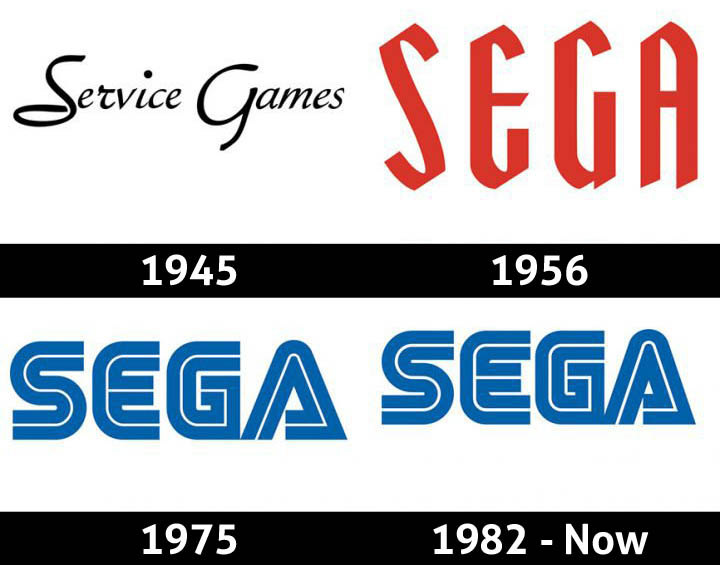
The earliest Sega logo appeared during the company’s formative years under the name “Service Games.” This hand-drawn black wordmark reflected the graphic conventions of the 1940s, prioritizing legibility over stylization. At this stage, the logo served a purely functional purpose, marking equipment rather than building a global brand.

1956–1975: The Birth of the SEGA Name
By the late 1950s, the company had adopted the abbreviated name “SEGA.” The wordmark appeared primarily in red, sometimes outlined in black. This period introduced a custom typeface that would later define the brand’s identity. The rounded, continuous strokes of the letters led to what some historians refer to as the “spiral” Sega logo.
Although exact creation dates are unclear, examples from 1958 confirm that the foundational typography was already in use. During the 1960s, experimental variations appeared, including white lettering with blue outlines on black backgrounds, signaling early brand exploration.

1975–1982: The Futuristic Transition
In the mid-1970s, Sega introduced a more futuristic interpretation of its wordmark. The logo adopted a blue color scheme with internal white striping, visually dividing each letter. This design aligned with the emerging digital and arcade-focused identity of the company.
This period marked Sega’s transition from amusement supplier to entertainment innovator, and the logo reflected a forward-looking, technology-driven mindset.

1985–Today: The Iconic Blue Wordmark
The modern Sega logo, introduced in the mid-1980s, refined the striped letter concept without altering its core structure. Rendered in cobalt blue against white or black backgrounds, the wordmark achieved maximum contrast and instant recognizability.
While minor adjustments were made to proportions and spacing over the years, the overall design remained unchanged. This stability helped cement Sega’s logo heritage, even as the company shifted away from hardware production and focused on software development and publishing.
Typography and Color Palette
Typography is the defining element of the Sega logo description. The current wordmark is believed to be derived from the Yagi Double typeface, a style popular during the logo’s development era. Sega modified the font extensively, elongating and squaring the “E” and “G,” while thinning the “A” to maintain balance and uniformity.
The color palette centers on cobalt blue, a shade chosen for its strong contrast, clarity, and technological associations. Blue conveys trust, intelligence, and stability, qualities that supported Sega’s transition into a global entertainment brand. When paired with white, the logo achieves maximum visual impact across physical and digital environments.
Logo Heritage and Industry Influence
Sega’s logo heritage is inseparable from gaming culture itself. The wordmark has appeared across arcade cabinets, console hardware, cartridges, discs, startup screens, and digital storefronts. Its consistent presence reinforced brand loyalty and nostalgia, even during periods of intense competition and market change.
Beyond the core logo, Sega has produced hundreds of playful variations incorporating characters from its franchises. Despite these creative adaptations, the base wordmark remains untouched, preserving a unified brand identity across decades.
Within broader discussions of gaming brand logo history, Sega stands as a masterclass in typographic branding, proving that a logo does not need constant redesign to remain relevant.
Sega Logo as a Timeless Gaming Icon
The Sega logo is a powerful example of how simplicity, when guided by intention and consistency, can achieve cultural immortality. From its origins as a service-based wordmark to its status as one of the most recognizable names in gaming, the logo reflects the company’s journey through innovation, adaptation, and endurance. In the story of video game branding, Sega’s logo heritage remains a defining chapter.
FAQ: Sega Logo Meaning and History
What does the Sega logo represent?
The Sega logo represents continuity, innovation, and entertainment, expressed through distinctive custom typography.
Why is the Sega logo only a wordmark?
Sega relied on typography to ensure clarity and memorability, allowing the brand name itself to become the symbol.
When was the modern Sega logo introduced?
The modern blue Sega wordmark was finalized in the mid-1980s and remains in use today.
What color is officially associated with the Sega logo?
Cobalt blue is the official Sega logo color, chosen for its contrast and technological associations.