Quake Logo: The Nail, the Ring and id’s Q

Quake came out as shareware on June 22, 1996, from id Software in Mesa, Texas, the studio that had already made Wolfenstein 3D and Doom. It was the first id game with true 3D environments and polygonal monsters, and its engine went on to power or inspire a long line of other games. Its emblem, a broken ring with a nail driven down through the bottom, still marks the series today.
Unlike Doom’s chunky 3D lettering, the Quake mark is a symbol first and a word second. You can see it on the 1996 box art, on the sequels and on QuakeCon banners nearly three decades later.
What is the Quake symbol supposed to be?
At its simplest it is a letter Q. A thick ring, open at the top, forms the bowl of the letter, and a long spike drops through the bottom of the ring to form the tail. Most people read the spike as a nail, which fits the game: the Nailgun and Super Nailgun are among its signature weapons, and their ammo boxes carry the Nine Inch Nails logo as a tribute to Trent Reznor, who made the soundtrack and sound effects.
Other readings exist. Some fans see a horseshoe, others an inverted cross or a medieval torture tool, and logo sites have compared it to a satanic staff. id never published an official explanation, so treat these as interpretations. What is clear is that the dark-fantasy look matched the game’s Lovecraftian monsters, gothic castles and rune-collecting episodes.
Where did the name Quake come from?
The name goes back to id’s in-house Dungeons & Dragons campaign, where Quake was a strongman character with a magic hammer. A teaser for a game called The Fight for Justice, starring Quake, even appeared at the end of Commander Keen in 1990. That project never shipped in that form. By 1996 the hammer-wielding hero was gone, but the name and the medieval tone stayed.
Who worked on Quake?
John Carmack led programming with Michael Abrash and John Cash. Levels came from John Romero, American McGee, Sandy Petersen and Tim Willits, and the art from Adrian Carmack, Kevin Cloud and Paul Steed. Development was famously rocky, and Romero left id shortly after release. The game still sold over 1.4 million copies worldwide by the end of 1997, and id estimated that as many as 5 million copies were in circulation once pirated and shareware copies were counted.
Has the Quake logo changed over the years?
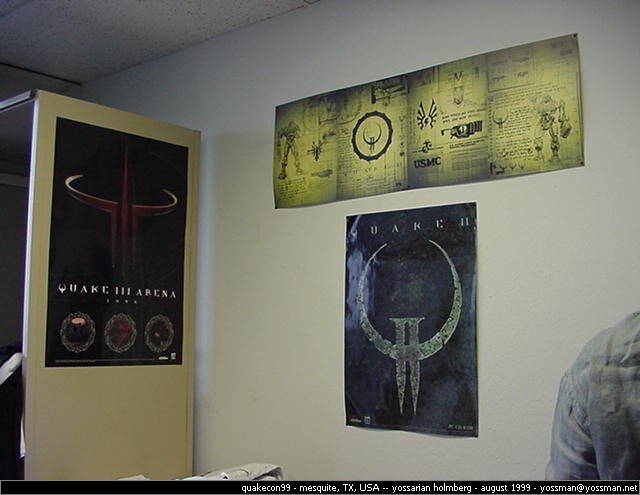
The core shape has barely moved. Quake II (1997) switched to a sci-fi war against the Strogg and gave the lettering a harder, industrial finish, and versions of the Q have appeared on Quake III Arena (1999) and the later games, including Raven Software’s Quake 4 in 2005 and the free-to-play Quake Champions, which entered early access in 2017. Newer versions add metallic shading or texture, while the underlying ring-and-nail silhouette stays the same.
In 2021, Nightdive Studios and Bethesda released an enhanced version of the original on August 19, during QuakeCon, and the emblem was used almost unchanged on the new store pages.

Why does Quake matter beyond its logo?
Quake made online deathmatch mainstream through QuakeWorld, launched the modding scene that produced Team Fortress, which later became Valve’s Team Fortress 2, and supplied the engine base for Valve’s GoldSrc engine and the original Half-Life. Its competitive scene gave rise to some of the earliest esports pros. For id’s earlier branding, see our pieces on the Doom logo and the Wolfenstein logo.
Quick facts
| Developer | id Software |
| Shareware release | June 22, 1996 |
| Retail release (North America) | July 22, 1996 |
| Music and sound | Trent Reznor and Nine Inch Nails |
| Emblem | Open ring with a nail-like spike, read as a Q |
| Enhanced edition | August 19, 2021, by Nightdive Studios |
| Current owner | id Software, part of ZeniMax (Microsoft) |