MTV Logo History: Meaning, Symbolism & Brand Heritage
Few media logos have reshaped popular culture as radically as MTV. Launched on August 1, 1981, MTV did far more than broadcast music videos—it changed how music was marketed, how artists were perceived, and how visual identity could become a cultural force in its own right. At a time when television branding was rigid and conservative, MTV introduced chaos, experimentation, and attitude.
From its earliest days, MTV positioned itself as a channel for youth, rebellion, and creative freedom. That philosophy was embedded directly into its logo. Unlike traditional broadcast marks designed for consistency and authority, the MTV logo was built to be altered, reinterpreted, and reinvented. Its logo heritage is not about static perfection, but about constant transformation.
MTV Logo Meaning and Cultural Identity
The MTV logo meaning goes far beyond typography or color. It represents disruption. From the beginning, the logo was conceived as a flexible container rather than a fixed emblem. This approach mirrored MTV’s editorial mission: to reflect youth culture as it evolves, not to define it rigidly.
The oversized “M” symbolizes mass media and dominance, while the hand-drawn “TV” layered over it suggests spontaneity, irreverence, and individuality. Together, they form a deliberate contrast between structure and rebellion—exactly the tension that defined MTV’s role in culture.
MTV Logo History Timeline: From Experimental Media to Global Icon
1977–1981: “Sight On Sound” and the Pre-MTV Era
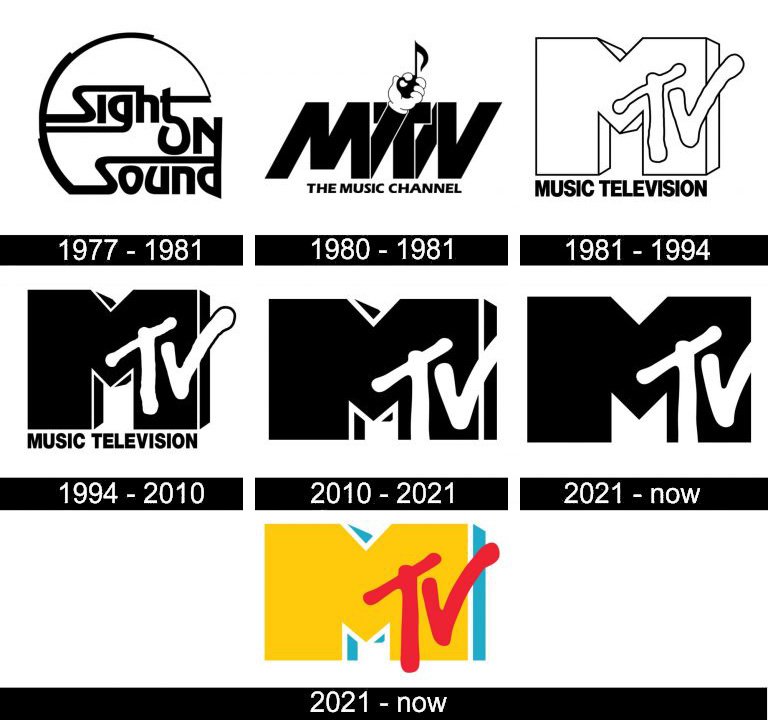
Before MTV existed, the concept lived under a different name: The Music Channel. In 1977, the earliest visual identity featured the phrase “Sight On Sound,” rendered in a progressive, multi-level wordmark. Executed in black and white, the logo used elongated sans-serif letterforms that merged into a rounded frame.
This early identity was experimental and forward-looking, emphasizing audiovisual fusion rather than branding consistency. It remained in use until the channel’s name and concept were finalized.

1980–1981: The First “MTV” Concept and Musical Symbolism
In 1980, Manhattan Design created the first logo to feature the “MTV” name. This transitional emblem introduced several ideas that would define the brand: bold lettering, visual layering, and playful symbolism.
The black “MTV” letters overlapped and were outlined in white. Beneath them appeared the tagline “The Music Channel.” Most notably, a diagonal element extending from the “M” to the “T” was stylized as a cartoon-like gloved hand holding a music note. This detail added humor and approachability, signaling that MTV would not behave like a traditional broadcaster.

1981–1994: The Birth of the Iconic MTV Logo
On August 1, 1981, MTV officially launched with the logo that would become legendary. The design featured a massive, three-dimensional block “M,” with the handwritten letters “TV” scrawled across its surface. In some applications, the words “Music Television” appeared beneath the emblem.
This logo broke every branding rule of its time. It was loud, irregular, and intentionally inconsistent. Most importantly, it was designed to be filled with patterns, textures, and imagery. The logo became a canvas rather than a fixed mark, aligning perfectly with MTV’s experimental programming and visual language.

1994–2010: Refinement Without Reinvention
The 1994 redesign strengthened the logo without altering its structure. The “M” was rendered in solid black with a crisp white outline, while the “TV” remained white with subtle black edging where it extended beyond the “M.”
The proportions were slightly reduced, giving the logo a more refined appearance while preserving its recognizability. This version became the most widely recognized MTV logo, appearing throughout the channel’s global expansion and peak cultural influence.

2010–2021: Flexible Identity and Customization
In 2010, MTV introduced subtle but important changes. The “M” became wider, creating more internal space. This adjustment was intentional: it allowed designers to place images, animations, and textures inside the logo more easily.
This redesign formalized MTV’s long-standing practice of visual customization, aligning it with the emerging concept of “flexible identity.” Rather than locking the logo into a single form, MTV embraced variation as a core branding principle. This version was developed internally, reinforcing MTV’s creative autonomy.

2021–Today: Color, Emotion, and Digital Boldness
In 2021, MTV introduced the most dramatic change in its logo history: color. For the first time, the emblem adopted a permanent color palette. The “M” became bright yellow with a white outline and light blue shadow, while the “TV” turned vivid red.
Yellow introduced optimism and visibility, blue added depth and digital clarity, and red emphasized passion and energy. The structure remained unchanged, but the emotional tone shifted, reflecting MTV’s modern role as a pop-culture brand operating across television, social media, and streaming platforms.

MTV Logo Symbolism Explained
MTV’s symbolism lies in its intentional imperfection. The contrast between the rigid “M” and the chaotic “TV” represents the clash between corporate media and youth expression. The logo’s ability to absorb different textures and colors symbolizes inclusivity, diversity, and constant reinvention.
Unlike logos designed to convey trust or authority, MTV’s emblem communicates freedom and attitude. It does not explain—it reacts.
MTV Logo Typography and Color Meaning
The typography of the MTV logo is deliberately inconsistent. The “M” is heavy, geometric, and architectural, while the “TV” looks hand-drawn and spontaneous. This typographic tension mirrors MTV’s content strategy, which blends polished production with raw, unfiltered expression.
Color usage has evolved from strict black-and-white to bold, expressive palettes. While early monochrome versions emphasized adaptability, the modern yellow-red-blue scheme introduces emotional clarity and digital impact without sacrificing flexibility.
Conclusion: MTV Logo Heritage and the Power of Reinvention
The MTV logo heritage is unlike that of any other media brand. Rather than pursuing timelessness through restraint, MTV achieved longevity through change. Its logo survived decades not because it stayed the same, but because it was designed to evolve.
By treating its logo as a living visual system rather than a static symbol, MTV created one of the most influential identities in modern media history—one that continues to reflect youth culture rather than define it from above.
MTV Logo FAQ: Common Questions About the Iconic Music Channel Logo
Why is the MTV logo so flexible?
MTV designed its logo as a container for visual experimentation, allowing it to change with cultural and artistic trends.
Has the MTV logo ever been completely redesigned?
No. Since 1981, the core structure—a large “M” with handwritten “TV”—has remained consistent.
Why did MTV introduce color in 2021?
The color update reflected MTV’s shift toward digital platforms and emotional storytelling while preserving brand recognition.
What does the MTV logo symbolize?
The logo symbolizes youth culture, rebellion, creativity, and the fusion of mass media with individual expression.