Mercedes Logo: History, Meaning & Evolution
Few symbols in the automotive world carry the same weight, prestige, and instant recognition as the Mercedes-Benz three-pointed star. Today, the badge stands for engineering perfection, luxury, and timeless German craftsmanship — but its story stretches far beyond elegant sedans and powerful engines. The Mercedes logo is rooted in family heritage, early motorsport ambition, and a bold vision to dominate land, sea, and air.
The origins of the brand begin long before the official formation of Mercedes-Benz in 1926. In the late 19th century, two brilliant inventors — Gottlieb Daimler and Karl Benz — were independently shaping the future of mobility. Benz patented the world’s first gasoline-powered automobile, while Daimler was designing advanced engines for everything from early cars to boats and aircraft. Their companies were competitors at first, but after years of parallel success, they merged to create the powerhouse known today as Mercedes-Benz.
The name “Mercedes” itself has a surprisingly personal story. Emil Jellinek — diplomat, businessman, and passionate early adopter of automobiles — commissioned custom vehicles from Daimler. He raced them under a pseudonym inspired by his daughter’s nickname: Mercedes. His influence was so strong that the name eventually became tied to the brand forever.
When the two companies united in 1926, they also introduced a unified visual identity: a three-pointed star held within a circular frame. The symbol would soon become one of the most famous in the world — a sleek, confident emblem representing engineering mastery and universal mobility.
Evolution of the Mercedes Logo
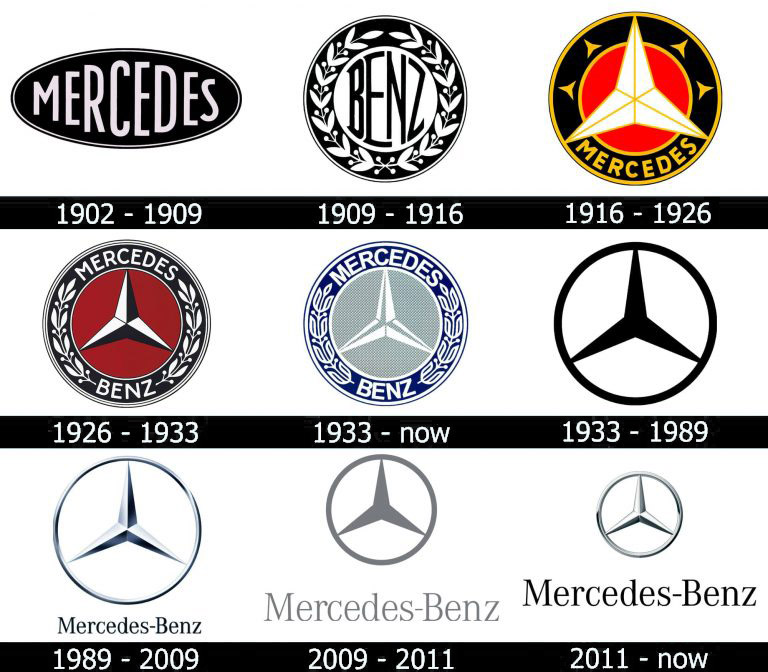
1902–1909: The Early Wordmark
The first Mercedes symbol was a horizontal oval badge featuring a bold, stylized wordmark. Elegant for its time and available in dark blue with silver accents, it helped define the young brand’s presence.
1909–1916: The Wreath & Early Star
Benz & Cie. introduced an ornate circular emblem decorated with laurel leaves — a common symbol of victory. Around the same time, Daimler registered the star symbol that would later inspire the modern Mercedes design, connecting it to Gottlieb Daimler’s earlier personal mark.
1916–1926: Color, Heritage & Ornamentation
A visually rich round badge featured a blue-and-white star on a burgundy field, surrounded by a detailed frame. This version connected strongly with elegance and premium quality — traits that would define Mercedes forever.
1926–1933: The Birth of an Icon
After the merger, the companies unveiled the three-pointed star inside a circular wreath. This is the true beginning of the modern Mercedes identity — clean, luxurious, and deeply symbolic.
1933–1989: Toward Modern Minimalism
While some versions still used ornate wreaths, others adopted a cleaner black-and-white star in a circle. These more minimalist interpretations began defining Mercedes as a future-oriented brand.
1989–2011: Metallic Dimension
The company introduced a sleek, three-dimensional metallic emblem — the version most people still picture on modern Mercedes vehicles. It captured precision, luxury, and engineering confidence.
2011–Today: Refined Modern Luxury
The current logo enhances the metallic star with cleaner lines and a slightly thicker circle, paired with an elegant serif wordmark. It looks modern yet unmistakably classic — a perfect reflection of Mercedes-Benz design philosophy.
What the Mercedes Symbol Really Means
The three-pointed star is often interpreted in multiple ways, but the most widely accepted meaning is Daimler’s original vision:
Mobility across land, sea, and air.
Mercedes once engineered engines for all three, and the emblem expressed this universal ambition.
Other interpretations include:
-
The unity of driver, passenger, and mechanic
-
A symbol of perfection, tied to the number three
-
A nod to Daimler’s early personal star mark used on postcards to his family
Regardless of interpretation, the star has remained consistent in one thing: it signals excellence.
Emblem Design: Font & Color
Font:
Mercedes pairs its emblem with a refined serif typeface — sharp, balanced, and sophisticated. It resembles Corporate A and other timeless serif fonts, though customized for exclusivity.
Color:
Black, silver, and metallic gray dominate the brand’s palette. The shift to 3D chrome in the late 20th century strengthened the identity of Mercedes as a luxury technology brand. Even earlier flat black designs felt premium due to the strict geometry of the star.
Interesting Facts
-
The first Mercedes cars were introduced as racing vehicles, driven under the alias “Monsieur Mercedes” by Emil Jellinek.
-
After World War II, production of civilian Mercedes vehicles helped the company survive the international ban on military manufacturing.
-
Some modern models feature a glowing LED emblem, available on select GLE, GLS, CLS and E-Class versions.
Mercedes Logo FAQ
Why is the Mercedes logo a three-pointed star?
It symbolizes the company’s ambition to power vehicles on land, sea, and in the air.
Who came up with the name Mercedes?
Emil Jellinek, a major Daimler client and promoter. The name honored his daughter’s nickname.
Which Mercedes cars have a glowing emblem?
Primarily the GLE and GLS SUVs, plus some CLS and E-Class sedans equipped with an optional illuminated badge.
Is the Mercedes logo inspired by a steering wheel?
Some early interpretations suggested this, but official records tie it to Daimler’s star symbol and the “three-elements” philosophy.