Maison Margiela Logo: The Numbers and the Four White Stitches
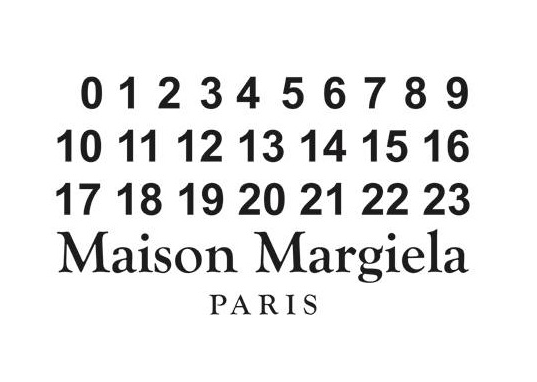
Maison Margiela built one of the best-known logos in fashion by trying not to have one. Its founder, the Belgian designer Martin Margiela, refused interviews and photographs, and his clothes carried a blank white label held on by four white stitches. Then came a strip of numbers from 0 to 23 with one number circled. That anti-logo is now so familiar that the four stitches peeking from the back of a sweater are enough for fans to spot the brand across a room.
What does the Maison Margiela logo mean?
The house’s identity has two parts. The first is the name, MAISON MARGIELA, set in a simple serif, sometimes with PARIS underneath. The second, and better known, is the number label: a small grid of the numbers 0 to 23 printed in plain type, with one number circled. The circled number tells you which line the item belongs to. For example, 0 marks the Artisanal collection of reworked, handmade pieces, 1 the women’s collection, 10 the men’s collection and 22 shoes.
The idea behind it was to point attention away from a designer’s name and toward the clothes and the way they were made. A logo that looks like a page from a catalogue, with no symbol and no flourish, was itself a statement against the logo-heavy luxury of the 1980s.
Why do Margiela clothes have four white stitches?
From the start, Maison Martin Margiela sewed a blank white cotton label inside its garments, attached at the corners with four large white tacking stitches. On many pieces the stitches go through to the outside, so they show as four small white marks on the back of a jacket or jumper, just below the collar. Owners were meant to be able to cut the label off easily, which would leave the piece anonymous. Instead, the four stitches became a quiet sign of the brand, recognised by people who know fashion, and they are still used today.
How has the Margiela logo changed?
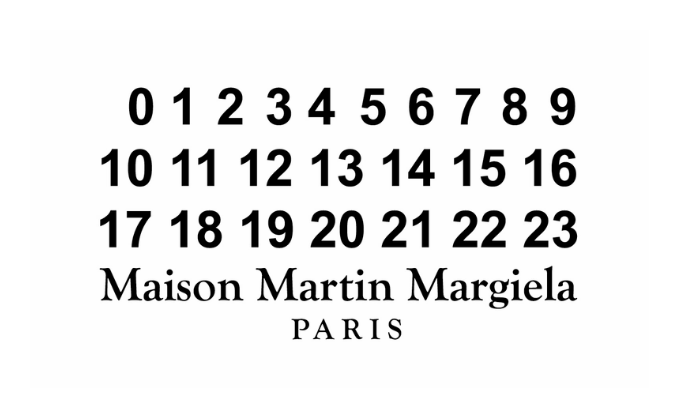
The biggest change was in the name. For its first 26 years the house was called Maison Martin Margiela, and the number labels and shop signs used that full name. In January 2015, at the same time as John Galliano’s first collection for the house, the company dropped “Martin” and became Maison Margiela. The number grid and the four stitches stayed. The wordmark was simplified to the two-word name, and in recent years it has been used with PARIS below it on bags, packaging and shop fronts.
Who is Martin Margiela?
Martin Margiela was born in Belgium and studied fashion at the Royal Academy of Fine Arts in Antwerp, graduating in 1979, a year before the group of designers later known as the Antwerp Six. He worked as an assistant to Jean Paul Gaultier in Paris from 1984 to 1987, and in 1988 founded his own label with business partner Jenny Meirens. His first shows took place in unusual places such as empty metro stations and street corners, and the models’ faces were often covered. He never took a bow, gave interviews by fax and signed letters “we,” which led the press to call him fashion’s invisible man.
His designs became famous for deconstruction: exposed seams and linings, garments made from old clothes and flea-market finds, and the split-toe Tabi boot, which first appeared on the runway in 1988 and has become one of the house’s best sellers. From 1997 to 2003 he also designed womenswear for Hermès. Margiela left his label in 2009.
Who owns Maison Margiela today?
In 2002 the house was bought by OTB, the Italian group led by Renzo Rosso, founder of Diesel. After Margiela’s departure an anonymous design team ran the collections until John Galliano became creative director in 2014. Galliano stayed for ten years and left at the end of 2024, after a well-received Artisanal show. In January 2025 Belgian designer Glenn Martens was named creative director, and he showed his first collection for the house that summer. The brand is now known in the United States as much for its Tabi shoes, Replica fragrances and Glam Slam bags as for its catwalk shows.
How did the Margiela anti-logo influence other designers?
Most luxury houses use logos that are easy to recognise from a distance, like the Chanel double C, the Gucci G or the laurel of MCM. Margiela went the other way and made a logo that only insiders read. That approach influenced a generation of designers. Balenciaga under Demna, who worked on Margiela’s design team before moving on, and labels like Off-White played with labels, quotation marks and printed tags as part of the design. Margiela’s diffusion line, MM6, takes its name from the number 6 that once marked it on the grid.
Quick facts
| Founded | 1988, Paris |
| Founders | Martin Margiela and Jenny Meirens |
| Logo | Number grid 0 to 23 with one number circled, plus MAISON MARGIELA wordmark |
| Signature detail | Four white stitches holding a blank label |
| Name change | Maison Martin Margiela became Maison Margiela in 2015 |
| Owner | OTB (since 2002) |
| Creative director | Glenn Martens (since 2025); John Galliano 2014 to 2024 |