
Lazada Logo History: Meaning, Symbolism & Brand Heritage

Lazada grew into a household name in Southeast Asia by making online shopping feel local, fast, and familiar across very different markets. In the wider world of Shopee Logo History and Myntra Logo History, Lazada’s identity stands out for how decisively it moved from “marketplace utility” to “brand emotion” without losing clarity. Within E-Commerce Logos, its logo history is a clean example of a platform evolving from a functional shopping symbol into a recognizable brand system built for apps, campaigns, and everyday trust.
The Lazada logo meaning has changed in one important way over time. Early branding focused on the act of buying. Modern branding focuses on the feeling of discovery, confidence, and connection. That shift is the heart of Lazada’s logo heritage.
Lazada Logo Meaning and History: The Origin of a Regional E-Commerce Flagship
Lazada was established in 2012 and quickly positioned itself as a multi-category marketplace built for Southeast Asia’s diverse consumer habits. From the beginning, the brand needed a logo description that could work across languages, cultures, and mobile-first behavior. That requirement shaped its earliest identity: a shopping cart, simple typography, and bright colors that read instantly on screens.
By 2016, Lazada became the regional flagship of Alibaba Group, gaining access to large-scale technology infrastructure and long-term expansion resources. That business shift didn’t immediately require a loud visual overhaul, but it did raise the stakes for branding. As the platform matured, the Lazada logo history moved toward a more polished and scalable identity—less literal, more emotional, and more consistent across digital surfaces.
In other words, Lazada’s logo origin began as a direct e-commerce signpost. Its modern logo meaning is closer to a brand promise: shopping as an enjoyable experience, not just a transaction.
Lazada Logo Symbolism: From Shopping Utility to Heart-Shaped Brand Energy
Lazada’s logo symbolism can be read as a timeline of how e-commerce brands grow up.
The earliest symbol used a shopping cart, the most literal metaphor in online retail. It communicated function first: buy things here. Bright multi-color accents reinforced variety and category range, a common approach for early marketplaces trying to prove breadth.
The 2014 identity stripped that storytelling away and leaned into typography. This was a symbolism shift toward professionalism and stability. A clean uppercase wordmark signaled confidence and scale, suggesting Lazada was no longer “just a site with products” but a platform with structure.
The 2019 rebrand brought symbolism back, but in a more sophisticated way. The heart-like geometric emblem introduced warmth and human emotion into the identity. It didn’t replace utility; it elevated it. Combined with a dark blue wordmark, the symbol creates a clear contrast between energy and trust—exactly the mix a marketplace needs when it wants to feel exciting while still feeling reliable.
Lazada Logo History Timeline: Year-by-Year Evolution of the Wordmark and Emblem
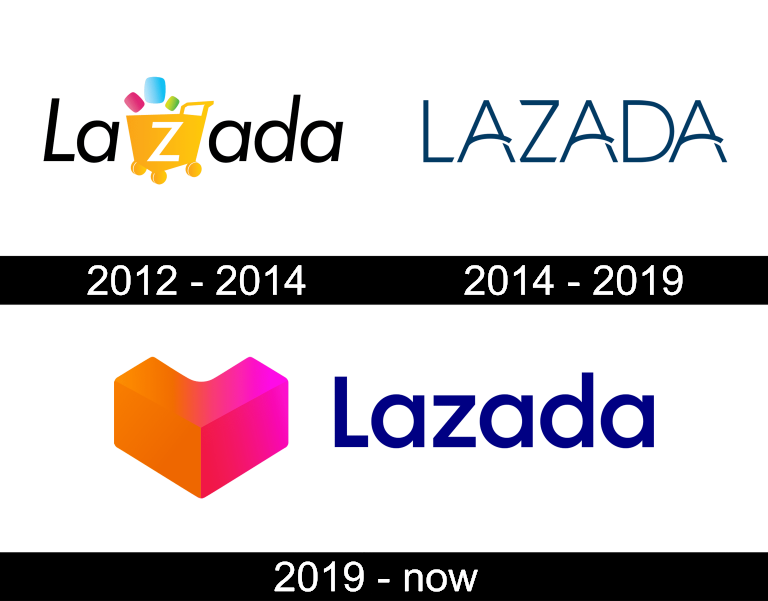
2012–2014: Shopping Cart Origins and Variety-First Marketplace Branding
Lazada’s first logo paired a playful shopping cart emblem with a simple title-case wordmark. The “Z” stood out inside the cart, while colorful shapes suggested product variety and broad category choice. The overall logo description was direct and friendly, designed for fast recognition and for communicating what the platform does at first glance. This era defined the early logo meaning as function-driven e-commerce identity.

2014–2019: The Uppercase Wordmark Era and a More Corporate Marketplace Voice
The 2014 redesign removed the cart and replaced the entire identity with a strong uppercase wordmark. Custom letter details added personality, but the overall direction was cleaner and more formal, using dark blue to signal stability. This stage shifted Lazada’s logo symbolism toward professionalism and platform maturity, building stronger logo heritage through a consistent, scalable typographic mark.

2019–Today: The Heart Emblem Rebrand and Modern Lazada Brand Heritage
In 2019, Lazada introduced a geometric emblem with a warm pink-to-orange gradient paired with a dark blue wordmark in title case. The emblem reads like a stylized heart, adding emotion and friendliness to the identity without sacrificing clarity. The wordmark reinforces trust and legibility, while the emblem adds energy and memorability. This era strengthened Lazada’s logo heritage by creating a system that works across app icons, campaigns, and regional markets with a single recognizable shape.
Lazada Logo Heritage Conclusion: How a Marketplace Logo Became a Brand Symbol
The Lazada logo history is a story of moving from literal retail cues to emotional brand ownership. The early cart symbol made the platform easy to understand. The 2014 wordmark made it feel established. The 2019 emblem completed the evolution by turning Lazada into a recognizable symbol, not just a name.
That is what gives Lazada its modern logo heritage. The logo meaning today is not only “shop here,” but “shop with confidence and enjoyment.” Its logo symbolism blends warmth and reliability, and its logo description remains clean enough to scale across every screen where e-commerce lives.
Lazada Logo History FAQ: Meaning, Symbolism, and Origin
What does the Lazada logo represent?
The Lazada logo represents online shopping with a modern brand focus. Earlier versions emphasized retail utility, while the current emblem and wordmark reflect trust, discovery, and a warmer marketplace identity.
Why does Lazada use a heart-like emblem?
The emblem adds emotional symbolism to the brand, suggesting care, connection, and enjoyment—positioning Lazada as more than a functional marketplace.
When was Lazada founded?
Lazada’s origin dates to 2012, when it launched as a Southeast Asia-focused e-commerce platform.
Why did Lazada remove the shopping cart from its logo?
As the platform matured, Lazada shifted from literal retail imagery to a more scalable and professional identity, relying on typography and later a distinctive emblem to build stronger logo heritage.
What colors define Lazada’s current logo meaning?
Dark blue supports trust and stability, while the pink-to-orange gradient adds warmth, energy, and a modern digital feel.