J.Crew Logo: How the Name and Wordmark Came About
J.Crew started as a mail-order catalogue in 1983 and became shorthand for a certain kind of American style: chinos, striped T-shirts, cable-knit sweaters and good coats, worn on weekends in New England or at the office in Manhattan. Its logo has followed the brand’s moods, from a looping script to crisp serif capitals and back again to a version with a descending J that recalls its catalogue years.
What does the J.Crew logo mean?
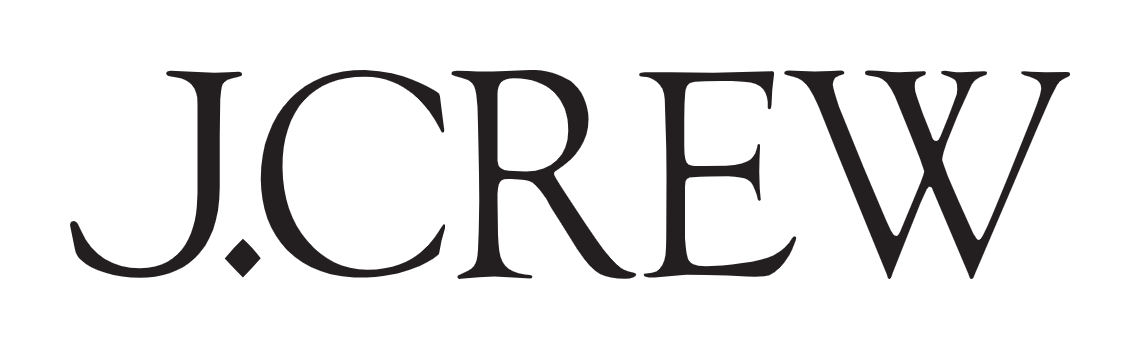
The current logo spells J.CREW in wide, elegant serif capitals with fine contrast between thick and thin strokes. The J drops slightly below the line, a small detail that gives the word a hand-set, slightly old-fashioned feel. The full stop after the J makes the name read almost like a person’s initial and surname, which suits a brand that sells the wardrobe of an imagined, well-dressed American.
The name itself comes from the sport of crew, or rowing, a pastime of East Coast universities, with a J added mainly because it looked good. That link to collegiate sport set the tone for the clothes from the start.
Has the J.Crew logo changed over time?
Yes, several times. According to logo archives such as 1000 Logos, the brand’s earliest marks used a flowing, connected cursive script in black, a version still kept on Wikimedia Commons as the J.Crew script logo. From 1983 the company used clean serif capitals with a J that hooked below the baseline, the look of the catalogue era. In 2012 the J was lifted onto the baseline and the letters became bolder and shorter.
The version on the company’s website today, introduced around 2021, brings back a descending J and lighter, more classical serifs, a nod to the brand’s 1980s and 1990s heyday at a time when J.Crew was leaning into its own archive.
Who founded J.Crew?
J.Crew grew out of Popular Merchandise, a company founded in 1947 by Mitchell Cinader and Saul Charles that sold inexpensive women’s clothing through home parties. Under Arthur Cinader and his daughter Emily Cinader Woods, the business created the J.Crew brand in 1983 and mailed its first catalogue that year. Sales grew quickly through the 1980s, and the first J.Crew shop opened at South Street Seaport in Manhattan in March 1989.
Texas Pacific Group bought a majority stake in 1997. Mickey Drexler, formerly head of Gap, joined in 2003 and, with creative director Jenna Lyons, turned J.Crew into one of the most talked-about American brands of the 2000s. The company bought the rights to the Madewell name in 2004 and launched it as a separate line in 2006.
Who owns J.Crew today?
J.Crew went public in 2006 and was taken private again in 2011 in a buyout of about US$3 billion by TPG Capital and Leonard Green & Partners. Heavy debt and falling sales followed. Drexler stepped down as chief executive in 2017, the same year Jenna Lyons left. On 4 May 2020, early in the COVID-19 pandemic, J.Crew filed for Chapter 11 bankruptcy and emerged in September 2020 under the control of its lenders, led by Anchorage Capital. Libby Wadle has been chief executive since November 2020.
J.Crew’s preppy American look puts it alongside Ralph Lauren, Brooks Brothers and Banana Republic.
Quick facts
| Founded | 1983 as J.Crew (company roots in 1947) |
| Key figures | Arthur Cinader, Emily Cinader Woods, Mickey Drexler, Jenna Lyons |
| Headquarters | New York City |
| Name | From the sport of crew (rowing) |
| Logo | Serif J.CREW capitals with a descending J |
| First store | South Street Seaport, Manhattan, 1989 |
| Sister brand | Madewell |
| Website | jcrew.com |