Issey Miyake Logo and the Designer Behind It
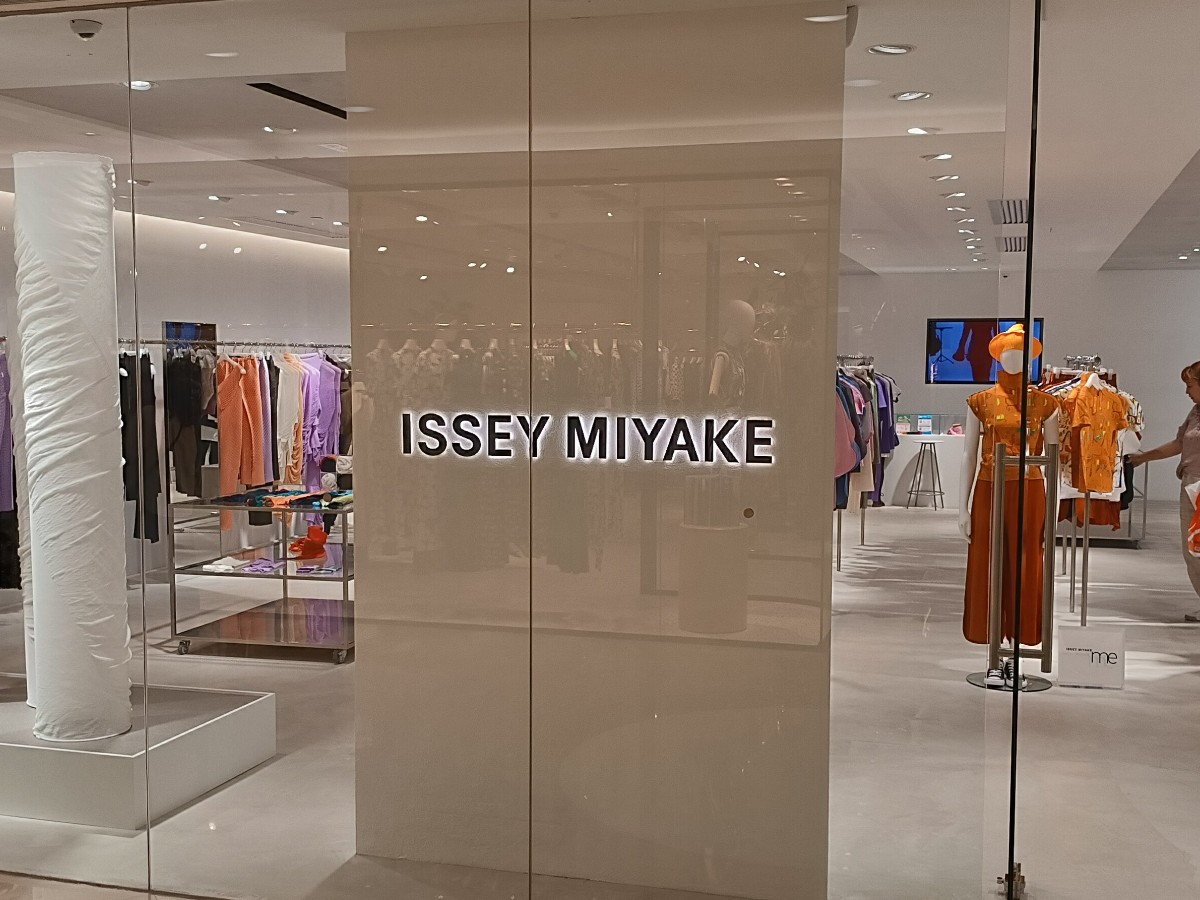
Issey Miyake built one of fashion’s most recognisable bodies of work around a simple idea he called “a piece of cloth”: clothing that starts from the fabric and the space between it and the body. The company he founded in Tokyo in 1970 has always presented its name with matching restraint. There is no crest and no monogram on the front of the shop, only ISSEY MIYAKE in clean, evenly spaced capitals.
What does the Issey Miyake logo mean?
The main logo is the designer’s name set in plain, upright capitals with steady proportions and generous spacing. It has the calm of Japanese graphic design, where clarity and balance matter more than decoration, and it suits clothes that are often complex in construction but simple in outline. The brand logo was developed by the graphic designer Taku Satoh, while an earlier IM motif was designed in 1979 by Ikko Tanaka, one of Japan’s best-known post-war graphic designers and a long-time collaborator of Miyake.
The house also runs several lines under their own names, such as PLEATS PLEASE ISSEY MIYAKE, HOMME PLISSÉ ISSEY MIYAKE and BAO BAO ISSEY MIYAKE. Each uses its own lettering, but they share the habit of placing the founder’s name in plain capitals alongside the line name.
Has the Issey Miyake logo changed over time?
Only modestly. Logo archives such as 1000 Logos describe the simple sans-serif capitals as the main logo since the late 1980s, with a serif version used for some products, notably the fragrances sold as Issey Miyake Parfums. Earlier material from the brand’s first decades used softer, more decorative lettering, including a red version. The steady, unadorned wordmark used today on shop fronts and the company’s website keeps the focus on the clothes.
Who founded Issey Miyake?
Issey Miyake was born in Hiroshima in 1938 and studied graphic design at Tama Art University in Tokyo, graduating in 1964. He then worked in Paris, apprenticing under Guy Laroche and working with Hubert de Givenchy, and in New York for Geoffrey Beene. Returning to Tokyo in 1970, he founded the Miyake Design Studio and presented his first Issey Miyake collection in 1971.
His research into fabric led to the patented pleating technique behind Pleats Please, launched in 1993, in which garments are cut and sewn first and pleated afterwards. In 1998 he introduced A-POC, short for “a piece of cloth”, where garments are formed from a single tube of machine-knitted fabric. The fragrance L’Eau d’Issey, created with perfumer Jacques Cavallier, became one of the best-selling scents of the 1990s, and Miyake also made the black turtlenecks worn by Steve Jobs.
Who runs Issey Miyake today?
Issey Miyake died in August 2022, aged 84. The company, Issey Miyake Inc., remains based in Tokyo and continues his design studio approach, with collections built on research that starts from the yarn. Designers trained in the studio have led the main lines over the years, including Naoki Takizawa, Dai Fujiwara, Yoshiyuki Miyamae and Yusuke Takahashi. Since spring/summer 2020 the ISSEY MIYAKE line has been designed by Satoshi Kondo.
For other fashion houses known for experimenting with materials, see Prada, whose nylon bags changed luxury accessories in the 1980s.
Quick facts
| Founded | 1970, Tokyo (Miyake Design Studio) |
| Founder | Issey Miyake (1938 to 2022) |
| Logo | ISSEY MIYAKE in plain, evenly spaced capitals |
| Logo designers | Ikko Tanaka (IM motif, 1979); Taku Satoh (brand logo) |
| Known for | Pleats Please (1993), A-POC (1998), L’Eau d’Issey, Bao Bao |
| Designer | Satoshi Kondo (ISSEY MIYAKE line since 2020) |
| Website | isseymiyake.com |