Helly Hansen Logo: What the HH Stands For
Helly Hansen began in 1877 in Moss, a small port on the Oslofjord, when a former sea captain and his wife started selling waterproof linen soaked in linseed oil to fishermen and sailors. Nearly 150 years later the brand dresses offshore workers, ski patrols and city commuters, and its red square with two white letters has become one of the most recognisable marks in outdoor clothing.
What does the Helly Hansen logo mean?
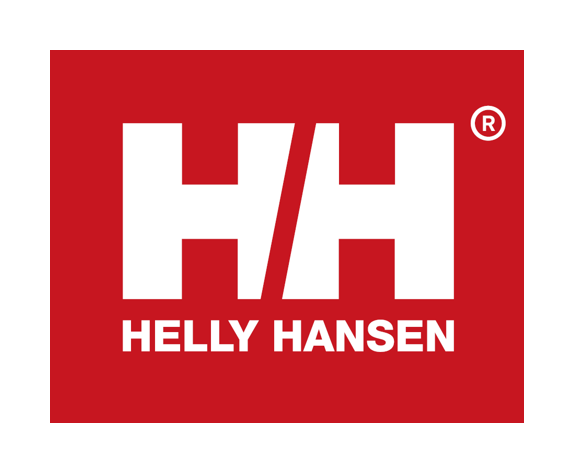
The logo is built from the founder’s initials. Two white capital H letters sit side by side on a red square, joined by a slanted stroke so that the pair reads almost like a single shape, often written as H/H. The name HELLY HANSEN runs underneath in plain white capitals, with a small registered sign beside the letters.
Red and white were practical choices for a company that makes gear for the sea and the mountains: the colours stand out against grey water, snow and fog, and they echo the bright red used on rescue and safety equipment. The tight, blocky letters also work well when stitched small on a sleeve, a cap or the chest of a jacket.
Has the Helly Hansen logo changed over time?
Yes, in three main steps according to logo archives such as 1000 Logos. From around 1969 the brand used its name in a bold script inside a simple rectangle, a look that leaned on its long history. In 1989 it switched to a modern sans-serif wordmark with the two H letters split by a thin red diagonal line, creating the double-H emblem for the first time.
The current version, in use since 2015, places the HH symbol and the name in white on a solid red square. The square makes the logo work as a patch or a badge, and gives the brand a strong block of colour on shop fronts and websites.
Who founded Helly Hansen?
Helly Juell Hansen and his wife, Maren Margarethe, founded the company in 1877. Their first products were oilskin jackets, trousers, sou’westers and tarpaulins made from linen treated with linseed oil, and the goods won a diploma at the Paris Exhibition of 1878, which helped them start exporting.
The company kept working on new fabrics. Helox, a PVC rain material, followed in 1949. In the 1970s Helly Hansen developed LIFA, a polypropylene base layer that pulls moisture away from the skin, and combined it with a pile insulation layer and rainwear to create one of the first layering systems for outdoor clothing. The same decade it made survival suits for workers on North Sea oil platforms, and in 1980 it introduced the breathable Helly Tech fabric.
Who owns Helly Hansen today?
The company passed through several owners after the 1990s, including Orkla, Investcorp, Altor and the Ontario Teachers’ Pension Plan, before Canadian Tire bought it in 2018 for CA$985 million. In February 2025 the American group Kontoor Brands, owner of Wrangler and Lee, agreed to buy Helly Hansen for about US$1.3 billion, and the deal was completed in June 2025. The head office moved from Moss to Oslo in 2009.
Helly Hansen competes in outerwear with brands such as The North Face and Canada Goose, and it sponsors sailing, including The Ocean Race, as well as ski teams and mountain guides.
Quick facts
| Founded | 1877, Moss, Norway |
| Founders | Helly Juell Hansen and Maren Margarethe Hansen |
| Headquarters | Oslo, Norway |
| Owner | Kontoor Brands (since June 2025) |
| Logo | White HH initials and name on a red square (since 2015) |
| Known for | Oilskins, LIFA base layers, sailing and ski wear, workwear |
| Website | hellyhansen.com |