Dockers Logo: The Wing and Anchor Explained
A Levi Strauss merchant travelling in Asia in the mid-1980s bought a few pairs of casual trousers that the company was selling in Japan as “Docker Pants,” complete with a wings-and-anchor badge, and carried them back to the United States, where they became the starting point for the Dockers brand launched there in 1986. The khakis went on to define office dress in the 1990s, the badge went through three redesigns before Dockers brought the original back in 2018, and in early 2026 Levi Strauss finished selling the whole brand to Authentic Brands Group.
What does the Dockers logo mean?
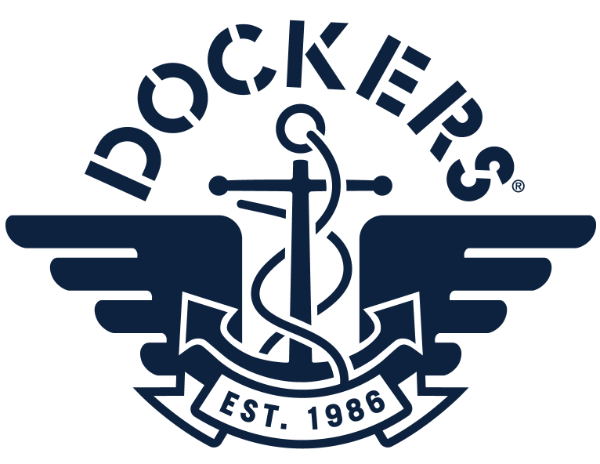
The current Dockers logo is a navy badge built around a ship’s anchor with a rope wound around its shank. A pair of broad, stepped wings spreads out from either side of the anchor, the word “DOCKERS” arches over the top in a stencil-style typeface with small gaps cut through the letters, and a ribbon across the bottom reads “EST. 1986.”
Every part of it points to the waterfront. The name comes from the British word “dockers,” meaning longshoremen, and early Dockers swing tags even showed a longshoreman in khakis on a quay as passengers stepped off a ship. The anchor ties the brand to the docks, the stencil lettering looks like the markings painted on shipping crates, and the wings, which recall military insignia, give a plain pair of trousers a bit of uniform-like pride.
Has the Dockers logo changed over time?
Yes, three times before it came full circle. The original 1986 badge was black and white, with a large anchor, two heavy black wings and the stencil “DOCKERS” arched above it.
Around 2000 the brand separated the parts: a solid, heavier “DOCKERS” wordmark sat above a lighter emblem whose wings were drawn as thin horizontal lines inside the anchor badge. A further update in 2008 redrew the lettering in a steadier sans-serif without the stencil gaps, refined the anchor, and reduced the wings to four smooth black strokes.
In April 2018 Dockers went back to its original badge, slightly modified. Karen Riley-Grant, then vice president of global marketing, said the change celebrated the brand’s roots and heritage and signalled a new chapter. The restored logo, with the “EST. 1986” ribbon, is the one Dockers uses today.
Where did Dockers come from?
The name was used inside Levi Strauss & Co. before the U.S. brand existed. In 1982 the company’s Argentine business made a line of nautically inspired jeans called Dockers, and in 1985 Levi’s Japan sold casual bottoms as “Docker Pants” with a wings-and-anchor logo. After those Japanese trousers reached the U.S. head office, Levi Strauss launched Dockers in America in 1986 as a brand of cotton khakis for men who wanted something between jeans and suit trousers.
The timing worked in its favor. Casual Fridays spread through American offices in the late 1980s and 1990s, and Dockers, later led by executive Bob Siegel, became the default “business casual” trouser; Levi Strauss even credits the brand with helping invent Casual Friday. The khakis put Dockers in the same wardrobe as shirts from Gap, Banana Republic and Brooks Brothers, while its rugged chinos compete with workwear names like Carhartt. By its 30th anniversary in 2016 it was sold in 60 countries, and its 2010 “Wear the Pants” campaign premiered during the Super Bowl.
Who owns Dockers today?
Dockers belonged to Levi Strauss & Co. for nearly four decades. On 20 May 2025 Levi Strauss agreed to sell the brand to Authentic Brands Group for $311 million, with an earnout of up to $80 million more depending on how Dockers performs. The U.S. and Canadian business moved over in 2025, and the international operations followed, with Levi Strauss announcing the final closing at the end of February 2026. Levi Strauss said the sale let it concentrate on the Levi’s brand and its Beyond Yoga activewear label.
Quick facts
| Launched in the U.S. | 1986 |
| Created by | Levi Strauss & Co. |
| Name | British term for longshoremen (dock workers) |
| Signature product | Men’s cotton khakis |
| Logo | Anchor, wings and arched stencil wordmark; original badge restored in 2018 |
| Owner | Authentic Brands Group (sale agreed May 2025, completed early 2026) |
| Sale price | $311 million, plus up to $80 million earnout |