Dakine Logo History

Dakine started in 1979 in Haiku, on the Hawaiian island of Maui, when Rob Kaplan began repairing and then making stronger surf leashes. A year later he brought out what the company calls the first adjustable foot strap for windsurf boards, and windsurfing became the brand’s home sport. He named the company after the Hawaiian Pidgin phrase “da kine,” a catch-all word that means roughly “the thing” or “you know, that one.” Today the brand makes backpacks, snow gloves, surf leashes and other gear, and it belongs to the brand-licensing firm Marquee Brands.
What does the Dakine logo mean?
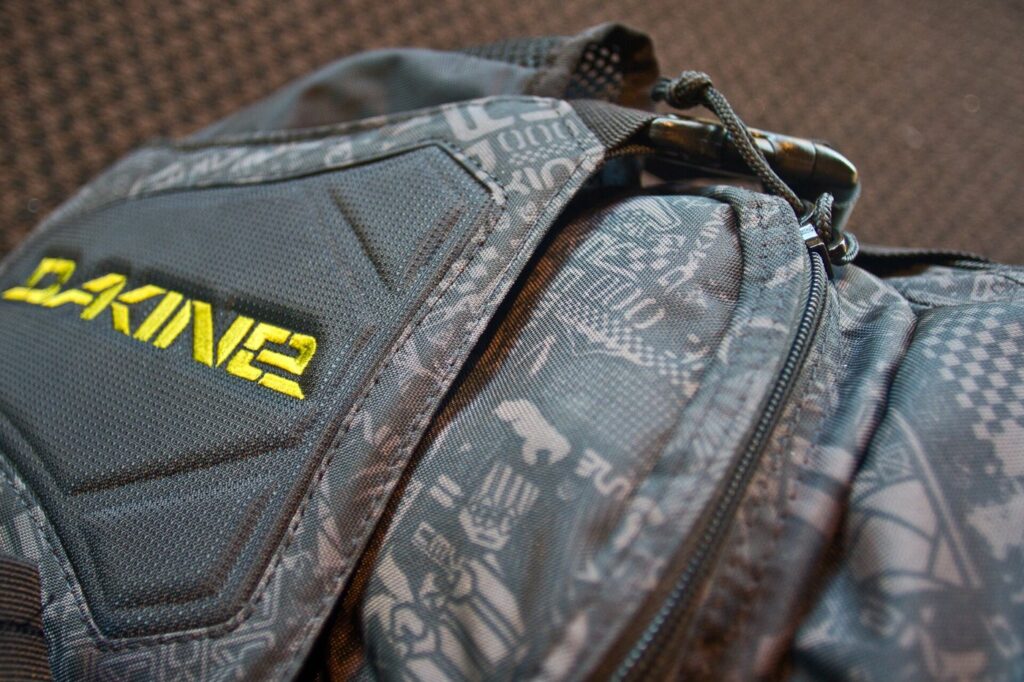
The logo is the name alone, in heavy black capitals with no symbol. Two letters stand out: the bottom stroke of the D runs out to the left and the bottom stroke of the E runs out to the right, so the word sits on a long line from end to end. The effect is a bit like a board under the letters, which suits a company that grew out of windsurfing.
The design has stayed black and white and has not changed much over the years. That has helped it survive several owners and moves, and it is easy to stitch onto a glove cuff or print on a strap.
Who founded Dakine, and who owns it today?
Kaplan’s foot straps sold well among Maui windsurfers, and the business soon added harnesses and bags. In 1986 Dakine moved to Hood River, Oregon, a town on the Columbia River Gorge known for strong winds and windsurfing, and later kiteboarding. From there it grew into snowboarding and mountain biking gear.
Australian surf company Billabong bought Dakine for about $100 million in 2008. In 2013 Billabong, short of cash, sold it to private equity firm Altamont Capital Partners for about $70 million. In December 2018 Marquee Brands acquired the Dakine name and intellectual property, while a company called JR286 took over day-to-day operations under a long-term license. The brand is now run from Torrance, California.
How did Dakine grow beyond windsurfing?
Most of the range grew out of customer requests. In 1982 the company added a waist harness and travel bags, and in 1983 it made what it describes as the sport’s first seat harness. After the move to Hood River, a snowboarder asked for a pack that carried only the essentials for helicopter trips in Alaska, and the result was the Heli Pack, still one of the brand’s best-known backpacks.
From the mid-2000s, as Hood River turned into a mountain biking area, Dakine began making packs and protective gear for riders too. Today its catalog covers surfing, kiteboarding, windsurfing, snowboarding, skiing and biking, with the same black wordmark on all of it.
Where is Dakine sold outside the US?
In 2025 Marquee Brands signed a deal with the distributor All Sport to sell more Dakine products in Europe. All Sport planned a new warehouse for the brand’s European shops and online orders, due to open in the first half of 2026. Dakine already works with regional distributors in other markets, including Japan, Taiwan, Australia and New Zealand, and the United Kingdom.
Quick facts
| Founded | 1979 |
| Founder | Rob Kaplan |
| Headquarters | Torrance, California |
| Industry | Action-sports gear and accessories |
| Owner | Marquee Brands (since 2018) |
| Logo | Bold monochrome wordmark with elongated “D” and “E” letterforms |
| Known for | Windsurfing and board-sports gear; name from Hawaiian Pidgin “da kine” |
In outdoor shops, Dakine packs and gloves usually hang near Vans, The North Face and Carhartt, with Under Armour and Skechers a few aisles over.