Courtyard Logo History: Meaning, Symbolism & Brand Heritage
Courtyard occupies a distinctive position within modern hospitality branding. Designed from the beginning as a business-focused hotel concept, the brand balances professionalism with approachability, offering consistency without formality and comfort without excess. The Courtyard logo history closely mirrors this positioning, evolving from traditional heraldic imagery into a restrained, contemporary identity aligned with transient business travel. When viewed alongside the corporate refinement explored in the Marriott logo history and the value-driven clarity seen in the Hampton logo heritage, Courtyard represents a carefully calibrated identity within global hotel logo history.
The Courtyard logo meaning emphasizes stability, clarity, and efficiency. Rather than projecting luxury or leisure, the visual identity communicates reliability and focus, reinforcing the brand’s appeal to business travelers seeking familiarity and comfort across locations.
Meaning and History: The Origin of the Courtyard Identity
Courtyard was introduced in 1983 by Marriott International as a purpose-built concept targeting short-stay business travelers. The first Courtyard hotel opened in Atlanta, Georgia, offering a new alternative within the upscale segment that prioritized functionality over decorative design.
From its inception, Courtyard was positioned as a practical extension of Marriott’s portfolio, focusing on efficient service, neutral interiors, and predictable quality. As global business travel expanded through the late 20th and early 21st centuries, the brand grew rapidly, eventually becoming the largest brand within the Marriott International portfolio by number of properties.
The logo origin reflects this pragmatic philosophy. Each redesign aligned with Courtyard’s evolving role within Marriott, shifting from traditional hospitality symbolism toward a modern, streamlined identity suitable for a globally mobile clientele.
Logo Symbolism: Stability, Focus, and Business-Oriented Comfort
The Courtyard logo symbolism is grounded in balance and restraint. Early tree imagery suggested calm and order, reinforcing the idea of a quiet, controlled environment conducive to work and rest. Over time, these symbolic elements were simplified or removed as the brand moved toward abstraction and typographic clarity.
Color choices also play a strategic role. Greens and golds initially conveyed reassurance and hospitality tradition, while later neutral grays and contemporary accent colors reflected professionalism and modern business culture. The current palette introduces warmth without distraction, signaling energy and progress rather than luxury.
Courtyard Logo History Timeline
1982–2003: Heraldic Crest and Hospitality Tradition
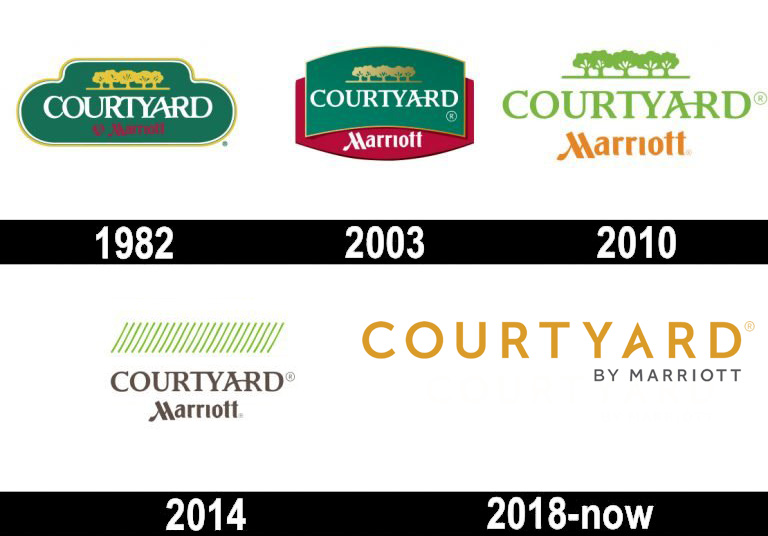
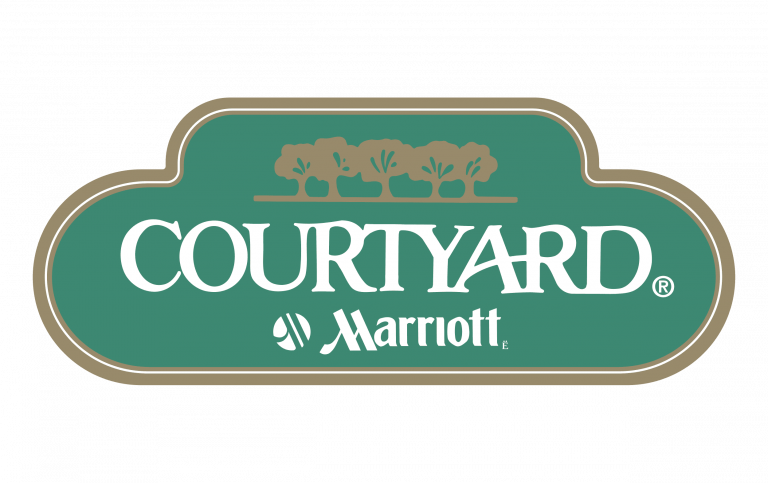
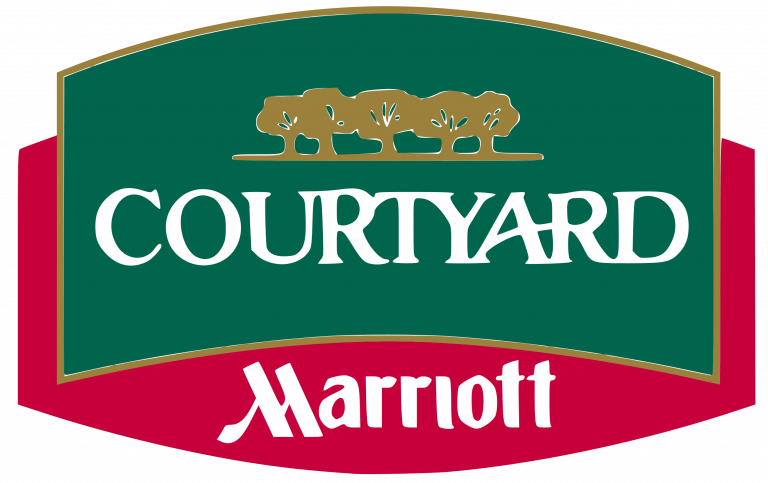
The original Courtyard logo was designed in 1982, ahead of the brand’s official launch, and remained in use for more than two decades. It featured a horizontally stretched green crest with rounded corners, outlined by a thick gold frame. At the top of the emblem sat a gold illustration of five trees aligned in a row, symbolizing tranquility and stability.
The central wordmark displayed “Courtyard” in uppercase white letters, executed in a refined serif typeface. Beneath it appeared the Marriott name in its corporate style, complete with emblem. This design firmly anchored Courtyard within Marriott’s heritage, conveying trust and established quality during the brand’s formative years.
2003–2010: Transitional Banner and Visual Refinement
In 2003, Courtyard’s logo underwent a significant redesign. The crest evolved into a layered banner, with a green upper section overlapping a red base. The bottom edge of the red layer curved downward, adding motion to the composition.
The tree emblem remained above the wordmark but gained a thin white outline, while the “Courtyard” lettering became slightly bolder. The Marriott logo was repositioned to the right side and enlarged, with its emblem removed for clarity. This version emphasized brand confidence and visibility as Courtyard expanded internationally.
2010–2014: Minimalism and Brand Simplification
The 2010 redesign marked a dramatic simplification. The crest and banner were eliminated, leaving a light green wordmark on a white background. The tree emblem was retained but reduced in prominence and rendered in the same green tone as the text.
The Marriott name appeared below in bold orange lettering without an emblem. While clean and modern, this logo lacked distinctiveness and struggled with recognition, making it the shortest-lived iteration in the brand’s visual history.
2014–2018: Typographic Authority and Neutral Elegance
In 2014, Courtyard adopted a more confident minimalist identity. The logo was reduced to typography alone, rendered in a medium-gray palette. “Courtyard” appeared in uppercase serif lettering with smooth, elegant proportions, while the Marriott wordmark was placed beneath in a smaller size.
This version reintroduced authority and sophistication through typography, aligning more closely with Marriott’s broader brand language while maintaining Courtyard’s independent tone.
2018–Today: Contemporary Energy and Modern Business Identity
The current Courtyard logo reflects the brand’s focus on modern business travelers. The wordmark uses a clean, contemporary sans-serif typeface, distinguished by a diagonally cut bar on the letter “A,” adding subtle dynamism.
A vibrant accent color was introduced to inject energy and forward momentum, signaling relevance to a new generation of professionals. The logo is clean, adaptable, and optimized for digital environments, reinforcing Courtyard’s role as a dependable, modern hospitality solution.
Typography and Visual Construction
Typography is central to the Courtyard logo meaning. The transition from serif to sans-serif reflects the brand’s evolution from traditional hospitality roots to modern business-centric positioning. The current typeface balances geometric precision with humanist warmth, ensuring clarity across signage, digital platforms, and global markets.
Spacing and proportions are carefully controlled, allowing the wordmark to stand confidently without supporting symbols.
Courtyard Logo Heritage and Brand Positioning
The Courtyard logo heritage illustrates a brand that adapts through refinement rather than disruption. Each redesign corresponded to a strategic repositioning within Marriott’s portfolio, moving steadily toward simplicity and relevance.
Positioned as a reliable option for short stays and business travel, Courtyard uses its logo to communicate focus, efficiency, and consistency. The identity avoids luxury cues, instead reinforcing a promise of dependable comfort and professional service.
Courtyard Logo History and Business Hospitality Identity
The Courtyard logo history reflects the maturation of a brand purpose-built for business travel. From heraldic crests to minimalist typography, each stage of evolution aligned with Courtyard’s operational priorities and target audience. Within the broader framework of hotel logo heritage, Courtyard stands as an example of how restrained design and strategic evolution can support sustained global growth.
FAQ: Courtyard Logo Meaning and History
What does the Courtyard logo represent?
The logo represents reliability, professionalism, and comfort tailored for business travelers.
Why did Courtyard remove symbolic imagery from its logo?
The brand shifted toward typographic simplicity to better align with modern business travel and digital platforms.
When was the current Courtyard logo introduced?
The current logo was introduced in 2018.
What colors define the Courtyard logo today?
The modern palette combines neutral tones with a vibrant accent to convey energy and confidence.