
Costco Logo History: Meaning, Symbolism & Brand Heritage
In the world of global retail, few brands rely on visual stability as deliberately as Costco Wholesale Corporation. Unlike companies that frequently refresh their identities to follow trends, Costco built recognition through repetition, scale, and clarity. Within retail logo history, the brand stands as a case study in how consistency can become a strategic asset rather than a creative limitation.
Much like the restrained evolution seen in Walmart logo history or the functional clarity explored in IKEA logo history, Costco’s visual identity matured through subtle adjustments rather than radical redesigns. Over decades, its logo remained anchored in bold typography and high-contrast color, reinforcing trust, efficiency, and value—core pillars of the Costco brand experience.
Meaning and History: The Origins of the Costco Identity
Costco’s roots trace back to 1976, when Sol Price and his son Robert founded Price Club in San Diego, California. The concept was simple but revolutionary: a membership-based warehouse offering products in bulk at reduced prices. This model reshaped modern retail and laid the groundwork for Costco’s identity philosophy.
In 1983, former Price Club executive James Sinegal partnered with Jeffrey H. Brotman to launch the first Costco store in Seattle. From the beginning, Costco positioned itself as a no-frills retailer, prioritizing value, efficiency, and scale over decorative branding. This philosophy directly influenced the logo meaning, which emphasized legibility and impact rather than symbolism or ornamentation.
The merger between Costco and Price Club in the early 1990s further reinforced the need for a unified, authoritative visual identity. Rather than starting from scratch, the brand refined existing elements, signaling continuity and reliability to a rapidly expanding customer base.
Costco Logo History Timeline
1976 – 1993: Price Club Origins
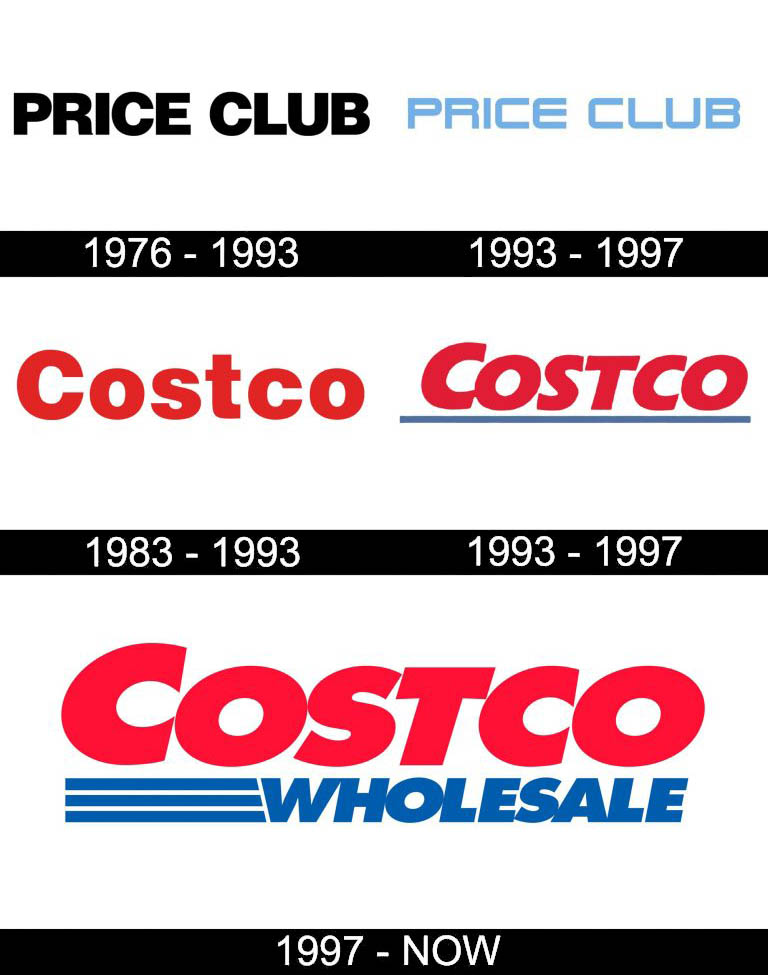
The earliest visual identity associated with what would later become Costco dates back to 1976, under the Price Club name. The original wordmark consisted of tightly packed black capital letters, moderately bold and compressed. The minimal spacing between glyphs reflected both the length of the company name and the functional mindset of the warehouse concept. This logo prioritized efficiency and instant readability, aligning with the no-frills retail philosophy introduced by Sol Price.

In 1993, shortly before the transition toward the Costco Wholesale identity, the Price Club wordmark was briefly modified. A lighter typeface and a light blue color were introduced, increasing spacing but reducing contrast. This version marked a transitional phase rather than a definitive brand direction.

1983 – 1993: Early Costco Identity
The first Costco store opened in Seattle in 1983, introducing a new wordmark while maintaining the core principles of the Price Club visual approach. The logo adopted bold red lettering, immediately improving visibility and distinctiveness. Letter spacing was adjusted to enhance legibility, particularly for storefront signage.

However, the decision to render most letters in lowercase slightly limited long-distance clarity. Despite this, the red Costco wordmark established the foundation for the brand’s long-term visual identity and coexisted with the Price Club logo during this period.
1993 – 1997: Merger and Visual Consolidation
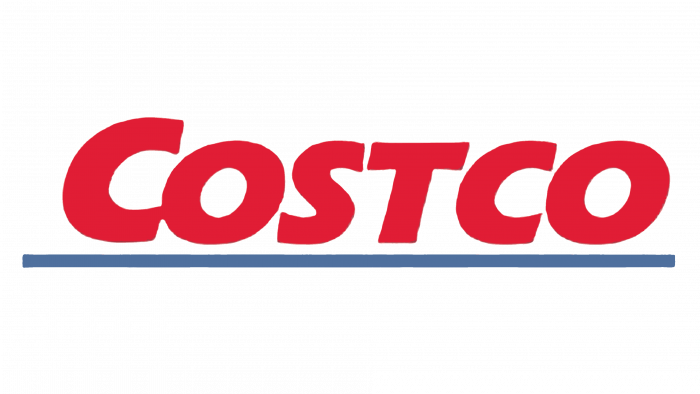
Following the operational merger between Costco and Price Club, the logo underwent further refinement. The “ostco” portion of the wordmark increased in size and moved closer to the initial letter, improving balance and legibility. Italicization introduced a sense of movement and momentum.
A blue horizontal bar appeared beneath the wordmark. This element visually grounded the logo while also referencing the blue used in the final Price Club identity, subtly acknowledging the merger without fragmenting recognition.
1997 – Today: Costco Wholesale Standard
In 1997, all warehouses officially adopted the Costco Wholesale name. The logo preserved its red italicized wordmark but increased weight and visual confidence. The single blue underline was replaced by three stacked blue bars, paired with the word “Wholesale” positioned beneath the brand name.
The blue became brighter and more saturated, while the red retained its dominance. Inspired by Futura Extra Bold Oblique and customized through slanted and extended letterforms, this logo achieved maximum clarity and scalability. It remains in use today, serving as one of the most stable and recognizable retail wordmarks globally.
Logo Symbolism: Function Over Ornament
The Costco logo symbolism is intentionally minimal. Rather than relying on icons or abstract imagery, the brand communicates meaning through typographic authority. Bold red letters convey urgency, value, and confidence, while the blue underline adds balance and structure.
The absence of pictorial elements aligns with Costco’s business philosophy. The brand does not sell aspiration—it sells efficiency and trust. The logo reflects this by functioning as a signpost rather than a narrative device.
Typography and Color Philosophy
Typography is the backbone of Costco’s identity. The customized Futura-inspired typeface emphasizes width, weight, and forward motion. Italics introduce subtle dynamism, suggesting scale and operational momentum rather than emotional expression.
Color consistency reinforces recognition. Red and white formed the foundation from the earliest versions, ensuring maximum visibility. The introduction of blue in the 1990s added a stabilizing counterbalance, reinforcing professionalism and reliability without diluting impact.
Costco Logo Heritage and Retail Identity
The Costco logo heritage illustrates how disciplined design can support massive growth. While competitors frequently adjust their visual identities, Costco maintained a recognizable silhouette across storefronts, packaging, and advertising worldwide.
This approach mirrors strategies observed throughout global retail brand logo heritage, where trust is built through familiarity. Costco’s logo does not seek attention—it commands it through scale and consistency.
Conclusion: Costco Logo History and Visual Discipline
The Costco logo history demonstrates the power of visual restraint in a competitive retail landscape. From the utilitarian Price Club wordmark to the refined Costco Wholesale logo, each iteration strengthened clarity rather than reinventing identity. This philosophy aligns closely with the long-term strategies seen in Walmart logo history and the functional minimalism central to IKEA logo heritage.
By prioritizing legibility, color authority, and typographic consistency, Costco established a logo that transcends trends. Within the broader context of retail logo history and corporate brand heritage, Costco stands as proof that the most effective logos are not the loudest—but the most reliable.
FAQ: Costco Logo Meaning and History
What does the Costco logo represent?
The logo represents efficiency, value, and reliability through bold typography and high-contrast color.
Why has the Costco logo changed so little over time?
Consistency reinforces trust and recognition, which are central to Costco’s business model.
When was the current Costco Wholesale logo introduced?
The current logo was introduced in 1997 and remains in use today.
What font is used in the Costco logo?
The logo is based on a customized version of Futura Extra Bold Oblique.