
Adobe Logo History: Meaning, Symbolism & Evolution
Few companies have shaped the visual world as profoundly as Adobe. From digital art and photography to video editing, animation, PDF technology, and design software, Adobe stands at the core of modern creativity.
Yet behind every innovative tool — Photoshop, Illustrator, Premiere Pro, InDesign, After Effects — stands a logo that has become just as iconic. Clean, sharp, and unmistakably modern, the Adobe logo has evolved only a handful of times, each redesign reflecting the company’s shift toward innovation, boldness, and creative empowerment.
This is the story of the Adobe logo — its heritage, its symbolism, and how a simple red mark grew into one of the most influential brand identities in the digital world.
Meaning and History
Adobe Systems, Incorporated was founded in 1982 by John Warnock and Charles Geschke. The company was named after “Adobe Creek,” a small stream running behind Warnock’s home in Los Altos, California. The original logo, created by Warnock’s wife, Marva Warnock, set the aesthetic tone for the brand’s future: strong lines, angular shapes, geometric clarity, and a sense of digital precision.
Over the decades, Adobe became synonymous with creativity, and its logo — especially its sharp “A” — became a visual shorthand for digital design itself. Through mergers, product expansion, and the rise of Creative Cloud, Adobe’s identity shifted toward minimalism and scalability, resulting in a brand mark built for both print and pixel-perfect screens.
Across all redesigns, one thing remained constant: Adobe’s commitment to clarity, modernism, and creative expression.
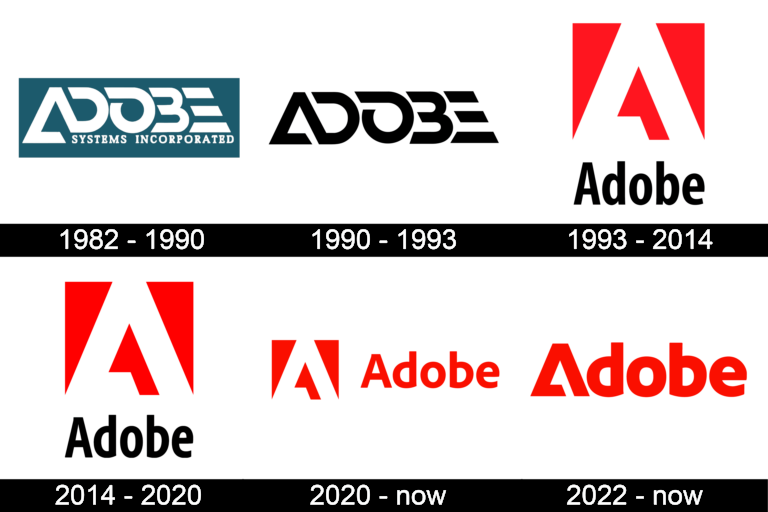
Adobe Logo Evolution Through the Years
1982–1990: The Original Adobe Identity
The first Adobe logo was a bold gray-and-white design enclosed within a rectangular shape with rounded corners. The name “ADOBE” appeared in a futuristic, geometric typeface with dramatic cuts — the “A” had an open triangular form, while the “E” was rendered as three horizontal bars with a diagonal slant.
Beneath the main wordmark sat the tagline “Systems Incorporated” in a serif typeface, creating a strong contrast.
This original emblem looked technical, confident, and slightly experimental — a perfect representation of a software company entering a new digital frontier.
1990–1993: A Clean Wordmark
In 1990, Adobe removed all graphic elements and presented a minimalistic black-and-white wordmark.
It was modern and elegant, focusing purely on typography without symbols. This version reflected Adobe’s growing presence in the professional graphics and publishing industries.
1993–2017: The Iconic Red Square
This redesign became the foundation of Adobe’s modern identity.
The famous white “A” — derived from the original 1982 letterform — was placed inside a bright red square. Below it, the “Adobe” name appeared in clean black lettering.
The sharp angles of the “A” conveyed precision and creativity. The red square symbolized energy, innovation, and the boldness of Adobe’s expanding product family.
This design instantly differentiated Adobe from other tech brands and set a template still used across Adobe software icons today.
2017–2020: Cleaner, Modernized Wordmark
While the emblem remained unchanged, Adobe refined its typography. The black wordmark moved to the right of the red square, rendered in a stylish sans-serif typeface with rounded counters — particularly noticeable in the mirrored “d” and “b.”
This redesign introduced a softer, friendlier look, aligning with Adobe’s transition to subscription-based Creative Cloud services.
2020–Today: The Unified Red Identity
In 2020, Adobe updated its visual identity again. The company retained the white “A” but intensified the shade of red for a brighter, more digital-friendly appearance.
The accompanying wordmark switched from black to the same red as the emblem, creating a unified monochrome identity.
The typography remained modern and bold, with slightly thicker strokes for improved legibility.
This era marked Adobe’s shift toward cohesive branding across all platforms, especially mobile and digital environments.
2022–Today: A Simplified Symbolic Approach
Adobe’s most recent refinement brought a symbolic twist. The company adopted a simplified red square icon, echoing the original triangular “A” through negative space and subtle geometry.
The updated mark feels bold, balanced, and unmistakably modern — a tribute to Marva Warnock’s original design while embracing a flexible, minimalist future.
This version represents Adobe’s vision: a creative, modular identity built for an expanding universe of apps, services, and digital tools.
Meaning and Symbolism
The Adobe logo has always relied on a combination of red, white, and geometric precision.
Red symbolizes power, energy, and creativity — all central themes of Adobe’s mission.
The sharp angles of the “A” emulate the edges of tools used in digital design: vector points, anchors, cursor shapes, and cutting tools.
Through its evolution, Adobe removed complexity, focusing on clarity and consistency.
Each redesign simplified the shapes, modernized the typography, and strengthened the symbol — making it instantly recognizable even at tiny icon sizes on software dashboards.
The current Adobe emblem is more than a logo; it’s a cornerstone of the brand’s visual heritage.
Adobe Product Logos
Adobe Illustrator Logo
Adobe Illustrator features an orange square with the letters “Ai” — a capital A and lowercase i — reflecting vector creativity and warm expression.
This minimalistic two-letter design became part of Adobe’s signature product-identity system.
Adobe Photoshop Logo
Photoshop’s iconic “Ps” sits inside a blue square.
Over the years, its gradients and shades have evolved, but the core concept stayed the same: simplicity, clarity, and brand consistency.
Adobe Flash Logo
Before Flash was discontinued, its emblem followed the same structure: “Ff” inside a red square.
This two-letter minimalism became a hallmark of Adobe’s software branding, creating instant recognition across applications.
Adobe Symbol
Rather than a single fixed symbol, Adobe embraces a unified approach to branding: sharp geometry, minimalism, and consistent color coding.
The red square, white “A,” and clean sans-serif typography combine to create a timeless visual identity recognized around the world.
Font and Color
Adobe’s primary typography is a customized, modern sans-serif style. Fonts closest to the company’s typeface include FF Pastoral Bold and Diodrum SemiBold, both featuring smooth curves and bold geometry.
The color palette relies on red and white, occasionally supported by black for contrast.
Red stands for creativity and innovation, while white reinforces clarity and simplicity — a perfect match for a company built on empowering creators.
FAQ
What does the Adobe logo represent?
It represents creativity, digital innovation, and clarity. The sharp triangular “A” symbolizes precision and design tools.
Who designed the first Adobe logo?
Marva Warnock, wife of Adobe co-founder John Warnock.
Why does Adobe use red?
Red conveys energy, confidence, and creativity — traits central to Adobe’s brand identity.
Has Adobe changed its logo often?
Only a few times. Adobe has one of the most stable logo histories in the tech world, with subtle refinements rather than dramatic changes.
What is Adobe best known for?
Photoshop, Illustrator, InDesign, Premiere, Acrobat, and Creative Cloud — tools used globally by professionals and creators.
5 Facts About Adobe You Probably Didn’t Know
1. Adobe was named after a creek — not a concept or idea.
2. Photoshop wasn’t created by Adobe; it was purchased from the Knoll brothers in 1988.
3. The Illustrator logo’s orange color symbolizes creativity and artistic energy.
4. Adobe invented the PDF format, revolutionizing digital documentation.
5. Marva Warnock’s original 1982 “A” still influences the logo design today.