Gildan Logo History: The Montreal Basics Maker
Brothers Glenn and Greg Chamandy bought a knitting mill in Montreal in 1984 to make fabric for their family’s children’s clothing business, and when that business closed ten years later, the mill had already turned into something much bigger: a maker of plain, undecorated T-shirts sold by the million to screen printers. Gildan is now one of the world’s largest makers of basic clothing, and since December 2025 it has also owned Hanes. Its logo is a short, sturdy, blue wordmark with a few softened corners.
What does the Gildan logo look like?
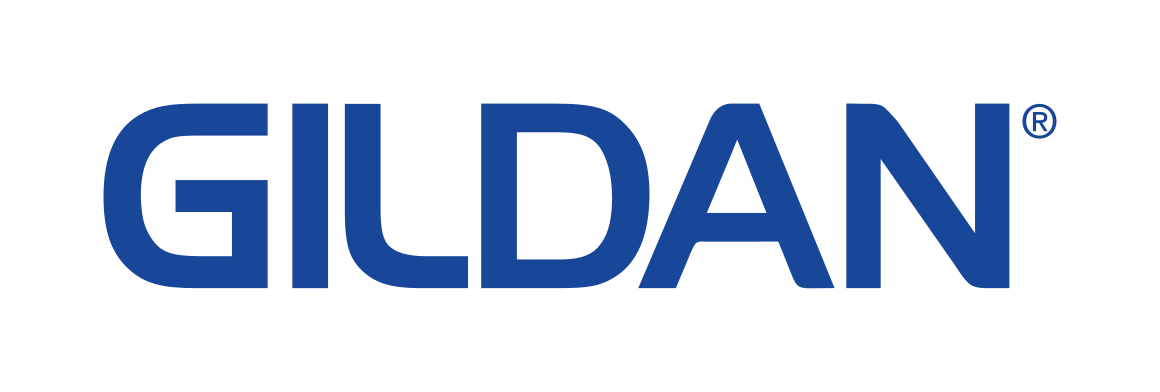
The current logo spells “GILDAN” in bold, wide capitals in a strong royal blue. The typeface is a geometric sans-serif in which some letters, such as the “A” and “N,” have rounded corners, while the “G,” “I” and “L” stay sharp. A small registered-trademark symbol sits at the top right.
Most of Gildan’s customers are businesses: screen printers, promotional-products firms and big retailers that buy its shirts, fleece and socks in bulk. The heavy, even letters also print well on neck labels and hangtags, where the logo often appears very small. Gildan’s blank tees are meant to carry someone else’s logo on the front, so its own mark is designed to be clear and practical rather than eye-catching.
Has the Gildan logo changed over time?
Yes, several times. Logo archives describe an early version from the 1980s with a grey square holding two intertwined threads, one thick and white, one thin and black, running into a bold uppercase wordmark, a direct reference to the company’s roots as a textile mill. Later versions in the 1990s and 2000s switched to heavy blue capitals crossed by a thick grey arc, with a grey circle sitting in the counter of the “A.”
Updates around 2011 and 2015 thinned and widened the letters and rounded some corners. On its current websites Gildan shows the blue wordmark on its own, without the grey arc, giving it a cleaner look that sits comfortably next to the other brands the company now owns.
Who founded Gildan, and who owns it today?
The Chamandy brothers set up the business in Montreal in 1984. Gildan opened its first offshore sewing plant in Honduras in 1997 and a large knitting, dyeing and cutting complex in Rio Nance, Honduras, in 2002, building one of the most vertically integrated supply chains in clothing. It later added brands to its blank T-shirts, buying Comfort Colors in 2015 and the bankrupt American Apparel for 88 million dollars in 2017. It also makes socks under licence for Under Armour and New Balance.
Gildan is a public company listed in Toronto and New York. In 2024 it went through a bitter boardroom battle after the board pushed out co-founder Glenn Chamandy as chief executive; shareholders sided with him, and he returned to lead the company. In August 2025 Gildan agreed to buy HanesBrands, owner of Hanes, Bali, Maidenform and Playtex, for about 2.2 billion dollars, and the deal closed on 1 December 2025. Gildan’s revenue was 3.62 billion dollars in 2025, and it expects 6.0 to 6.2 billion dollars in 2026, its first full year with Hanes, putting it in the same basics market as Fruit of the Loom.
Quick facts
| Founded | 1984, Montreal, Canada |
| Founders | Glenn and Greg Chamandy |
| Industry | Basic apparel: T-shirts, fleece, socks, underwear |
| Brands | Gildan, Comfort Colors, American Apparel, Hanes, Bali, Maidenform, Playtex |
| Manufacturing | Own plants in Honduras, the Caribbean and Bangladesh |
| Revenue | 3.62 billion US dollars (2025) |
| Logo | Bold blue “GILDAN” wordmark |