Furla Logo History: Bologna Since 1927
Aldo Furlanetto started out in Bologna in 1927 selling women’s accessories wholesale, travelling around Europe to find the pieces his customers wanted, and the family business that took the first syllables of his surname as its name opened its first Furla shop on the city’s Via Ugo Bassi in 1955. Almost a century later the Furlanetto family still controls the handbag maker, which has come through years of losses and a debt restructuring, and its logo is a plain row of wide, black capitals: F U R L A.
What does the Furla logo mean?
The name is a contraction of Furlanetto, the founding family’s surname, and the logo keeps it as short and direct as possible. The current version spells “FURLA” in a heavy, geometric sans-serif with generous spacing between the letters, always in black on white or white on black. On some uses it carries a small line underneath, “Since 1927 Italy,” a reminder of the company’s age and its Bologna roots.
The plain lettering suits a company people know for its bags rather than its logo. Furla is best known for structured leather handbags in bright colours, including the boxy Metropolis and the transparent, sweet-coloured Candy bag of the late 2000s, so a quiet wordmark lets the colour and shape of each bag stand out. The wide spacing also helps the name read cleanly when it is stamped small on a metal plate or embossed into leather.
Has the Furla logo changed over time?
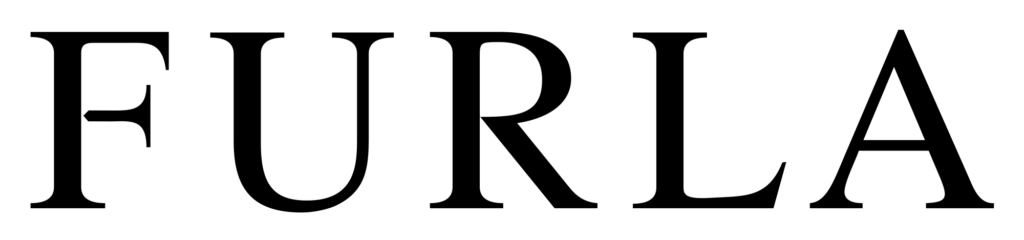
Yes, once in a big way. For decades the brand used “FURLA” in an elegant, high-contrast serif with sharp, triangular serifs, a classic Italian luxury look. Around 2019 it switched to the current geometric sans-serif, with heavier, more uniform strokes and wider letter spacing, sometimes paired with the “Since 1927 Italy” line. The new mark is more modern and easier to use online and on small hardware, while the all-capitals, black-and-white formula stayed the same.
Who owns Furla, and how is it doing?
Aldo Furlanetto’s children, Carlo, Paolo and Giovanna, were running the business by the 1970s and took it international from the early 1990s. Giovanna Furlanetto set up the Fondazione Furla in 2008 to support young artists. Growth peaked in 2018, when sales reached 513 million euros and Furla bought a manufacturing plant in Tuscany and full control of its retail network in China. In 2021 it opened Furla Progetto Italia, a large production and training campus near Florence.
The pandemic hit hard. Furla’s US arm filed for Chapter 11 in 2020 and its Canadian business went bankrupt in 2023. By 2022 group revenue had fallen to 186 million euros with a loss of 27 million, and in August 2024 the company entered Italy’s negotiated debt-settlement procedure, with the family committing 25 million euros of new money. Eraldo Poletto, who had led Furla from 2010 to 2016, came back as chief executive the same year, and in July 2025 Furla signed an agreement with its financial creditors. In August 2026 local press reported interest from an unnamed Asian investment fund, as the brand approaches its 100th birthday in 2027.
Furla competes in the accessible-luxury handbag market with American brands such as Coach and Michael Kors, a step below Italian leather houses like Bottega Veneta.
Quick facts
| Founded | 1927, Bologna, Italy |
| Founder | Aldo Furlanetto |
| Name | Short for Furlanetto |
| First store | Via Ugo Bassi, Bologna, 1955 |
| Headquarters | San Lazzaro di Savena, near Bologna |
| Industry | Leather handbags and accessories |
| Ownership | Furlanetto family |
| CEO | Eraldo Poletto (again since 2024) |
| Current logo | Wide geometric sans-serif “FURLA,” since around 2019 |